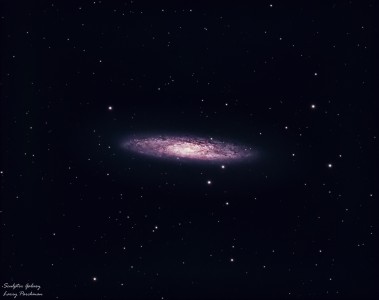
Image of the day

Captured by
Lawrence Parchman

Sculptor Galaxy (NGC 253)

My Account

New to Astromart?

Register an account...

Need Help?

Posts Made By: Jarad Schiffer

February 24, 2004 01:57 PM Forum: Telescope Making

Mirror Coating Services

Posted By Jarad Schiffer

Reposting this from my reply on the equipment talk forum:

Precision Applied Products. They have a website: http://www.precisionapplied.com/

They coated a 10" for me a few years ago and did a very nice job. Good service, quick turnaround, and they did the secondary for free (just put it in the chamber with the primary). They are located in Placentia, a suburb of LA.

Jarad

March 1, 2004 08:25 PM Forum: Equipment Talk

Moving the Primary Mirror Forward

Posted By Jarad Schiffer

Try doing it with the collimation screws. Turn all 3 of the screws a few turns so that mirror moves up the tube (probably clockwise). Then recollimate, and during collimation only move the screws in the same direction you already did (i.e. don't move it back down during collimation). You should be able to get at least 1/4"-1/2" or so this way, which may be enough, and it doesn't require touching the mirror or drilling any holes....

If this is only a problem using your camera and not for visual use, and you can't adjust far enough with the collimation bolts, try using a barlow or powermate.

Hope this helps,

Jarad

March 5, 2004 08:30 PM Forum: Equipment Talk

Information on Planetary Scopes

Posted By Jarad Schiffer

Have you considered a newtonian? The scopes you already have are excellent planetary scopes, so they will be hard to beat, but something like a 12.5" f5 Portaball (on eq. platform), or a 12.5" or 14.5" Starmaster (with Goto), or one of Rob Teeter's Planet Killer long f-ratio scopes also make great planetary scopes and are cheaper than some of the ones you already listed.

If you already have a 150mm AP scope and a 200mm D&G, I am not sure that you will get a lot of improvement from a 170mm or 180mm scope, so I would narrow down to the larger scopes (the TEC or Tak 250's, or one of the newtonians mentioned above).

Unless you are planning to use it for astrophotgraphy, in which case the cassegrains would be better than a newt.

Jarad

March 23, 2004 04:51 PM Forum: Telescope Making

Are shrouds unavoidable?

Posted By Jarad Schiffer

You don't necesarily need a full shroud. You should put a baffle below the UTA opposite the focuser so you can't see that slice past the UTA. Other places for a baffle are a ring behind the primary, and in front of the focuser. Read the stuff on Mel Bartel's pages about the minimal baffling necessary: http://members.efn.org/~mbartels/tm/ul-dobs.html

Jarad

March 26, 2004 08:23 PM Forum: Telescope Making

Secondary Mirror Sizes

Posted By Jarad Schiffer

Get the program Newt 2.0:
http://home.att.net/~dale.keller/atm/newtonians/newtsoft/newtsoft.htm

You enter the mirror diameter, focal ratio, tube diameter, focuser size, focuser height, and secondary size and it will calculate the field illumination for you (with a nice graphic display). This will give you a good feel for the trade-offs between secondary sizes. Essentially, the larger the secondary the better illuminated the edge of the field is (good for wide field use), but the smaller the secondary the less diffraction (good for contrast, especially for planets).

A good general rule for visual use is to aim for 75% illumination at the edge of the field of the lowest power eyepiece you plan to use a lot (75% is where vignetting generally becomes visually noticeable). Of course, you can go smaller if you want to concentrate on planetary use, or much higher if you plan on doing photography (in which case you want 100% illumination over the field you are photographing to avoid vignetting).

Hope this helps,

Jarad

March 26, 2004 08:30 PM Forum: Refractors

FS-128 vs TEC 140 vs Achro w/chromacorr

Posted By Jarad Schiffer

The chromacorr is a doublet lens designed to correct the chromatic aberation (essentially turning an achromat into a petzval 4-lens system). It should do considerably better than a minus-violet filter (it is supposed to actually refocus the chromatic abberation back into the image, not just block it).

From the reports I have read, the chromacorr does a pretty good job, but not quite as good a true APO, since in a true APO the lenses are designed and tested together as a single system, which generally means tighter tolerances. There are some reports on Cloudy Nights you can read. If you go this route, I would certainly order a matched scope and chromacorr from Markus, rather than try to estimate the spherical abberation yourself.

Jarad


March 29, 2004 02:00 PM Forum: Equipment Talk

DSC's, GOTO, or Star Hop??

Posted By Jarad Schiffer

I have had both goto and non-goto scopes. The most important factor to me is actually to have tracking (i.e. either an equatorial mount/platform, or GOTO on a dob). I got GOTO on a big dob mainly because that was the best way to get it to track. Once I had it (I had already been starhopping with a 10" on an equatorial mount for several years), I did find it quite useful for showing things to other people (especially my wife, who would get bored standing there waiting for 10 minutes while I hunted down some faint object....). I found that when I was either with other people, or was tired and wanted to find something quickly, I used the GOTO. When I was by myself, I often just starhopped for the fun of it, then locked the clutches so the scope would track.

Jarad

March 30, 2004 08:31 PM Forum: Equipment Talk

Step One...

Posted By Jarad Schiffer

The AP-1200 is a great mount, but keep in mind that is quite large and heavy. What kind of scope are thinking of getting? You want it to be solidly mounted, but not too overmounted or you won't want to put out the effort to set it up (exception - if you have a permanent observing site where you can leave it set up, then get the biggest mount you can).

If you are getting an 8" SCT or 4" refractor or similar, I wouldn't get the AP1200 - too much weight to set up for that size scope. At most, get a smaller mount now and put your name on the waitlist for the AP1200, and see what size scope you have when your name comes up.

Before you buy a mount like this, try to find someone near you who has one, and help them set it up one night to see what is involved. Make sure you will be willing to do that on a regular basis before you buy. If not, get something smaller. You could also get a smaller mount for visual use, and a higher end one for photography, so you have something to use on nights when the big mouint is too much trouble to haul out.

Since the AP wait is so long, you should also look at the Losmandy mounts, and the Mountain Instruments ones. They are also excellent mounts, but are available sooner.

Jarad

April 6, 2004 12:44 PM Forum: Refractors

Orion ED-80 - Next batch?

Posted By Jarad Schiffer

David -

I already have one - got it from the clearance section in November. It looked to me like it was outo f collimation for the first owner - the focuser screws showed signs of it having been recollimated (presumably by Orion after the return). Also performing quite well. I am just curious to see if the can keep it up.

Jarad

April 13, 2004 01:18 PM Forum: Equipment Talk

Do Pentax XLs need a Paracorr in a fast newt?

Posted By Jarad Schiffer

As the others have said, it is a personal decision. The problem that cheap eyepieces have in fast scopes isn't coma, it's astigmatism. That won't be a problem for the Pentaxes. Best bet is to get the scope, go to a star party and borrow a paracorr from somebody. See how your eyepieces perform with and without it. Then decide if the difference is worth the cost of a paracorr to you.

For what it's worth, most people I have talked to find the paracorr worthwhile at f4.5 or faster. But some prefer the extra bit of field.

Hope this helps,

Jarad