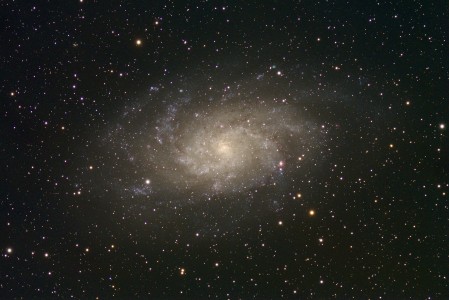
Image of the day

Captured by
Erwin Forbragd

M33 in Triangulum

My Account

New to Astromart?

Register an account...

Need Help?

Posts Made By: Todd Leen

September 4, 2003 03:11 PM Forum: Film Astrophotography - Imaging and Processing

Cygus - Finally a good one :-)

Posted By Todd Leen

Chris,

That's an excellent shot. Cygnus is full of
wonderful stuff, and your exposure time is dead
on. Lots of deep stuff. One of my first good
shots was in Cygnus too. Keep it up!
(Steve's right, you've scanned it backwards ...)

Take the same lens/film/exposure combo and take
a shot of Casseopea and the Double Cluster in
Perseus -- there's lots of good NGCs there too!

Keep your results coming!

Cheers
Todd

September 8, 2003 07:43 PM Forum: Film Astrophotography - Imaging and Processing

One Stop Shop for Astrophotography

Posted By Todd Leen

Hi Tim,

My suggestions:

For the moon, look up exposure times in Covington's
book Astrophotography for Amateurs (or something like
that). Exposure for the moon depends strongly on
its phase and Covington's formulae work well in
my (limited) experience. Folks get better shots
of the moon and planets using a consumer digital
camera held up to (or clamped onto) the eyepiece.

For deep space, I use Elite-Chrome 200 - as do
many of us. See Jerry Lodriguss' web site for
specific exposure suggestions. At f/4 I use 45-60
minutes, at f/2.8 15-30min from dark sites. From
my light-polluted house, about 10min at f/2.8 is
max -- so I don't bother. I suggest stopping
your lens down 1-2 f stops from wide open to avoid
star images bloated by coma at the corners and edges.

Your star trails should look encouraging, but you
might try 1 hour or so at f/8 (again from
a dark site).

Slide film is nice since they can't ruin the
development (unless they run it through C-41
chemistry -- this HAS happened to me, lost a
whole 36 exposure roll of material).

Good luck, and show us the results!

Todd

December 27, 2003 01:27 AM Forum: Film Astrophotography - Imaging and Processing

Medium format exposures

Posted By Todd Leen

Hi Marilyn,

With a normal lens on a 35mm camera mounted
on a tripod, anything more than about 30
seconds gives star trails. You may be more
constrained with the 80mm depending on final
display. See Jerry Lodriguss' web page

http://www.astropix.com/HTML/I_ASTROP/I06/I0602/I0602.HTM

To quote Jerry

Try shooting a series of exposures of 5, 10,
20 and 30 seconds. Generally, if you can see
a star or planet with your unaided eye, you
can photograph it on a fixed tripod
with an exposure of about 10 seconds at
f/2.8 with ISO 400 speed film.

All this suggests going to faster film. E200
works well, or faster as Jerry suggests.

If you have a wide angle lens for your Blad, that
may be a better bet. Also, if you stay nearer the
pole - Perseus, Casseopei - you can go longer.

As long as you're out, try some color star trails
too. On E200, 1-2 hours at f/8 is nice.

For the future, a good source on how long you can
shoot without trails is Covington's book
"Astrophotography for the Amateur". I suggest
you borrow a copy from the library and look up
his tables.

Don't forget to post your results! Good luck!

Cheers
Todd

January 8, 2004 06:15 AM Forum: Film Astrophotography - Imaging and Processing

Cover for a Pentax K-1000 50mm lense...

Posted By Todd Leen

Ivan,

Aftermarket lens caps are usually available
in lots of different sizes at most camera shops.

Todd

January 15, 2004 02:43 AM Forum: Film Astrophotography - Imaging and Processing

A couple for the experts! part 1

Posted By Todd Leen

Maurice,

Hmm, I disagree with Steve, I think it's
overexposed.

There are concentric circles of
shading difference (visible when the brightness
and contrast are accentuated). I don't know what
that's from.

I did manage to improve it, but most of the stars
and the comet tail are buried in the background.
I didn't get ALL the color and intensity gradients
out, but am convinced it's do-able. I used various
masks in Photoshop, and curves.

Cheers
Todd

September 25, 2004 12:30 AM Forum: Film Astrophotography - Imaging and Processing

NGC7000 on E200

Posted By Todd Leen

Mike,

That's pretty good nebulosity for 1 hour on
the FS102 without a reducer. Is this normal,
or push-processed?

Todd

September 25, 2004 09:01 PM Forum: Film Astrophotography - Imaging and Processing

NGC 1499 or California Nebula

Posted By Todd Leen

Augie,

Lots of information on that slide! The one-stop
push really looks helpful, I'll have to try that.
Let us know when you post a larger version.

Thanks
Todd

September 29, 2004 08:34 PM Forum: Film Astrophotography - Imaging and Processing

Lagoon Nebula!!!

Posted By Todd Leen

Hi Taylor,

That's really pretty. I took the liberty
of bringing up the nebulosity a bit. You've
got quite a lot recorded. Nice image!

Todd

October 4, 2004 05:25 AM Forum: Film Astrophotography - Imaging and Processing

Swan Nebula on Elite Chrome 200

Posted By Todd Leen

That's *really* nice -- are you using a
reducer is this a very long exposure.

Todd

October 8, 2004 08:27 PM Forum: Film Astrophotography - Imaging and Processing

M-31

Posted By Todd Leen

very nice image -- ist the FS102 with a reducer/flattener,
is film 35mm?

Thanks
Todd