Image of the day

Captured by
Erwin Forbragd

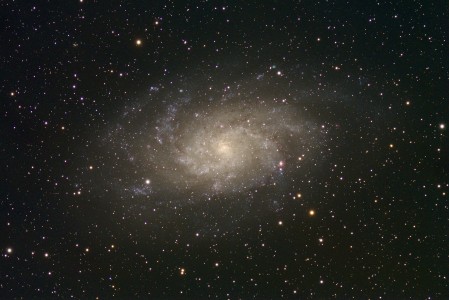
M33 in Triangulum

My Account

New to Astromart?

Register an account...

Need Help?

Posts Made By: Inge Skauvik

December 15, 2003 08:22 AM Forum: Deep Sky Observing

Nacreous clouds

Posted By Inge Skauvik

Deep-sky observation has been out of the question for weeks from my location on the Norwegian coast. This morning, however, I and my colleagues observed a very nice shallow-sky phenomenon that sometimes is seen from Scandinavia in connection with stormy weather.

The sun was some degrees below the horizon when I discovered the vividly luminescent nacreous clouds above the horizon in the south-east. Most striking was an 8 degrees long lenticular cloud about 20 degrees above the horison. The cloud was strongly iridiscent like mother-of-pearl. (The Norweigan term is perlemorsskyer: mother-of-pearl clouds).
Near the horizon were several smaller clouds, strongly coloured and nicely structured. In between were some delicate filaments, looking more like noctiucent clouds with a strange bluish colour.

The altitude of nacreous clouds is in the range 20.000 - 30.000 metres (up to 100.000 feet). They consist of very small crystals, and the iridiscence is caused by diffuse scattering of sunlight.

I can't provide a photo, but persons interested can search the web for images and more information about the phenomenon.

December 30, 2003 08:56 AM Forum: Equipment Talk

TMB monocentrics vs. UO orthos

Posted By Inge Skauvik

Anthony Allsobrook kindly lent me three TMB monocentrics for testing. Yesterday night I had the chance to try them out, and compare them with my own UO orthos. The following focal lengths were available:

TMB's (6mm, 8mm, 10mm)
UO's (5mm, 7mm)

I tried the eyepieces on Saturn as well as various double stars, NGC2392 (Eskimo nebula), M51 and M81/82. Sometimes the 2.8x Klee barlow was used in combination with the eyepieces.

The most obvious difference between the eyepieces is the field of view. The 30 degree field of the TMB monos really looks small compared with modern eyepieces. However, I found the narrow f.o.v. somehow appealing. Maybe there is a nostalgic or sentimental reason for this, but I would recommend anyone who gets the chance to observe M82 through a TMB mono. With my 8" f/6 in combination with the 6mm, the galaxy traversed almost the whole field. This made the galaxy look very large and impressive. The obscuring clouds of the galaxy were quite prominent - very nice.
M51 was also very nice with the same eyepiece. The spiral structure is not easy to see in an 8-inch, but it is definitely there. Like M82, the M51/NGC5195 pair nearly filled the field of view, and the image contrast was excellent.
On double stars I found the difference between the TMB's and the UO orthos to be marginal. Depending on the separation, the optimum magnification could be anything in the 120 - 240x range, and the eyepiece giving the best magnification also gave the best impression.
On Saturn the TMB's and the UO's performed equally well. My general impression is that the resolution and light throughput of the TMB's are equal or just a shade better than the UO orthos.
I had no problem combining the 8mm monocentric with the 2.8x Klee. At a magnification of 420x and a real field of view of 4.3' one might expect that it would be difficult to keep an object within the field of view using a Portaball, but I found it reasonably easy.
I like the TMB's, and will definitely acquire at least one or two of them. Not only for observing planets and double stars, but also for scutinising small DSO's.


January 2, 2004 08:54 AM Forum: Deep Sky Observing

8 diffuse nebulae

Posted By Inge Skauvik

After finishing up my Orion tour of doubles (29.12.03 cf. double star forum) moonlight was no longer a problem, and I aimed my telescope at some gaseous nebulae and other DSO's. During my session I observed 8 diffuce nebulae, all very different in shape, size and brightness.

M42: The nebula in the sky showing the greatest amount of detail (at least as seen from my location). It is very interesting to use different magnifications on this nebula. Viewing the central part with the Trapezium with a 6mm monocentric eyepiece was a real joy.
NGC1999 (Orion): A moderately small, round nebula surrounding a faint star south of Iota Orionis. Easy to spot, but not showing much detail.
NGC281 (Cassiopeia): A relatively large nebula responding well to the O-III filter. Only three stars in the central star, Burnham 1, this time (four can be seen under the best conditions).
NGC1931 (Auriga): The surface brightness of this nebula is very high, but it is easy to overlook since it is so small. I usually use the clusters M36 and M38 as navigation aid whan I want to locate this nebula.
NGC1788 (Orion): One of the less known diffuse nebulae in Orion. A moderately difficult object which is not enhanced by the O-III filter. Not large, a bit elongated and with a couple of faint stars involved.
NGC2042 (Orion): The Flame nebula, near Zeta Orionis. I personally don't find that the O-III filter helps much on this nebula. I prefer a magnification of about 100x, and see more of this nebula when Zeta is outside the field. The intersecting dark lane (Russians call it the "Italy nebula") was easy to see from my dark observation site.
Rosette nebula (Monoceros): The O-III filter is essential to see this nebula well. A very good view with a hint of the dark globules was provided by my 24mm Erfle eyepiece.
NGC2261 (Monoceros): Moving from the Rosette to this nebula illustrates how different diffuse nebulae can be. This nebula has a shape like a small comet with a fan-shaped tail, very bright. Very good object.

January 5, 2004 10:47 AM Forum: Deep Sky Observing

Observing projects supporting education

Posted By Inge Skauvik

In my local astronomy club we are planning a course in basic astronomy with particular emphasis on stars, stellar evolution, determination of distances, luminosities, HR-diagram etc. There will be a series of lectures, and some calculation exersises. We will emphasise the link between astronomy and physics. In addition we would like to include some practical observations. Unfortunately we have highly unstable weather conditions, therefore the extent of the observational program will be limited. Another limitation is the size of our equipment. The largest available aperture is 12.5 inches.

We will, of course, show representative examples of all kinds of DSO's, open/globular clusters, diffuse and planetary nebulae, SNR's and exterior galaxies.

We will also show how the spectral type is related to colour, and if possible, follow some variable stars.

We will use close doubles to demonstrate how small stellar parallaxes are (The separation of Zeta Cancri AB is comparable with the parallax of Alpha Centauri).

We will point the telescope at Kreuger 60 to demonstrate the faintness of a red dwarf compared with a 1'st magnitude star at similar distance.

I would be highly interested in any other ideas for observations/small projects. Any ideas are welcome, but at present we are keeping outside the solar system.

January 22, 2004 02:24 PM Forum: Deep Sky Observing

Colourful DSOs?

Posted By Inge Skauvik

Small telescopes don't show much colour in deep-sky objects. Among the objects outside the solar system, a few N-type stars and some doubles would probably top the list of colourful objects.

Which objects within the category "clusters and nebulae" are the most colourful in the sky? Here is my top-5 list:

1: Double cluster in Perseus (incl. M-type supergiants)
2: M41 (also striking red stars)
3: NGC7662 (strong blue colour)
4: M42 (definitely green)
5: NGC6543 (similar to 7662, but colour less striking)

Other opinions? What do big Dob owners say?

February 11, 2004 01:45 PM Forum: Eyepieces

Eyepiece choice/focus travel

Posted By Inge Skauvik

I just acquired a new telescope, and against all odds the sky cleared up just as I had assembled the instrument. Of course I immediately put it to a test, and was surprised that I couldn't focus several of my eyepieces. I have a series of 1.25" eyepieces, a 24mm Erfle, a 16mm UO Konig, and three UO Orthos (12.5mm, 7mm and 5mm). I was able to focus the Erfle and the Konig, but none of the orthos. Using a 2.8x Klee Barlow made the situation worse.

My question is: Are there any other eyepieces for medium/high power which have a longer distance from the top of the barrel to the focal plane than the UO orthos? (1.25" or 2" barrel). Are there any barlow on the market that can help of the situation?

February 13, 2004 01:13 PM Forum: Equipment Talk

What is the ultimate personal scope?

Posted By Inge Skauvik

Sometimes, there have been discussion threads about the best thinkable scope for the amateur astronomer. The discussion tends to end up with less serious statements about personalised 10 meter aperture scopes, space scopes and other fancy things. Therefore I would like to put some limitations to the discussion.

What would you consider to be the ultimate scope for your own use, spending the money you realistically would use for it, also limited by what you are able to handle in terms of size and weight?

Which factors are important for your choice, e.g.
- Aperture
- Telescope design
- Craftsmanship
- Computer control
- Capability to image
- Bells and whishtles
- Convenience in operation
- Portability

The ultimate scope may be a particular brand, or perhaps the ultimate ATM project.

February 17, 2004 07:30 AM Forum: Deep Sky Observing

New toy, first light

Posted By Inge Skauvik

I finally realised my dream of acquiring a 12.5-inch Portaball as my personal scope. This is an older version with non-Zambuto optics (an excellent mirror, though) bought from John Rennekamp, Jackson, Tenesse. I made a two day trip to the US to pick it up, and I'm highly satisfied with the consideration and helpfulness of John. Anyone buying from him will definitely be satisfied.
I made a preliminary test the day after I returned home, just to realise that I had an in-focus problem with my orthoscopic eyepieces. I'm now awaiting a remedy from Pete Smitka to resolve this.

Sunday evening, however, the sky cleared up, and I had the opportunity to borrow some TeleVue eyepieces from a friend. We got about an hour observation time before fog came in from the ocean, but this gave me a first impression of the scope.

I'm upgrading from an 8-inch Portaball, and clearly there is a great leap from 8 to 12.5-inches of aperture. My first target was M37, a good object for the 8-inch, and GREAT in the new scope. The orange colour of the star near the centre of the cluster was striking.
M36 was a bit loose for the magnification I used (94x). The nearby emission nebula, NGC1931 was extremely bright, and for the first time I noticed a double star embedded in it.
M35 was also a great view, although it does not appear very compressed at higher powers. The background cluster, NGC2158, however, was beautiful. It appeared large and bright, and many stars were visible against a backgorund haze.
The amount of detail of the Orion nebula and other nebulae in the region was so great. I look forward to many great observing sessions to explore this region.
Just before the fog came in we observed Saturn with a 6mm Radian giving 250x power. The image was crisp and sharp, showing features on the planet's surface as well as the ring system. The scope definitely has a potential of higher magnifications, and I look forward to the double stars.
For me the 12.5-inch Portaball is the ultimate scope. It is so easy to handle that there is no excuse for leaving it in its shed, and it seems to be a great performer both at low and high power.

March 2, 2004 09:42 AM Forum: Equipment Talk

Zoom eyepieces - dust collectors or...?

Posted By Inge Skauvik

A question to persons who own zoom eyepieces together with series of high quality eyepieces: Do the zoom eyepieces see much use? Or put in another way: Is it a good idea for a person on a budget to acquire a zoom eyepiece (+ perhaps a barlow) and skip everything else?

I have never looked through a zoom eyepiece, and I'm a bit curious about them. Are there any problems with them (e.g. the 8 - 24 TeleVue zoom) or do they work flawlessly. I have 12.5-inches of aperture and a focal ratio of 1:4.8.

March 8, 2004 01:18 PM Forum: Equipment Talk

Any low power Barlows out there?

Posted By Inge Skauvik

Finding a barlow giving an increase of 2x or more in magnification seems to be quite easy. However, I'm looking for a barlow giving a lower magnification, perhaps 1.5x or 1.8x. Does anything like this exist on the market?

One additional question for the optical specialists: Will a low power barlow improve the edge definition of a low power eyepiece with a wide-field eyepiece. More specificly: How would this combination work:
12.5-inch 1/4.8 mirror + 1.5x Barlow + 30mm 80 degree BW EP
???