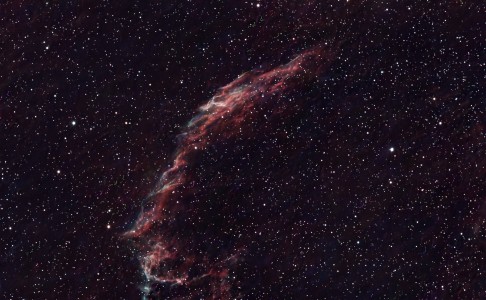
Image of the day

Captured by
GERALD KREITZBURG

Eastern Veil Nebula

My Account

New to Astromart?

Register an account...

Need Help?

Posts Made By: Rod Kaufman

August 1, 2013 03:05 AM Forum: Eyepieces

Initial Impressions: DGM NPB Filter

Posted By Rod Kaufman

Now that the moon is not a glaring factor in the equation, I decided to compare the Lumincon 0111 filter and my DGM NBP on Tuesday evening in front of my home on 7-30-13.
With relatively good seeing and transparency, I could visualize the milky way coursing through Cygnus and down as far as Sagittarius. Not too bad for a moderately light polluted sky. Summer skies are ripe for filter comparos because they're mainly rich in prime targets: planetary nebula.
First up: Aquila:
1. NGC 6772--the dimmest of the observable lot in front of my home at magnitude 12.7. The Observer's Guide notes a UHC filter elongates the north to south annular disk while an 0111 filter further brightens and defines the annular disk. I chose this object because it pushed the envelope on the limits of detection in a moderately light polluted environment and because the Guide described distinct differences in appearance between the a narrow band pass filter and a line filter. In other words, we're basically talking Floyd Blue specs here by getting right into the wavelengths to systematically dissect the image in each filter. What could be greater than that? So, how did the filters do? To cut to the chase, the filters responded according to the aforementioned description of the Observer's Guide. Whereas my observations with the filters matched those contained in the Guide, I felt the DGM filter acted more like a hybrid between a UHC filter and an 0111 filter, providing ample enhancement of the image without excessive darkening of the field of view that typically accompanies a line filter like a Lumicon 0111 or equivalent. I think this becomes more important as apertures decrease in scopes utilized by amateurs.
2. NGC 7681: A large planetary, 11.4 magnitude, with the Guide noting a UHC filter increases the annularity. Both filters worked well here, with a nod to the DGM providing a UHC view without excessive darkening of the field of view. Very good through the Lumicon 0111 as well.
3. NGC 6804--A neat planetary at mag 12.0 that has a cometary appearance in the eyepiece. Essentially the same in either filter, with less darkening of the field of view in the DGM.
Cygnus:
1. NGC 6826--The Blinking Planetary--so-called because a central star appears to overwhelm the nebulosity when viewed head on but when using averted vision the nebula pops out again. The importance here is the blue green color which shows very well in the DGM filter but less so in the 0111.
2. NGC 7008-- The Fetus nebula: so-called because it resembles an in utero human fetus, shows a tinge of bluish green color in either filter, perhaps a bit brighter in the 0111 but too close to call.
3. NGC 7027--Noteworthy because of its blue color, bright at 8.4 magnitude, impressive in either filter, with an 0111 filter showing an outer shell according to the guide. I'll have to try for the fainter outer shell at Pinos.
NGC 7016--noteworthy for its blue-green color, quite evident in the DGM filter but visible in either filter.
4. NGC 6888--the Crescent nebula, previously commented upon in my initial post, now in somewhat darker skies and appearing more alike than dissimilar in both filters. I felt the views were quite good and I'll await the verdict from a dark sky location before passing judgment.
5. The Veil--better in my experience in the Lumicon 0111 filter than just about any other filter you care to name.
Next update, from dark skies...


July 18, 2013 06:50 AM Forum: Eyepieces

Initial Impressions: DGM NPB Filter

Posted By Rod Kaufman

During new moon weekend at Pinos this July, I caught a view through a Discovery 12.5" equipped with a 20mm ES 100 AFOV eyepiece and an DGM NPB filter centered on the western segment of the Veil nebula. I was impressed by the fact that the view was not only outstanding but also by the fact that an 0111 filter is usually the optimum filter for this object. This piqued my interest and I ordered an NPB a few days ago and tested it tonight under challenging conditions in my 16" f4.5 dob. When I state challenging conditions I mean moderate light pollution in front of my home with a 3/4 full moon bearing down on my equipment.
I used three eyepieces and three filters in comparing various objects: an ES 24mm 82 AFOV, ES 14 and 9mm 100 AFOV and a lumicon 0111, Zhumell UHC and the NPB filter.
First, the crescent nebula: the fact that I could see it at all was impressive under the ambient conditions, better in the NPB in all eyepieces, similar in the lumicon 0111 and invisible in the Zhumell UHC.
The veil, eastern and western portions, best in the lumicon 0111 but still detected in the NPB and invisible in the UHC filter.
M27: The dumbbell is outstanding in the NPB, excellent in the 0111 and reasonable under the conditions in the UHC.
Dimmest object detected: NGC 6894, A 12.3 magnitude planetary in Cygnus, good in the NPB, better in the 0111 but not by much. The fact that I could see it at all, given the prevailing lighting, was remarkable to me.
Color rendition: I heard up at Pinos that the NPB has a red bandpass but the blue flash nebula retains its color as did two other blue green planetaries that I observed during the evening. I would rate the color fidelity and clarity of the images as excellent.
At this point, I'm delighted with this filter and I can't wait to see it perform under dark sky conditions...

August 10, 2013 09:40 PM Forum: Eyepieces

Initial Impressions: ES 6.7mm

Posted By Rod Kaufman

I was able to get up to Pinos again on Friday evening, 8-9-13, in order to evaluate the ES 6.7mm eyepiece under dark sky conditiSons. As I expected, the parking lot was filling up but not quite as bad as last week. Still, the incessant arrivals of late night lookie lu's in anticipation of the annual Perseid meteor shower this weekend(when half of LA shows up)was particularly annoying so I'd like to take this opportunity to vent a little.
First, I'll start with last week when clouds obscured the sky for the first several hours of the early evening. That's when a couple of lookie lu's came by and asked what I was looking at as I sat in my canvas chair. I'll call them dork and son. I explained to Mr Dork that's it's cloudy above his head and I couldn't be looking at anything. Then, to my surprise, Mr Dork(and not his son)demanded to know, with righteous indignation, "WHAT WERE YOU LOOKING AT!?" I again explained that cloudy conditions prevented me from viewing anything and Dork & Son moved on. Then, to my bigger surprise, a cute gal drives up next to me in the same model vehicle as mine and asks if she can set up her 12" dob along side me. "Absolutely!" I exclaimed and I began to tidy up a little as she chatted on her phone. I thought to myself this might turn out to be a pleasant evening after all. Then, to my absolute amazement, she stated she was in the wrong place and proceeded to drive away to meet friends at the LAAS site in Lockwood Valley! For all I know, she probably hooked up with Floyd Blue, too!(I told my wife about the whole thing next day and she got pissed!) Anyhow, instead of a noble endeavor, assisting a first time observer at Mt Pinos, I then get another schmuck setting up near me. He gets there right at nightfall, lighting up the whole area, then comes over to me and asks how it was the previous evening. He doesn't even ask me if I had been there the night before, he evidently ASSumes that if somebody doesn't arrive at the same time he does, then they must have been there the previous night and can therefore inform him of the observing conditions. I ignored him and that prompted the same question from him which was met with, er, ah "I wasn't even here last night". Following that, I get another lookie lu asking me where the bathrooms are. I thought to myself, do I look like the Shell answer man? Do I have a sign that reads "tourist information, this exit" stamped on my butt? I told him, "see the trees, pick one!"
Now to the present evening, Friday 8-9, when I arrive at 7:30pm after work. As I set up and subsequently move my vehicle a few feet forward from my scope, a guy swoops around the parking lot in front of me and nearly turns right into my car. I thought to myself the only world this guys sees ends at the tip of his own nose. Now, some of you may be familiar with National Lampoon's "Vacation" movies, made in the 80's and starring Chevy Chase as Clark Griswald, the biggest buffoon on the planet. Griswald arrived last night on Mt Pinos, and after nearly taking out my vehicle, proceeded to set up nearby. A few moments later, Clark Griswald walks over to me and asks if I have a hacksaw or a bolt cutter. Is it just me or do most motorists not carry such items that might not only seem out of place but could also pique the interest of a police officer during a routine traffic stop that might produce some consternation of why potential burglary tools happen to be on the seat next to you? Of course, I told Clark I didn't carry such items in my car and, out of curiosity, I asked him why he needed them. It seems Clark forgot the key to his footlocker and in order to get his scope, he eventually happened to find someone in an RV who had a hacksaw and Clark proceed to saw his lock off for the next 20 minutes! After accomplishing his initial task for the evening, Griswald sets up by walking between my scope and my vehicle which was separated by a few feet and loaded with eyepieces, books, sky maps and the like. Clark had plenty of room to simply walk around my stuff, as his son did, but it took my canvas chair and an exclamation of "unbelievable" from me in order to make him stop. Later in the evening, Mr Griswald was overheard cautioning other people not to walk between cars and scopes because wires might be set up between the two. Speaking of being overheard, Mr Griswald loudly cleared his throat, every five seconds with the regularity of an atomic clock or any comparable pulsar you care to name. Finally, Griswald's son is overheard asking him why his tripod looks funny. Clark's reply? He had driven over it...
Now to the observing report: seeing conditions early on when Saturn was highest in the sky wasn't the best it could be but my observations during seconds of stability demonstrated ample contrast from the es 6.7mm eyepiece. I checked for color fidelity on Uranus and Neptune and found them to be as expected. I spent some time checking light transmission on DSOs. I could pick up the central star in the ring, twinkling in and out of view with the seeing conditions. I then selected Stephen's Quintet which I normally view with a 10mm Ethos eyepiece or somewhat longer focal length like the ES 14mm 100AFOV eyepiece. I felt the shorter focal length might wash out the image but I was pleasantly surprised that all members appeared well defined. I could also discern structure in NGC 7479, an S shaped galaxy in Pegasus. Two other edge-on galaxies in Pegasus, NGC 7332 and 7339, were visible in the same field of view with good definition.
In general, I'm delighted with the ES 6.7mm eyepiece and I wouldn't hesitate to use it for either planetary or DSO observations...

August 9, 2013 05:11 AM Forum: Eyepieces

Initial Impressions: ES 6.7mm

Posted By Rod Kaufman

I viewed Saturn through one of these at Mt Pinos in a Meade 16" Lightbridge with refigured optics a couple of months ago. I was favorably impressed with it but vendors seemed to be back ordered of many ES products. I ordered one from Hands On Optics which surprisingly enough got it to me in a couple of days with USPS priority shipping, faster than a week or more from UPS ground and Fedex. I tried it in front of my home this evening(8-8-13) in my 16" f4.5 with fair to good seeing on Saturn. I was favorably impressed with the views and it did very well when compared with a venerable 6mm UO Ortho and a TMB 6mm planetary eyepiece.
I intentionally let Saturn sit on various edges of the field of view without a paracorr in order to look for smearing of the image, lateral color and distortion but I could find none. I switched back and forth between the eyepieces, using them with and without a paracorr, looking for differences in contrast and resolution/definition of the image. There was one instant when I felt the UO ortho did better but this may have been due the difference in magnification and/ or seeing. I'd like to see Saturn up higher in these comparos in a darker sky to know for certain.
Still, this eyepiece did very well and it's widefield of view with an AFOV of 82 degrees is quite nice in an unguided dob.

September 17, 2013 02:12 PM Forum: Eyepieces

The big, green "Circle R" thing

Posted By Rod Kaufman

Andy,
I wish I could answer your question regarding the Televue/Japan origin. Perhaps contacting Televue directly might be decisive.
I also share your concerns regarding the CN(aka "cloudy noggins")forums...

December 1, 2013 09:50 PM Forum: Eyepieces

Tune Your Eyepieces & Filters

Posted By Rod Kaufman

After reading thread after thread on the CN forums anytime anyone asks about filters and how they do or don't work and why you should or should not buy them, I think it's time to take the bull by the horns and set the record straight.
Last night(11-30), I first when up to Pinos but decided not to set up after I saw snow and ice melting across the road about a half click up the mountain, and I didn't want to take the chance of hitting black ice when I departed early Sunday morning, so I went to plan B and setup at the LAAS site in Lockwood Valley. The site does offer various amenities: PREMIUM-GRADE Afghan moon dust, guaranteed to stick to your scope for twenty years(the Taliban would love it there)and your choice of outhouses. However, the local light pollution is well-controlled, ie the imagers thoughtfully keep their computers shielded and the observers seem to play by the rules so I'm hitching up with them for another membership.
Anyhow, coming back on topic, the CN folks and the rest ought to, in my opinion, be optimizing their filters with their eyepieces. Frequently I read something like broadband filters don't work, or use primarily UHC filters or an O111 or equivalent, all from an supposed "authority" on the subject on a CN forum. BS!
Again, a far more reliable source(and one that I fail to see cited in CN)is Phil Harrington's workup on filters:
http://www.astronomy.com/~/media/import/files/pdf/8/c/7/0805_nebula_filters.pdf
It's better than anything else I've seen because it compares multiple filters on multiple objects in multiple scopes. However, it doesn't go one more step that I believe it and others should go and that is evaluating individual filters with individual eyepieces or more SPECIFICALLY EYEPIECE FOCAL LENGTHS. Here's the crux of it: most observers know that if you shorten the focal length of your eyepiece, your field of view darkens and the contrast between the object you're viewing and the background increases, and you may be able to see the object more clearly. Some observers use the aforementioned technique instead of relying on a filter to do the same thing. However, the same technique, using different focal length eyepieces when coupled with various filters can also be used effectively to the point that it can make the difference between seeing(or not seeing) an object.
Here's my technique for observing from light polluted skies:
1. First, if you don't already have one, get an inexpensive zoom eyepiece like the Zhumell 8-24mm from Telescopes.com or equivalent for around $49.00.
2. Attach any 1.25 light pollution filter of your choice to the zoom eyepiece or place a 2" filter in an eyepiece slide.
3. Select ANY DSO of your choice and focus the object, carefully comparing the view thru the different focal lengths. Note which focal length affords the best view.
4. Replace the zoom eyepiece with a better one such as a more immerse widefield premium eyepiece and enjoy the view.
As an example, NGC 891 is a beautiful galaxy, well-resolved in my 16" dob under dark skies with a 10mm Ethos eyepiece. However, it is also an object of known low surface brightness, as per the Observer's Guide, and is quite challenging under light polluted skies. In fact, I can't see it at all from my suburban home with or without a broadband filter with the 10mm Ethos. However, I've found that by using my aforementioned technique, a 16mm eyepiece reveals it with a broadband filter, making the difference between seeing it and not seeing it. It's the same for other objects as well. You have to try different focal length eyepieces with different filters on different objects to get the view you want. This won't work in every case or in every light polluted big city but it will probably work well for many in suburban locations who haven't tried it. Your MPG may vary.
Meanwhile, the so-called experts on CN remain in their light polluted domain...

December 23, 2013 07:20 AM Forum: Eyepieces

Levenhuk CLS Filter

Posted By Rod Kaufman

Ya know, I've got a boatload of new stuff and the weather has been absolutely Winchester. Windy, cloudy, and even if it's clear the seeing has sucked. Two new apos, a new filter and eyepiece, and for various reasons I haven't even unpacked one of the apos.
Finally, tonight(12-22)I was able to set up in front of my home and get the scope up and running ahead of the rising moon. Seeing was still ify at 3/5 but sufficient enough to allow for an eyepiece/filter comparo.
First up, my take on the meade series 5000 20mm 82 AFOV 2" eyepiece. 20MM isn't what I normally use in my 16" f 4.5 dob, preferring instead to user shorter focal length eyepieces for DSO and planetary observations. Still, there are times a longer focal length eyepiece might do better on a larger extended object so I considered either a 20mm meade 82 or an ES 100. I decided to go with the meade because it cost less and the reviews I've read were decent enough. However, I've seen some good views thru the ES100 thru other scopes and I believe it has better edge correction than the meade over its larger AFOV. Still, the meade is immerse in its views despite the early appearance of coma about 80% outward towards the edge. A paracorr is required to get the most out of it. However, the eyepiece barlows quite well and together with my GSO 2X unit, the stars appear sharp to the edge and views of Jupiter during periods of steady seeing were excellent. I felt the combo outdid the 10mm ethos although the appearance of Jupiter appeared more magnified thru the 20mm/2X GSO combo so I suspect the spacing of the lens elements was giving me more power than I realized at the time. Anyhow, if you want a relatively inexpensive 20mm 2" eyepiece that provides a widefield and you want to power up with an inexpensive barlow, the aforementioned combo is hard to beat.
The CLS filter is a winner for my purposes. It's a broadband filter that's non-aggressive, meaning it doesn't dim and kill the star images like my Orion broadband skyglow filter tend to do and the latter makes it unsuitable for galaxies. I found the CLS filter to be perhaps a bit more mild than my preferred galaxy filter: the astrotech broadband filter. I use the latter 1.25" filter with my 10mm Ethos and I've had some nice views of certain galaxies with the combo. I compared the 1.25 astrotech/10mm Ethos with the 20mm meade/2" CLS filter on several objects this evening in front of my home.
First, on NGC 278: the galaxy was visible with or without the filters, perhaps a bit more prominent in the meade/2X power combo than the 10mm Ethos astrotech combo.
Second: NGC 2403 in the camelopardalis, better in the meade CLS 2X barlow combo.
Third: emission nebula 281 in Cassiopeia: similar in both the CLS and astrotech filters. Of interest since the Observer's Guide notes either a UHC or O111 is required but both broadbands picked it up without too much difficulty.
Fourth: NGC 891: difficult under each filter eyepiece combo, discernible but a real challenge.
Fifth: NGC 1491: an emmission nebula in Perseus: better in the CLS meade/barlow combo.
Sixth: NGC 1023: galaxy in Perseus: tied in both.
I'll have to wait for dark skies for another test of the cls filter but it seems very promising now...

December 2, 2013 06:36 AM Forum: Eyepieces

Levenhuk CLS Filter

Posted By Rod Kaufman

I've been interested in using a CLS filter for some time now but I don't feel like forking over approximately $170.00 for a 2" astronomik model. If you reference Phil Harrington's article in my thread regarding tuning your eyepieces and filters, you'll see he designates it as a broadband filter and rates it a "4" on a 0-5 scale with M81 being easily visible. Imagers reportedly use this filter as well.
I can't say whether the Levenhuk 2" model, which goes for around $89.00, is the same as the aforementioned model. I could only find one review of it on a google search and the latter was a translated page from a Russian amateur who did a spectral test on it and described it as "pretty good" in meeting its design parameters as a deep sky filter. Levenhuk's advertizing states it can be used for photo-visual work so I may get one for use with my 2" eyepieces and report on its usefulness in suburban viewing. I find my astrotech 1.25" broadband filter works well with my 16" scope and a 10mm Ethos eyepiece for viewing some galaxies in front of my home whereas my Orion broadband model is too aggressive and dims the sky by a half a magnitude which makes it less suitable for viewing galaxies. My hope is the Levenhuk unit is a bit less aggressive than the Orion model and therefore may be of use in viewing certain galaxies. We shall see...

December 13, 2013 03:27 AM Forum: Eyepieces

celstron 2" eyepieces

Posted By Rod Kaufman

Brian,
With curvature of the field, you can focus on stars in the center and it will appear sharp but other stars near the edge of the field will appear out of focus until you refocus on them while the stars in the center will then appear out of focus.
If only the stars in the center appear in focus, something else is responsible for the apparent optical defect. With a long focal length eyepiece(like a 40mm), astigmatism in the eyepiece or within your own eye may be responsible for the defect you describe. Use a shorter focal length eyepiece and report your results. Make sure your scope is well-collimated, too.

December 31, 2013 07:03 AM Forum: Eyepieces

Extreme Observing

Posted By Rod Kaufman

Monday evening(12-30) in front of my home was quite exceptional in terms of seeing: 4/5 with six stars in the trapezium being visible in both broadband and UHC filters, a first in my 16" scope, so I decided to pull Thor's Helmut out of the muck with three filters, stacked, as follows: lumicon 0111 in the filter slide, DGM NPB in the paracorr, and the levenhuk CLS broadband filter screwed into a 24mm ES eyepiece. THAT pulled it out. Not too bad on the orion nebula, either. Especially through the rolling clouds obscuring the otherwise excellent transparency.
Barlowed my 10mm ethos on Jupiter with a GSO 2x barlow and caught one of the moons emerging from the limb. It's always nice to see that occur.
Ok, you guys can go back to your leather cases and UO whatevers...