Image of the day

Captured by
GERALD KREITZBURG

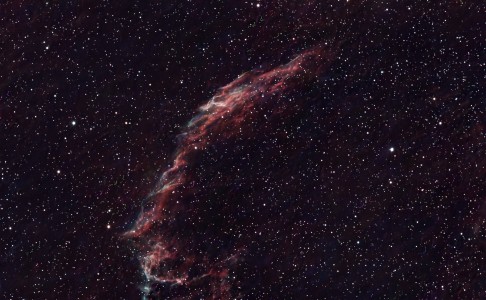
Eastern Veil Nebula

My Account

New to Astromart?

Register an account...

Need Help?

Posts Made By: Rod Kaufman

March 23, 2014 05:27 PM Forum: Eyepieces

Filters Revisited

Posted By Rod Kaufman

I've been itching to try my CLS filter under dark skies and last night (3-22), I finally got the chance. I took my new Forester up to Mt Pinos and driving the twisties with it is sure to put a smile on your face. Next best thing for those roads other than a Mazda Miata. Those vehicles are made for mountain roads and they are definitely in their element. (Even Floyd would like it, better than his van! grin)
I had planned to observe until the moon rose and climbed above the tree line at 1:00am but, as it happened, the optics, eyepieces and filter FROSTED(not dewed)over at 12:00. The temperature, I'm guessing, was either in the low 20s or upper teens. I can recall observing there with FLOYD BLUE in the past when it got down to 18 in May or June. Mute testimony to the fact that a high mountain can generate its own weather. Another amateur observing next to me with an SC was cooked earlier than me. Anyhow, let's get to the report now that my fingers have thawed. First, my initial observations with the Levenhuk CLS filter led me to believe it's a mild broadband filter and my expectation was that it would remove the ever present skyglow under dark skies without attentuating the image of GALAXIES. Does it do so?
With my 16" F4.5 dob, equipped with a 10mm Ethos eyepiece/paracorr, the answer is a definitive "yes" on M81/M82/M51/Leo Trio. I could see ample evidence that the views of the latter appeared enhanced/contrasted against a seemingly darker sky background without loss
of the primary image. In short, I was delighted with the views. However, I repeated the observation on M109 in Ursa Major and I found the view of this particular galaxy was better without the filter. I don't know why. I then repeated the observations with a 20mm Meade ultrawide eyepiece and got similar results. I plan on using the CLS filter as a galaxy filter as spring time brings the realm of the galaxies into view with the arrival of the constellation of virgo. I might try again next week during new moon but a snow storm with a 60% probability is due to hit the area in mid week. shocked


January 26, 2014 08:32 PM Forum: Eyepieces

Filters Revisited

Posted By Rod Kaufman

I've been looking forwards to new moon weekend so I can test my CLS filter under dark sky conditions but, as fate would have it, I've got to take my annual re-licensing seminar on the same day. IT ALWAYS HAPPENS THAT WAY! >sad
Still, I salvaged some eyepiece time in front of my home last night(1-25). The clear sky clock was spot-on with a forecast of very good seeing and fair transparency. Seeing was 4/5 and transparency, although reasonable, could have been a notch or two better.
IMO, the number one mistake amateurs make in using filters is that they tend to try them on only one or two objects or with only one or two focal length eyepieces and conclude they do or (as is more often the case) don't work. Big mistake!
For instance, many galaxies have regions that do emit wavelengths that can appear enhanced by a broadband or a narrow band filter. As an example, a bright, large face-on galaxy which is a member of the M81-M82 local group and is now prominently riding high in the winter sky is NGC 2403. This huge galaxy is in a constellation that nobody seems to know much about but contains many fine galaxies as well as planetary nebula. It's a fine source of galaxies that beckon the arrival of the realm of the galaxies in the spring. The constellation is Camelopardalis. It's currently well-placed for observation. A link to NGC 2403can be found here:
http://www.noao.edu/outreach/aop/observers/n2403.html
My CLS filter allowed a "deep-sky" view of this galaxy and it quickly fills the AFOV of a 14MM ES100 eyepiece. This filter functions as a mild broadband unit with just enough blocking to reduce light pollution under mild to moderate skyglow but preserves most of the desired wavelengths. I'm itching to try it out under dark skies to block the ever-present natural skyglow and I have high hopes of its success.
Whatever filter you try, remember to try it on multiple objects and in multiple focal length eyepieces.
Finally, it's a bit amusing to see some of my ideas and advice appearing in CN forums a few days after I post here. Either a few of the guys happen to think like I do and have similar experiences or they read this forum and post elsewhere...

February 24, 2014 06:35 AM Forum: Eyepieces

GBO 9mm on Jupiter Last Night & Oops

Posted By Rod Kaufman

Picked another inky black moon shadow coming across the Jovian limb just after 9:00pm on Sunday evening, 2-23, using the ES 6.7mm eyepiece. Nice detail and contrast with the latter eyepiece, especially with 4/5 seeing and good transparency. I caught the best image thus far in front of my home of Thor's Helmet with the Levenhuk CLS filter piggybacked with a Lumicon O111 on a Meade 20mm ultrawide. I could even pick up the extensions but still far less than from a dark sky location. I've got to get that CLS filter under dark skies and do some galaxy hunting with it to see if it knocks out the natural skyglow without killing the image. I hope that storm forecast for next weekend waits until after new moon to arrive...

February 23, 2014 05:52 PM Forum: Eyepieces

GBO 9mm on Jupiter Last Night & Oops

Posted By Rod Kaufman

Saturday evening,(2-22), 4/5 seeing in front of my house, rolling clouds, Jupiter near the zenith,
16" dob with a barlowed 2X 9mm genuine baader orthoscopic eyepiece locked on to a jet-black moon hovering in the Jovian belts. Talk about heaven! I mean we're in a drought in California and the first major soaker expected to hit us is next week on new moon weekend(figures), and I've got to get in SOME eyepiece time. I tracked that inky black pinpoint moon on the Jovian background for a half an hour. Definitely worth the price of admission. The badder 9mm ortho does wonders on bringing out the ruddy color of the Jovian bands/belts/whatever and barlows quite well. the color rendition is the best I've seen thus far.
Now, I did encounter a perplexing problem though. Although my scope performed to the max at the zenith, something went askew when I lowered the scope to look at DSOs elsewhere in the sky. I started seeing some evidence of miscollimation/astigmatism. I couldn't figure it out until I finished for the evening and rolled the scope back into the garage. I mean there's only so much that can go wrong with a dob(unless you're a typical CN member and everything is wrong). Or, you're a typical Mt Pinos imager with $25,000 worth of equipment and nothing works! So, there had to be a simple explanation and there was. I had forgotten to tighten the truss knobs at the bottom of the mirror box so every time I lowered the dob the the tubes sagged just enough to mess with the image. At the zenith, everything was fine because the vertical position and gravity kept it all in alignment. Gotta remember to tighten those knobs!

March 31, 2014 04:33 AM Forum: Eyepieces

Jupiter 3-30-14

Posted By Rod Kaufman

Anybody catch Jupiter Sunday evening? TWO moon shadows transiting across the Jovian planet simultaneously! THAT was awesome to see!
I was pissed I couldn't get to Pinos or Lockwood on Saturday because of weather but Sunday cleared in front of my home and despite the breezy ground conditions, seeing was 4/5 above me. I was able to pick out the extensions of Thor's Helmut with a lumicon 0111 piggybacked with a CLS filter and used the latter on the messier galaxies in Leo and Ursa Major. I used my ES 9MM 100AFOV on Jupiter with my 16" dob together with a paracorr. Well worth taking the scope out tonight! smile

April 1, 2014 07:47 PM Forum: Eyepieces

A New Light Filter?

Posted By Rod Kaufman

http://www.sciencedaily.com/releases/2014/03/140327142447.htm
Perhaps we'll see a new application to deflect light pollution...one can only hope.
Presently, I've taken stacking of three light pollution filters(0111,CLS,NPB) and used them successfully to suppress light pollution on certain objects but the method described above *might* be an alternative to deflect unwanted light while lending itself to the addition of one or more filters. Seems like an exciting application!

April 21, 2014 06:13 AM Forum: Eyepieces

20mm ES 100 Review...Not

Posted By Rod Kaufman

I had planned to post a review of the ES 20MM 100AFOV eyepiece this evening, Sunday 4-20-14, but this eyepiece would not come to focus in my 16" F4.5 dob, with or without a paracorr in place. It requires far more infocus than anything else I've utilized thus far. I have a lot of eyepieces and this is the first time I've seen it not come to focus. I focused my 20mm meade ultrawide without issues. My other 9mm and 14mm ES 100s also focused this evening without issues. It's too bad since the seeing in front of my home was 4/5 and the clear sky clock was spot on. Mars and Jupiter revealed nice details in my ES 6/7mm eyepiece and I used my CLS filter to good effect for multiple galaxies in Leo, Ursa Major and CV with the above eyepieces.
Unfortunately, I'm going to have to send the ES 20mm eyepiece back...

July 25, 2014 05:21 AM Forum: Eyepieces

Bagged It!

Posted By Rod Kaufman

Well, here it is, July 24, nearly the end of the month and sky conditions above my home and probably at Pinos/Lockwood Valley are excellent. However, according to the clear sky clock and the weather service thus far, new moon weekend appears to be a bust with rapidly deteriorating sky conditions for Friday and Saturday evenings. Perhaps it'll change for the better.
Here's hoping...

July 4, 2014 07:03 PM Forum: Eyepieces

Bagged It!

Posted By Rod Kaufman

I was debating with myself on Thursday July 3 on whether or not to go up to Mt Pinos/Lockwood Valley for the night. The moon, only 1/3 illuminated, would set shortly before midnight and would be behind the tree line well before that time. Plus, it doesn't get very dark until 9:45-10:00 pm so you really don't lose much observing time to the glare on the moon. The clear sky clock was predicting excellent transparency and very good seeing conditions so what's not to like?
I decided against going up to Pinos after work for two reasons. First, the fourth of July holiday get-away traffic was on over-drive on the I-5 freeway. Second, I worry about fires if some stupid kid lights up Frazier Park and vicinity with fireworks. I don't want to become stir-fry up there.
In my area in the Santa Clarita valley, fireworks are banned and professional firework displays have been curtailed or cancelled entirely as in the case of the annual display at the Castaic lake. The lake has lost a lot of water to the drought and fire conditions are extreme. So what do the residents of Santa Clarita do? They go up the 126 highway to nearby Fillmore, a small town along the way, and buy their fireworks on that map dot on blacktop. A couple of my patients who live in Fillmore tell me the town has firework stands set up almost every 200 feet. You can't open up the blinds without seeing one. From what I've been told, the town is choked and clogged with traffic from Santa Clarita and those residents will presumably cart their treasure back to the valley where they will willfully and illegally ignite them to their heart's content. I believe the decision to curtail the professionally managed shows was a bad one since the residents will do it themselves and many don't know what they are doing.
Anyhow, that placed me in a dilemma. I wanted to observe but I didn't feel it was prudent to travel. So, that left plan B, and I set up in front of my home. I'm relatively lucky because I happen to live under a small patch of semi-dark sky surrounded by my neighbor's high ambient lighting. I'm lucky enough to glimpse portions of the milky way when it's near the zenith. However, I could walk a block or two away and see only a first or second magnitude star. If conditions are decent, my 16" dob can penetrate thru the light pollution to about 12.5 magnitude, more than enough to observe many galaxies and planetaries. Last night, however, brought the best transparency I've ever seen in front of my home. Humidity levels were extremely low and that means less light scatter off of less ice crystals at higher altitudes. Combined with good seeing conditions, my portal of semi-darkened sky beckoned for exploration. To do it, I used my CLS broadband filter with my 10mm ethos eyepiece and hit virtually every galaxy noted in Volumne 2 of the Observer's Guide in the constellations of CV and Draco. To give you an idea of how good the transparency was last night, I could actually see rifts in the milky way above my home at 2:00am.
One of my biggest delights and one of my biggest challenges was seeing NGC 6742, a faint 13.4 magnitude planetary in Draco. I've seen it better at Pinos but given my conditions with high ambient lighting, I was thrilled to see it at all. My link puts it at magnitude 15 but I believe the Observer's Guide to be correct.
http://www.noao.edu/outreach/aop/observers/n6742.html
I then switched the CLS filter for my Lumicon 0111 and bagged additional planetaries in Aquila and Cgynus, along with reasonably good views of the veil and crescent nebula with a set of longer focal length eyepieces(14mm ES 100, 20mm Meade ultrawide, 30mm ES 82). The 14mm with the 0111 did very well on M17 and you could see the fainter outlying extension of it which was also visible in the ES 30mm. Ditto for the extensions on the dumbbell.
I finally called it a night when I saw the great square of Pegasus rising higher in the sky but I continued to marvel at the sight of the milky way above me and I'm thankful I could see it as well as I did.
Seeing and transparency....

July 30, 2014 06:19 AM Forum: Eyepieces

I Had No Idea...

Posted By Rod Kaufman

I wanted to add this translated link from a Russian amateur on Levenhuk filter spectral tests:
http://astro-talks.ru/forum/viewtopic.php?f=7&t=1001
Interesting info here...
