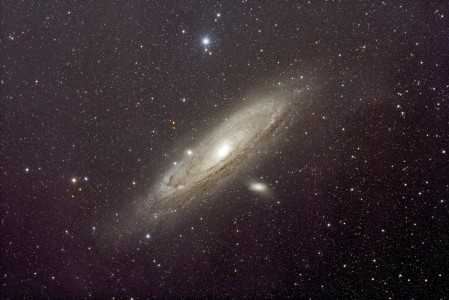
Image of the day

Captured by
Ralph Ford

M31 with Redcat 51

My Account

New to Astromart?

Register an account...

Need Help?

Posts Made By: Inge Skauvik

March 11, 2004 07:16 AM Forum: Deep Sky Observing

Great deep sky night

Posted By Inge Skauvik

I spent 4 hours last night with my 12.5-inch Portaball at a dark sky site. There was some glow from a city in the south east, and seeing could have been better. Therefore I spent little time with the planets and observed just a few double stars.
Equipped with a 24mm Erfle and an O-III filter I had my first really good view of the Rosette nebula. The amount of detail was impressive. The northern part of the annulus was brightest, but nuch more irregular in the outline than I have seen with my smaller scope. Many dark lanes and patches could be seen. An impressive sight.
While in Monoceros I also observed NGC2261. At high power (214x) the nebula appeared large and bright with definite signs of the darker regions that can be seen in photos.
Another very attractive gaseous nebula in this region is NGC2245. It looks like a small comet with a tiny bright core (probably a star). Didn't use the O-III for the two last objects.
Encouraged by the success I went for the Medusa nebula (PK205+14.1). A nearby cluster (NGC2935, not impressive) was easy to spot. A small distance to the east a faint glow could be perceived without the filter. For this nebula the O-III worked like magic. The planetary stood clearly out, half moon shaped with the upper and lower part definitely brighter than the middle.
A small part of the supernova remant, IC443 could be seen with direct vision with the O-III. This object is far more difficult than the medusa nebula.
I observed many galaxies. Both M51 and M101 showed nice spiral structure. I find the spiral arms of M101 to be easier to detect visually than those of M81. Unfortunately the city light made scrutiny of M99 and M100 impossible. Have to wait for a dark night.
NGC4236 is considered to be difficult, but it was readily seen under yesterday's conditions. Huge, elongated and impressive. On the opposite end of the scale was NGC3115 in Sextans which appeared tiny and very bright.
Most distant view was the pair NGC4874 and 4889 in the Coma cluster. They appeared quite large and bright, and a lot of fainter spots and smudges call for my attention on a later occasion when the galaxy cluster is higher in the sky.

March 15, 2004 01:28 PM Forum: Equipment Talk

Need advice. Low power eyepiece for f/4.8 dob

Posted By Inge Skauvik

I have recently upgraded from an 8-inch f/6 to a 12.5-inch f/4.8 Portaball. My high power eyepieces work fine with the new telescope, whereas both my 16mm UO Konig and my 24mm Celestron Super Erfle show edge distortion. Therefore I have decided to start with an open mind, looking for new eyepieces for the lower power range. I think I need one eyepiece in the 27 - 32mm range, and one in the 14 - 17mm range. Very wide field of view isn't crucial to me, but something in the 50 - 60 degree range would be fine.
I would really like to stick with 1.25-inch barrels since I have several filters for this eyepiece size.

Any good suggestions? Is the 30mm Takahashi LE a good choice? Maybe a 32mm TeleVue Plossl?

March 22, 2004 12:58 PM Forum: Deep Sky Observing

Obscuring clouds in external galaxies

Posted By Inge Skauvik

Obscuring clouds are features to look for during visual observation of external galaxies. Although they often are very prominent in photographs, they can be very difficult to detect visually, since their surface brightness is not considerably less than the rest of the galaxy. In NGC891 the surface brightness of the equatorial dust lane is about 80% of the rest of the galaxy.

In which galaxies are the obscuring clouds easiest to detect? Here is my list in order of increasing difficulty based on observation with a 12.5-inch Newtonian:

1: M82
2: Andromeda galaxy
3: NGC3556 (M108)
4: NGC3628 (near M65/66)
5: M64 (Black eye)
6: NGC4565
7: M104 (Very low from my latitude)

I don't find the equatorial dust lane of NGC4565 to be easy to see, whereas it always seems obvious to me in NGC3628.
With 8 inches of aperture I generally find obscuring clouds considerably more difficult to observe. The only good ones were the three first ones on the list, and for the Andromeda galaxy, a dark sky was always crucial.

Other people's opinions? What can be seen in the small APOs or big Dobs?

March 25, 2004 12:02 PM Forum: Equipment Talk

Dream set of eyepieces

Posted By Inge Skauvik

Imagine that you own one single telescope, a 12-inch f/4.8 with high-class optics. You want to purchase a set of quality eyepieces for this scope. The total cost should not exceed 2000$. No limitations to the number of eyepieces.
Due to limited finances you will have to purchase one eyepiece at a time.
One more limitation: Stick to 1.25" barrel.
Which eyepieces would you purchase, and in which order would you acquire them?


April 20, 2004 05:57 AM Forum: Deep Sky Observing

Farewell for now, dark skies

Posted By Inge Skauvik

This is the time of the year I use to spend some time wheening about the disadvantages of living at a high latitude. Now, it is time for putting away the astronomical gear until the end of August, just because it will not become dark at night. Truly there are still a couple of weeks with a short dark period around astronomical midnight (which is about 1:20 due to daylight saving and an unfavourable longitude). But since the weather does not cooperate, chances are very small that I will have another observing night this season.
At the same time I will have to say goodbye to Jupiter for a period of 6 years. From now on it will be so far to the south that the atmosphere will seriously impair the images from my location. I suppose, that major features like the GRS and shadow transits can still be seen if skies are calm - at least next year. But I will have to wait until about year 2010 to get the planet high enough in the sky to enjoy the more subtle features of the planet.
My hope for the next season: More clear nights and less auroras. I anticipate my first sighting of the Veil nebula with 12.5-inches of aperture.

May 27, 2004 05:16 AM Forum: Deep Sky Observing

Gaseous nebulae showing detail

Posted By Inge Skauvik

The thread about galaxy detail is interesting. I would like to have your opinions about gaseous nebulae as well. With "gaseous nebulae" I mean emission and reflection nebulae, associated clouds of dark matter, planetary nebulae and SNR's.
For my own sake I'm mainly interested in what can be seen in a 12-inch with the option to use a narrowband filter (e.g. O-III).
I find round nebulae fading off towards the edges to be the less visually interesting. My top-three favourites are M42, Veil complex and Rosette nebula (The last one being almost nothing in my 8-inch, but great in the 12.5-inch). Other nice objects are NGC281 in Cassiopeia, M57 in Lyra, M76 in Perseus. I even find the Medusa nebula in Gemini to be an attractive visual target with its half-moon shape. As mentioned many times before, the Sagittarius region with M8, M17 and M20 can not be observed from here. But I'm interested to hear about visually interesting nebulae regardless of their position in the sky.

September 11, 2004 10:05 AM Forum: Deep Sky Observing

A dream came true....

Posted By Inge Skauvik

Most of you will probably not see my point at all. Still I want to share last night's experience with you. Awaiting a week with bad weather I was very happy to see that the sky cleared up in the evening, and I brought my scope to a dark site to make use of (hopefully) a couple of hours with good observing conditions. I started out before it was completely dark hoping to have a glimpse of M11 and some other objects in the "difficult" region of the summer sky. I was surprised to notice that several stars in Sagittarius were visible. In fact Sigma Sgr shone quite bright low above the horizon. Such an air transparency in the low sky is quite unusual here, and I decided to check the low sky with binoculars. I immediately noticed two nebulous patches which I figured out possibly could be M16 and M17. Being very exited I pointed the Portaball in the direction of the patches, and a large, bright nebula floated into the field of view. WHAT AN OBJECT! I have been told that M17 is a great nebula, and seen many photos, but the view through the eyepiece exceeded my expectations by far. Applying an O-III filter made out even more of the nebula, and I was overwhelmed by the amount of detail.
I decided to check M16 as well. Without the filter it appeared as a rather loose cluster, but some nebulous haze was obvious. The nebula responded very well to the O-III filter, and in my opinion this nebula is a far better object that e.g. NGC281 which is one of the better ones in the northern sky.
At the time the sky was completely dark, the two neublae had moved out of my range. The night probed to be no better than average for double star observing, but I was very happy when I went home two hours later.

Inge Skauvik
Haavik, Norway

September 22, 2004 08:51 AM Forum: Deep Sky Observing

NGC6888

Posted By Inge Skauvik

NGC6888 in Cygnus is often called the "Crescent Nebula" from its shape.
I find this to be a visually very interesting object in a 12.5-inch telescope with an O-III filter. It looks to me as a miniature version of the Veil nebula. It is possible to see at least as much in the eyepiece as in many photos of the object, and to me it looks more like a figure "6" than a crescent. With my aperture this is one of the most interesting diffuse nebulae in the northern celestial hemisphere. I could see it in my 8-inch too, but this nebula gains a lot by the increase to 12.5 inches. It must be a great sight in larger instruments. Any reports?

Inge Skauvik
Haavik, Norway

October 8, 2004 07:57 AM Forum: Deep Sky Observing

Deep-sky objects observed 6th of October

Posted By Inge Skauvik

During yesterday's observing session I split observing time about fifty-fifty between doubles and DSO's. I reviewed several favourite objects, and I also found some new ones.

Dmitri Kuglinov recommended the open star cluster NGC6940 in Vulpecula. I observed it for the first time yesterday, and found it to be a good object. I used a 24mm Panoptic giving a magnification of 63x. Possibly the cluster is better at lower magnification. Many of the stars are bright and cover an area of nearly half a degree. Near the centre of the cluster was a delicate pattern of very faint stars. Good object!

I just had to get a view of galaxy NGC6946 (The one with the present supernova). I find this galaxy bright in the 12.5-inch with several faint stars in front of it. Hard to tell which one was the supernova. Nearby cluster NGC6939 could be seen at the same time in the 24mm Panoptic. This is one of my favourite open clusters.

I observed both the Veil nebula and NGC6888 using an O-III filter. Superb!

M33 is a show object in the 12.5-inch. The spiral pattern is easily discernable. I found the emission region, NGC604, to be very conspicuous. It responded well to the O-III filter, revealing its true nature.

The great Andromeda Galaxy was near zenith. The star cloud, NGC206 eas obvious, as well as the dust lanes. M32 appeared very bright and NGC205 very large. If placed anywhere else NGC205 would have been a very popular target.
Also observed NGC404 and NGC891. In 891 the equatorial dust lane could be percieved with averted vision.
The galaxy pair NGC672/IC1727 in Triangulum was a good target. I found it slightly north of a C-shaped asterism containing a wide double star. IC1727 wasn't easy to see, but required averted vision.
M74 appeared large and pretty bright. But I couldn't make out the spiral pattern.

Galaxy NGC7331 in Pegasus often has disapionted me a bit. It is bright, but quite small. Maybe previous disappointment made it a positive surprise yesterday night. It appeared larger than I've seen it before, quite sharply defined towards a dust lane on one side, and with the small neighbour, NGC7553 as a faint smudge nearby. I also positively viewed Stephans quintet. The largest galaxy in the group, NGC7320 wasn't really difficult to see. The quintet, however, is no show object in the 12.5-inch.

I observed the globular cluster, M15 for the first time with 12.5 inches of aperture. To me it appears more concentrated in the centre than many of the other globulars. However, outlying members cover a large area.
I also observed a few planetary nebulae. NGC1501 in Camelopardalis appears round, bluish and well-defined. NGC7027 in Cygnus is much smaller. I suppose it is bright enough even for the smallest scopes, but it may be difficult to see that it is a nebula and not a star. The most interesting of yesterday's planetaries was IC2149 in Auriga. It looks like a star at 63x magnification, but its colour reveals that this is a planetary. An O-III filter reveals its nature beyond doubt.

Inge S
Haavik, Norway

October 10, 2004 11:32 AM Forum: Deep Sky Observing

Low surface brightness galaxies

Posted By Inge Skauvik

Yesterday night I compared several galaxies, all with integrated magnitudes indicating that they are relatively bright, but wiht a low surface brightness. Here is my rating of their difficulty.

1(Most difficult): IC342 in Camelopardalis. I saw this galaxy for the first time yesterday night. Its core is probably bright enough to be seen in a smaller scope, but since it is located in a pretty rich star field, it isn't easy to spot. However, the halo was faintly visible behind the star field.
2: NGC147 (Cassiopeia). A bit easier than IC342, perhaps because it is located in a void in the star field.
3: NGC4236 (Draco). Considerably easier than the previous ones. A very large ghostly cigar shape.
4: NGC185 (Cassiopeia). Not really difficult with the 12.5-inch.
5: NGC891 (Andromeda) Seen edge-on it contrasts pretty well with the background. This galaxy, like all the others, however, requires a dark clear sky. Scattered light will extinguish this nebula almost regardless of aperture.
6: M74 (Pisces)
7: M101 (Ursa Major)
8: M33 (Triangulum)

In the last two galaxies, the spiral pattern is visible in my scope. Also several emission nebulae in their spiral arms can be seen under the best conditions.

Inge S