Image of the day

Captured by
Yue Ma

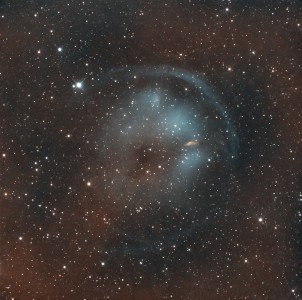
HFG-1

My Account

New to Astromart?

Register an account...

Need Help?

Posts Made By: Kim Colter

September 8, 2005 11:06 PM Forum: Solar System Observing

Tharsis plain this AM

Posted By Kim Colter

I'm hoping that some more seasoned Mars observers can add some insight into what I have seen the last two mornings on the Tharsis plain on Mars. I observe a white object, rather circumscribed, in the upper Tharsis plain just below Mare Sirenium. Using the Sky and Telescope map for Mars, what I see is too close to Mare Sirenium to be orographic cloud on Olympia Mons, but it could be orographic cloud on one of the smaller volcanoes. It may just be an area of bright albedo, although it looks as white as the polar ice cap. I have seen this area two mornings in a row, yesterday it would "come and go" as the seeing fluctuated. This morning in steadier seeing I was able to see it for minutes at a time. I did not try any filters. I was using a 20 inch Starmaster and a 7 inch refractor and could see the area plainly in both scopes. I made a sketch, but when I try to scan it and attach it, it is too light to see on the scan copy. Perhaps later I can darken the sketch and see if a suitable copy can be posted. Anybody else see this or something like it this AM? Thanks.

September 8, 2005 11:15 PM Forum: CCD Imaging and Processing/Solar System

White area in Ed Roach's excellent image 9/7/05

Posted By Kim Colter

I'm hoping more experienced Mars observers can tell me what the white area in the upper Tharsis plain is in the central portion of Ed Roach's superb Mars image of 9/7/05. It is particularly evident in his reprocessed image which shows the volcanoes on the Tharsis plain so well. The area is just to the left and down from Mare Sirenium in his image. Is this white area orographic cloud, or an area with particularly bright albedo? I have seen this area visually on 9/7 and particularly well on 9/8. Thanks.

November 21, 2005 12:20 PM Forum: Maksutovs

The closest available scope to the AP 10 inch Mak

Posted By Kim Colter

What Mak that is readily available comes the closest to equalling the performance of the AP 10 inch Mak? Thanks for opinions.

December 31, 2005 02:44 PM Forum: Deep Sky Observing

Lumpy Sky (Coma Galaxy Cluster)

Posted By Kim Colter

I had not been out to my 40 inch f5 Dob for about six weeks. Earlier this week I was out in the predawn hours. I looked at a lot of old favorites; M51, M101, Ghost of Jupiter, NGC 4565, M81, M82, Twin Quasar Ursa Major, and after the moon came up M3 and M13. For the first time since last spring I looked at the Coma Galaxy Cluster with a wide field eyepiece (31 Nagler.) There are single eyepiece fields around NGC 4824 in which the sky reminds me of poorly prepared cream of wheat (one lump after another.) I counted 45 tiny galaxies in a single eyepiece field. There were so many galaxies that I wondered if I had missed some, or counted some twice. After spending perhaps too much of my available observing time at my house squinting at Mars in the last months I was reminded that deep sky observing is what I get the biggest charge from. I am very fortunate to live (at least for now) where I can drive to a spot with skies dark enough to see such sights. I certaily am fortunate to have the opportunity to observe through such a large aperture. When I compare the image of NGC 4565 through the 40 inch using a 20mm Nagler (fills the eyepiece from one edge to the other, 250X, very dark prominent dust lane, looks like an exotic spaceship) to the more "suburban" view I get of it from my house (20 inch Starmaster) 22 miles closer to the metropolitan light dome that is fifty miles east of my house and 70 miles east of my dark sky site, there is no comparison. I can see NGC 4565 and its dust lane from my house in the 20 inch, but if you have looked at it through twice as much aperture at a darker site two days before, it looks kinda bland.
I am also noticing how much greater my enjoyment of the TeleVue eyepieces that produce large exit pupils is since the attachment of the Dioptrix to correct for my astigmatism. I wonder sometimes if my tendency to gravitate toward higher magnifications and smaller exit pupils was in part due to the imperfect appearance of stars in wider field eyepieces due to my astigmatism. The Dioptrix has made me appreciate my 31 Nag, 41 Panoptic, and 26 Nag even more than I did previously.
I attempted my annual "Ozark pet trick" of climbing the 17 foot ladder so I can see over the top of the trees to the south of my observatory to try and spot Omega Centauri with binos 4 degrees above the southern horizon as Spica culminates at about 0600. No luck, too much low lying haze. I will get it sometime in the coming weeks.
If you have dark skies and are up early in the morning, give the Coma galaxy cluster a try.

February 5, 2006 03:03 PM Forum: Deep Sky Observing

Red Barber and the Virgo cluster

Posted By Kim Colter

While roaming through one galaxy after another in the Virgo cluster in 15 degree pre-dawn skies with the 40 inch Dob I found myself spontaneously quoting the words the late Red Barber used to describe Willie May's over the shoulder catch in deep center field at the Polo Grounds, "OH, DOCTOR!" It is a joy to cruise Coma and Virgo with a scope this size. M51 showed visible dust lane in the bridge at 450X (11 Nagler.) At this power M51 is too big for the field of the Nagler. Many of the separately designated NGC areas in M101 were visible. The dust lanes in the Sombrero and NGC 4565 were very dark. The galaxies were looking so good I forgot how cold my hands were.

February 27, 2006 01:01 PM Forum: Deep Sky Observing

Supernova in Aries

Posted By Kim Colter

Has anyone seen the supernova in Aries that is featured on the Astromart home page? I tried it from WSP with a 20 inch scope without success. The only "tools" I had were the pictures and the coordinates. Some of the time my "GoTo" was functioning as "GoNear" so I may not have been right on it. I didn't find any info on what the magnitude of the stars in the star field of the image on the home page was. They may have been pretty dim. Has anyone seen it? Anyone have any info on a finder chart for it? I would like to try it with the big Dob.

June 8, 2006 11:57 AM Forum: Deep Sky Observing

Sharpless 1-89 in Cygnus

Posted By Kim Colter

I've enjoyed working through the planetary nebula in the recently published guide from the Astronomical League that I purchased at WSP. I was observing the planetary nebulae in Cygnus and Aquila two nights ago and I believe I found Sharpless 1-89 in Cygnus, but wondered a little about whether what I was seeing was a dim galaxy. I think it was the planetary because it responded to OIII filter. I can't find an image on the web of Sharpless 1-89. It looks like there may be a "Sharpless-2" catalogue in addition to a Sharpless 1 catalogue. Does anybody have any images of this planetary. The Astronomical League guide lists it as the "moth nebula."

July 13, 2006 11:04 AM Forum: Astro-Physics

shipping boxes?

Posted By Kim Colter

Anyone know where it is possible to buy substantial shipping boxes like the ones AP uses to double box their equipment for shipping? Thanks

October 22, 2006 03:40 PM Forum: CCD Imaging and Processing/Solar System

Re: Jupiter at 38 degrees from June

Posted By Kim Colter

Ouch! Is it really true that we northern hemisphere observers face low altitude passes of Jupiter for several years? Coupled with shallower angles of Saturn's rings we may be in for a planetary observing dry spell...

January 17, 2007 01:55 PM Forum: Deep Sky Observing

Thermal issues and seeing

Posted By Kim Colter

The Winter Star Party in the Florida Keys is coming next month. From past trips to WSP I know that the seeing there is legendary--for deep sky observing and planetary observing as well. I have heard some veteran amateur astronomers attribute this legendary seeing to "the laminar air flow off the Caribbean" and other characteristics of the atmosphere. The other day I saw a graphic display of the month by month temperatures in the Florida Keys. The difference between the high and low temps for the day in all months is 10 or 11 degrees. It makes me wonder how much of the legendary seeing is due to stable atmosphere, and how much can be attributed to a thermal environment in which it is possible to get the delta in temp between one's primary mirror or refractor objective reduced to a very small difference. It may be that such environments create thermal stability within the atmosphere and small deltas between glass and air and that both are major factors in the legendary seeing. I continue to find that the pre-dawn hours in the American Midwest give me the best looks at deep sky and planetary targets. Those hours are the ones when ambient temperature drop is slowing down compared to the hours just after sunset and seem to be the hours when there is less twinkling of bright stars.
I suppose that astronomers who are monitoring the delta between their primaries and ambient temperature and doing active/passive cooling can dissect out the portion of seeing that is due to thermal/boundary layer issues compared to that portion that is atmospheric.