Image of the day

Captured by
Erwin Forbragd

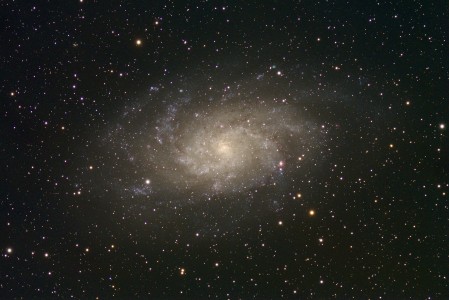
M33 in Triangulum

My Account

New to Astromart?

Register an account...

Need Help?

Posts Made By: Steven Jindra

January 12, 2006 03:16 AM Forum: Equipment Talk

You Know Your an Astromart Junky When .....?

Posted By Steven Jindra

There is a line (albeit hazy) that many (most) of us cross when we go beyond being just a casual Astromart brouser. You know your an Astromart junkie when.....?

January 13, 2006 06:13 AM Forum: CCD Imaging and Processing/Deep Sky

CCD Drift Polar Alignment - It's Worth the Time

Posted By Steven Jindra

I purchased a CI-700 GEM for imaging a while back, installed it on a permanent pier, and performed a relatively quick polar alignment using the polar scope. I figured the autoguider with my SXV-H9 would guide out any error. The best I could tell the peak to peak guiding error was about 3 to 4 arcseconds plus some field rotation over a several hour series of images. Often stars had a lump on one side, which I now attribute N or S correction always being one direction due to poor polar alignment.

So the other night I decided to perform a CCD drift polar alignment, based loosely on the instructions in the HELP menu of MaximDL. After about 2 hours of fine adjustments the polar alignment was very good. I set up a guide error chart in MaximDL and clicked off actual tracking. Over a period of about 8 minutes the E/W periodic error (PE) was about a 10 arcseconds peak to peak. The N/S error was within 3 arcseconds. With autoguiding on, the total peak to peak tracking error in N/S or E/W appears to be less than 2 arcseconds.

Images the last few nights, since the CCD drift alignment, appear to have considerably better stars (no more lumps). I've attached a picture cropped and stitched from "before" and "after" images, 1-1/2 hour (9 x 10 minute) and enlarged x3.

The bottom line. Don't be like me and get so excited about getting your hardware together and wanting to produce images that you fail to perform an accurate CCD drift alignment. That and good balancing go a long way towards improving your tracking and your images.

Thanks
Steven Jindra

January 13, 2006 06:07 PM Forum: Equipment Talk

GEMs - What Periodic Error Are You Seeing?

Posted By Steven Jindra

I recently took the time to perform a CCD drift polar alignment of my CI-700 GEM. At the same time, using the autoguiding error chart in MaximDL I checked the periodic error of the mount. With autoguiding OFF it appears to be 10 arcseconds peak to peak E/W with a 3 arcsecond peak to peak N/S error. With autoguiding turned ON, with an SXV-H9 autoguider, the error is reduced to 2 arcseconds E/W and N/S.

How does this compare to other GEM mounts currently being used for CCD imaging, with autoguiding and without autoguiding?

The CI-700 is mounted on an 8" permanent pier (with lots of concrete underneath) and carries an FS128, FS78, and FS60 in an over/under configuration inside a building with a slide off roof.

So, what periodic error are you seeing?

Thanks
Steven Jindra

January 25, 2006 04:21 PM Forum: Refractors

Field Flattener - Does It Bring Focus Forward?

Posted By Steven Jindra

I currently have the Tak FS60, FS78, and FS128 mounted in over/under fashion on a CI700 mount for imaging. I have the SXV-H9 (with filter wheel) and guide camera and change to different OTA's according to the target. I have the Tak reducers which bring the F ratio to F6 (F4.5 on the FS60) and brings the point of focus nearer the focuser, which helps with balance and keeping things rigid.

There are times I would prefer to image at the full focal ratio of F8.1 (F6 for FS60) but the pain of adding extensions and performing a major rebalancing discourages this.

My question: Does a non-reducing field flattener bring the point of focus significantly forward (closer to the focuser)? I have been looking for a Borg 1.04 Flattener to try this with, but they are no longer available new. Are there any other non-reducing flatters readily available and would they work for this(preferably in $200 to $250 range)?

Thanks
Steven Jindra

January 25, 2006 09:15 PM Forum: TeleVue

RPF-2804 Flattener - Does It Bring Focus Forward?

Posted By Steven Jindra

I have a permanently mounted imaging setup including an FS128, FS78, and FS60 mounted in an over/under fashion on a CI700 mount. I have an SXV-H9 imager (with filter wheel) and SXV guiding camera that I attach to either of the OTA's depending on the target. I have the Tak focal reducers for imaging at F6 (F4.5 on the FS60). At times I would like to image at the full focal ratio (F8.1 and F6) of the scopes, but the trouble of adding the extentions and rebalancing everything is prohibitive.

I have a few questions about the RPF-2804 (Ranger/Pronto Field Flattener:

Are the threads female "T" threads to the front and male "T" threads to the rear? If not what threads are there?

Does the flattener bring the point of focus to the front, closer to the focuser of the OTA. If so, by how much (based on your Pronto or TV-85)? If it does, this would allow me to image at full for or slightly greater focal length without major rebalancing and would keep the optical train more rigid.

Thanks

Steven Jindra
Deer Park, Texas

March 10, 2006 11:36 PM Forum: CCD Imaging and Processing/Deep Sky

Canon DSLR Distance From Front to CCD?

Posted By Steven Jindra

I now have my Canon Rebel XT with the IR filter removed (no glass
replacement). I am trying to set up the correct distance from the back
of my focal reducer to the CCD chip. Does anyone know the distance from the
front surface of the camera to the CCD, as I am leary of sticking a
tape measure down to the chip surface?
Thanks
Steven Jindra

March 20, 2006 04:34 PM Forum: Wildlife Photography

10X-12X Digital Camera(s) - Recommendations?

Posted By Steven Jindra

There seem to be a number of the non-SLR digital cameras with 10X or 12X optical zoom capabilities ranging in price from $220 (for the Kodak Z7590) up to $500. Sony, Panasonic, Kodak, etc. Some have the image stabilization and some do not. For wildlife photography, which have you had good experience with and which have not worked out so well? How important is the image stabalization feature? The better value?
Thanks for any input.
Steven Jindra

October 27, 2006 02:40 PM Forum: Equipment Talk

Re: cpc 9.25 vs. g9.25asgt

Posted By Steven Jindra

Mark
For visual only, I've found the fork mount, in alt-az is easier to set up and align. This setup is be okay for short photos, such as planets and lunar. For longer, deep sky photos, you would need a wedge, and set up becomes more difficult with accurate tracking a challange.

A higher quality GEM (CGE, G-11, etc.) is usually more work to set up and align but will track moore accurately for longer duration images. Plus you will probably find deep sky imaging easier and more fun with a smaller APO refractor (Orion 80ED, TAK FS-78, etc.). The longer focal length of the 9.25" is quite challenging to start off with for deep sky photos.

I have a fork mount alt-az 9.25" for visual use and a permanently mounted GEM in a building with a slide off roof and a couple of refractors for imaging.

Hope this helps.
Steven Jindra

November 8, 2006 06:19 PM Forum: Equipment Talk

Re: one scope only!!!!!

Posted By Steven Jindra

Mark
I'll second (or third) the Celestron 9.25" SCT. It's very good on planets and does well on DSO's. For visual only, I recommend the Go-To fork mount in alt-az mode because it is easier to handle for setup and, with a barstool, usually makes for comfortable viewing.
Hope this helps.
Steven Jindra

March 11, 2007 07:11 PM Forum: CCD Imaging and Processing/Deep Sky

Genesis SDF-101 Vs. Tak FS-78 For Imaging

Posted By Steven Jindra

I've been using a Tak FS-78, usually with the Tak F8.1 to F6 focal reducer for some time now and enjoying it. A TV Genesis SDF 101 popped up here on AM and on an impulse I ordered it. Delivery is probably a week away.

My imaging is limited to the city, so it's primarily nebula with an Ha filter and on the best nights an occasional galaxy with the LPS filter, all in B&W with an SXV-H9 and autoguider. My mount is the pier mounted CI-700, so no weight problems there.

I'm looking for experiences, images, comments, and oppinions pro and con on the SDF and/or the FS-78.

The loser (actually no losers here) as my primary imaging scope will then compete with an Orion 100ED (also on order) for my quick look visual setup. One of the three will then go back to AM for another astronomer to enjoy.

Thanks for your thoughts.
Steven Jindra