Image of the day

Captured by
Erwin Forbragd

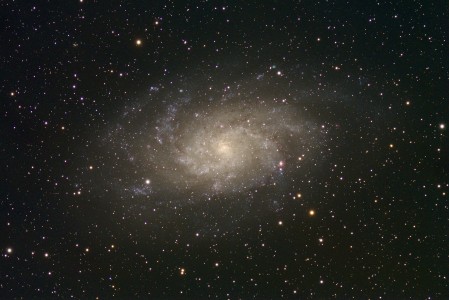
M33 in Triangulum

My Account

New to Astromart?

Register an account...

Need Help?

Posts Made By: Inge Skauvik

October 11, 2004 06:25 AM Forum: Deep Sky Observing

Some exotic DSOs observed 8th of October

Posted By Inge Skauvik

I've already posted a list of galaxies observed 8th of October. However, I observed several other DSOs that night, some of which are rarely mentioned under this forum.

In the southern part of Perseus I spotted two diffuse nebulae, NGC1333 and NGC1579. The first one was the less visually interesting. It was just a large, ill-defined patch of light with one star involved. The background was unusually poor due to obscuring clouds. I almost had the impression of viewing from a highly light polluted area. NGC1579 appeared as a double nebula. Not a show object, but worth the search.

I also found the open cluster, NGC1245 in Perseus. This was one of the evening's greatest surprises. It is a rich cluster, reminding me of NGC6939 in Cepheus, but with a brighter star at the edge. Recommended!

After the mandatory viewing of the North-America nebula and the Veil, I checked the region near Gamma Cygni. Embedded in the rich star field I noticed a large, faint patch of nebulosity, which I later identified as IC1318b. It is listed as an emission nebula, but the O-III rather killed the nebula than enhancing it.

I re-observed NGC7331 in Pegasus, and used more magnification than last time. 120x brings out more detail than 63x, but I was still only able to see one of the satelite galaxies, NGC7335. Using the same magnification on Stephans quintet revealed three separated nebulous patches, presumably NGC7318/7319/7320.

Finally I'd like to mention NGC7479, south of Alpha Pegasi. I remember when observing it with the 8-inch a year ago I found it faint and uninteresting. In the 12.5-inch, however, it is a much more striking object, and the spiral structure can be made out.

Inge Skauvik
Haavik, Norway

October 12, 2004 08:58 AM Forum: Equipment Talk

Choice of magnifications

Posted By Inge Skauvik

I'm presently updating my eyepiece set, and I have decided to acquire a series of TV eyepieces covering the magnification range between 63x and 500x. I already have a 24mm Panoptic for the lowest power (12.5-inch scope, focal length 1500mm).

I figured out that a "logarithmic" distribution of the magnifications is the best choice, for instance selecting eyepieces giving a 50% increase in magnification for each step. (E.g. 100x / 150x / 225x /338x )

Which ratio between magnifications is considered to be optimal. Manufacturers and dealers will, of course recommend a 10% increase for each step, but I'm interested in somthing giving a good performance for the buck. Any thoughts?


October 15, 2004 07:31 AM Forum: Deep Sky Observing

NGC185 and 147

Posted By Inge Skauvik

I was very satisfied the tirst time I saw the two galaxies, NGC147 and 185 in Cassiopeia with an 8-inch, and considered this to be a proof of excellency of my Zambuto mirror.

Recently I had a report from a young guy who was able to see both with an 80mm refractor. And this was not from the Arizona desert, but from windy, humid western Norway.

I start realising that my own visual skills are just average. If I'm able to see anything with a given aperture, many observers will be able to do the same with considerable less.

This is not a problem for me. After all amateur astronomy is not competition, and nobody can claim the ownership of any item in the celestial treasure box.

Inge S

October 20, 2004 01:04 PM Forum: Equipment Talk

Is a Nagler as sharp as a Radian

Posted By Inge Skauvik

Probably a subject that has ben discussed before, and my reason for posing the question is to get a basis for a decision, and not to make a long thread.

Will a 6mm Nagler (Type 6) provide the same sharpness at the centre of the field as a 6mm Radian?

Additional question: Do the 2.5mm and 3.5mm Naglers perform well as planetary eyepieces.

Long eye relief is not an issue for me. In fact I very often prefer an eyepiece with a relatively short eye relief.

October 26, 2004 02:22 PM Forum: Deep Sky Observing

Plans for the upcoming lunar eclipse.

Posted By Inge Skauvik

It seems that we will have a clear sky during the upcoming lunar eclipse. I have already planned what to do (in spite of the fact that it is very early in the morning in Europe).

Having just acquired a 9mm Nagler, I'm going to test out this eyepiece on some deep-sky objects. The couple of dark hours at full moon come like a gift sent from heaven.

Inge S

P.S.: Perhaps I'll spend a few minutes on the moon too. But only a few.....

November 4, 2004 06:33 AM Forum: Deep Sky Observing

NGC1535

Posted By Inge Skauvik

I "found" this planetary (NGC1535 in Eridanus)while leafing through Kepple&Sanner's observing guide. I usually pay very little attention to Eridanus, since most of it is located too far south for me. However 1535 is within range, and from the descriptive notes is seems to range high on the list of the most impressive planetaries in the sky.
Have anyone observed this object? How does it compare with objects like M57, M76 or NGC7662/6543?

Inge S

November 7, 2004 01:29 PM Forum: Deep Sky Observing

Sentence served

Posted By Inge Skauvik

After comitting the crime of acquiring two TeleVue eyepieces and one Orion soft eyepiece case (to be strapped around the observer's waist), I have served my sentence of three weeks of lousy weather. Last night was clear, with good air transparency and average seeing. I therefore went for a combined deep-sky and double star session.

I observed several interesting objects, many of which I have never seen before. here I will only report the ones I found most interesting.

M33 is a good object in a 12.5-inch scope. Yesterday I observed it with 63x (24mm Panoptic) and 167x (9mm Nagler). The sky background appeared much darker at the high power, and several emission regions appeared. However, I find 167x to be a bit too much for this galaxy. On the other hand 63x is too little. Therefore I have to face the cruel reality. I need an eyepiece in the 13-15mm range, probably a 13mm Nagler.
M1 also becomes very interesting with 12.5 inches of aperture. I can make out hints of the filaments in the nebula with averted vision. I think it will be very interesting to observe M1 from an extremely dark location with high air transparency. O-III doesn't improve the view of M1, it rather reduces its brightness.
I checked out two clusters with involved emission nebulae. In Auriga nebula IC410 is involved in open cluster NGC1893. The nebula is very difficult to see without a filter, but it stands out with considrable detail with the O-III. The other cluster/nebula combination I checked out was NGC2174/NGC2175 in the northern part of Orion (not far from Zeta Taurii/Eta Geminorum). The "cluster" is one of the poorest I ever saw. The nebula, however, was obvious without a filter, and with the filter it was quite large and bright. More or less in the same league as NGC281 in Cassiopeia.
I made out the Merope nebula for the first time in my life. I realise that it isn't really difficult. I simply never paid much attention to it before. I did not use a filter on this object since it is a reflection nebula.
I found NGC1535 in Eridanus, and can confirm that it is a good object. However, I observed another, much neglected planetary which I found even more interesting. This is NGC1514 in Taurus (near the Perseus border). Pointing my scope at its approximate position a saw some moderately bright stars, one of which seemed to have a faint halo. To begin with I suspected that there was some dew on the eyepiece, but the O-III filter confirmed that this, indeed, was NGC1514. This nebula is one of the ones that responds best to the O-III filter. The nebula appeared large (167x) and bright, and numerous condensations could be seen in the nebula. It was a great surprice to me, a confirmation that there are still a lot of interesting things to find in the sky. This planetary probably is best with larger aperture. It is superb in the 12.5-inch, and doesn't get the attention it deserves.

Inge S

November 8, 2004 05:47 PM Forum: Deep Sky Observing

Administrator, something odd is going on

Posted By Inge Skauvik

I have posted two replies to posts by Dmitri Kuglinov about NGC278.
This morning everything looked ok (I display the posts as threaded - newest thread first).
Now, however, my replies are still there, but Dmitri's postings have disappeared. Instead my replies seem to be attached to another post which I haven't ever read yet.
Database mainetnance needed or...?
I appreciate very much this forum, and hope that the problem can be resolved.

Inge Skauvik

November 10, 2004 07:08 PM Forum: Deep Sky Observing

Leo 1 and other dwarf galaxies

Posted By Inge Skauvik

What does it take to see Leo 1 visually? Have anyone detected it with a 12-inch or smaller aperture scope?

I'm just curious, and would normally not chase extreme challenges like this. Generally I find it more rewarding to observe objects showing some detail, like the larger spirals or galaxies with obscuring clouds. However, since it is so close to Regulus, it would be very interesting to try. I suppose that Regulus must be kept outside the field of view. But what is the right magnification?

Inge S

December 6, 2004 07:42 AM Forum: Deep Sky Observing

Gemini clusters

Posted By Inge Skauvik

M35 is by far the most frequently observed cluster in Gemini. It is very nice with its prominent chains of stars, but with a telescope where the lowest magnification is 50 - 60x it is a bit too large to really stand out from the background milky way.
The background cluster, NGC2158, is a better object in big telescopes. Even with an 8-inch a few stars can be glimpsed in it, and with a 12-inch partial resolution is possible.

There are other fine open clusters in Gemini. A couple of degrees north of Epsilon lies NGC2266. Some magnification is recommended for this cluster, since an 8.5 magnitude star involved in the cluster tends to overpower the fainter ones at low power. 2266 can be observed in small telescopes, but an aperture of 8 inches or more is recommended for a really good view.

An even better cluster, even for very small telescopes is NGC2420. It is fairly large, but stands well out even at magnitudes in the 50 - 100x range. It is #1 in Herschel's sixth catalogue of compressed clusters.

Inge S