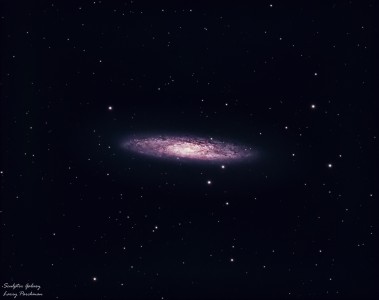
Image of the day

Captured by
Lawrence Parchman

Sculptor Galaxy (NGC 253)

My Account

New to Astromart?

Register an account...

Need Help?

Posts Made By: Jarad Schiffer

September 28, 2004 08:18 PM Forum: Equipment Talk

Mirror Evaluation

Posted By Jarad Schiffer

If the numbers are expressed in wavefront, as Floyd is assuming, it should be okay. The P-V is marginal, but the RMS is actually quite good (which just means that the peak affects a small area of the mirror). If the numbers are surface error, then it is going to be marginal at best (in this case P-V is almost double the diffraction limit, and the RMS is just a bit above the diffraction limit).

But it's kind of a funnly looking picture to me. Does this mirror have a central perforation? It's hard to tell what's going on in the center, there's no sharp edge that I would expect if it was a perforation, but if there is no hole then there is one heck of a mess near the center. Granted, most of it should be in shadow of the secondary most of the time, but still.... I also see a little bit of turned edge both at the outside and near the central whatever-it-is, and the lines on the upper left all have a bend in them. I am not sure that I would believe those number came from this picture if they are supposed to be wavefront.....

Jarad

October 4, 2004 02:53 PM Forum: Equipment Talk

Nagler T2,T4 clash with Paracorr

Posted By Jarad Schiffer

Have you considered making a parfocalizing ring for the 12T4? This is basically a ring that fits over the 2" barrel and takes up a bit of room so that the eyepiece slides into the paracorr and stops before it hits the lens. Gary Wolanski makes them if yo want a really nice one, but you cn probably make one yourslf from a bit of 2" ID PVC pipe or something.

Jarad

October 7, 2004 01:54 PM Forum: Telescope Making

Telescope Collimation

Posted By Jarad Schiffer

It's a little hard to tell for sure without a cheshire or something similar to make sure you are looking dead center, but it looks pretty good to me. Certainly very close, if not necessarily dead on (could be dead on, just can't be sure from that pic....).

Jarad

October 12, 2004 07:42 PM Forum: Equipment Talk

Bad Battery or Bad Charger?

Posted By Jarad Schiffer

Is this a trickle charger? Is it one of the types that checks for voltage load before it starts charging to prevent overcharging the wrong type of battery? Some chargers will not start to charge a battery that is too low (usually below the next common voltage, i.e. below around 9V for a 12 V charger). You could buy a cheap non-trickle charger for it, hook that up for a few hours, then switch to the trickle charger (the cheaper chargers don't do the voltage check, but don't leave it connected too long or it can overcharge and damage the battery). Or if you have a cigarrette-lighter connector, you could hook it up to your car for a few hours to get the charge up over the trickle-charger threshold voltage.

Hope this helps.

Jarad

October 14, 2004 07:18 PM Forum: Equipment Talk

Stupid refractor questions

Posted By Jarad Schiffer

1: The obstruction is usually given as a percentage by diameter, not area. Certainly a 20% obstruction is by diameter (it would be 4% by area). Most SCT's and MCT's have obstructions around 30-35%, most newts have them around 15-25%.

The affect on resolution is complex. Do a search for MTF to find some more complete discussions, but basically the CO reduces contrast by putting some of the light from the airy disk into the diffraction rings. This mostly affects low-contrast detail like planetary surface features. A rough guide for the effect on that is that an obstructed aperture has equivalent resolution to an unobstructed aperture of D-d where D is the aperture and d is the obstruction diameter. This is a very crude estimate of the effect on low-contrast resolution, and not applicable to all things (for example, resolution of double stars is actually enhanced by the CO because the airy disk is made smaller by the light moved to the diffraction rings).

2: Yes, although you also need to take into account the reflectivity of the surfaces. A well coated refractor lens will pass 99% of the light that hits it (multiply by however many air-to-glass surfaces are in the lens). Most reflecting surfaces pass ~90% for standard coatings or ~96% for enhanced, or 99% for dielectric (usually only found on diagonals), so multiply thos numbers for each reflective surface (primary, secondary, and diagonal if there is one. Don't forget to multiply in the diagonal for the refractor, too).

3: Contrast. Part of it is the CO as mentioned above. The rest depends on the optical quality. A rough surface will scatter more light (refractor or reflector). Low-quality optics tend to be machine polished and relatively rough. So, cheap scopes (including cheap refractors) tend to have poor contrast. A very smooth surface doesn't scatter much light, so well-polished optics give better contrast. That is why certain brands (AP, TAK, TMB etc. for refractors, Zambuto, Pegasus, Royce, etc. for reflectors) have such great reputations for high-contrast optics, while others don't.

Jarad

November 3, 2004 01:38 PM Forum: Equipment Talk

Dual Axis Equatorial Platform

Posted By Jarad Schiffer

A dual axis platform is for photography, so you can plug in an autoguider to correct for any minor errors in polar alignment, bumps on the curved surfaces, etc. Usually the second axis only has a small amount of travel, and is only used for high-power centering and photo guiding. For visual use, a single-axis platform works fine.

Jarad

November 3, 2004 08:05 PM Forum: Equipment Talk

Newtonian Focal Reducer / Relay Lens Idea

Posted By Jarad Schiffer

I am not sure if the double eyepiece idea will work at all, and it will certainly be fairly difficult to get them lined up properly. But the more serious issue is vignetting. Unless you have a fairly large secondary, you are likely to have significant vignetting across a 30mm focal plane (which you are trying to shrink into 10mm for your CCD). You would probably be better off by replacing your secondary with a larger one, moving the secondary/focuser down a bit closer to the primary to bring out the focal plane, and using a normal focal reducer.

This is one of the reasons that newt's are not the best choice for astrophotography. If you want wide field, you're real best bet is to get a small refractor. An ED-80 doesn't cost much more than 2 high-quality eyepieces....

Jarad

November 4, 2004 01:48 PM Forum: Equipment Talk

Dobsonian Mirrors

Posted By Jarad Schiffer

Yes, the more enhanced mirrors will give slightly brighter images (note that the percent increase is small enough that you would need to have the scopes side-by-side to tell the difference). The enhanced secondaries are used by most of the big dob makers, but some feel that enhanced coatings on primaries degrades the image quality (by slightly altering the figure of the mirror).

It seems to be a QC issue - Zambuto stopped using enhanced coatings because he found that about 1 in 3 mirrors had problems with the coating and had to be recoated. Since that comes out of his pocket (he retests the mirror after coating), he decided it wasn't worth the improvement in reflectivity.

On the other hand, that means you have a 2 in 3 chance of success, so if you are willing to give it a shot and pay for a recoat if you're not happy, go for it.

It could also be that it was problem specific to one or a few coating companies, and they may have improved their process by now.

Jarad

November 8, 2004 03:23 PM Forum: Equipment Talk

Vogel VE Digitrak input power polarity?

Posted By Jarad Schiffer

I had one - it uses a standard 12V wall-wart, center positive as you guessed. Take it with you to Radio shack and buy the one that fits, or the ciggarette-lighter adapter that fits.

Jarad

November 30, 2004 04:58 PM Forum: Telescope Making

secondary mirror size

Posted By Jarad Schiffer

Can yougive us some more specs? How wide is your tube, how tall is your focuser, how much extra in-travel do you need for the CCD, and how big is the chip?

Assuming a 14" tube diameter, a 1.6" tall focuser, and an extra 0.5" of in-focus travel for the CCD to reach, you have a 100% illuminated field of about 0.7" with the 2.6" secondary. That goes up to just over 1" with the 2.9" secondary. If the 0.7" will fully illuminate the CCD chip, then I would take the 2.6" secondary. If it won't, get the bigger one.

If your tube is wider, focuser taller, or you need more in-focus for the CCD, then you need to recalculate the fully-illuminated field based on your measurements. Download Newt 2.5 and enter your specs to see what size secondary you need to illuminate your CCD chip.

Jarad