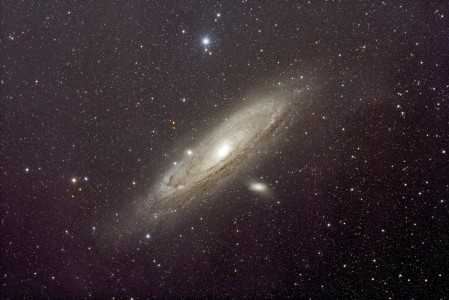
Image of the day

Captured by
Ralph Ford

M31 with Redcat 51

My Account

New to Astromart?

Register an account...

Need Help?

Posts Made By: Kim Colter

October 15, 2002 03:09 PM Forum: Deep Sky Observing

Help with "manual go-to"

Posted By Kim Colter

Simon
I think you're going to be better off with a Telrad and some good starcharts than trying to create "poor man's setting circles." One of the guys in my club just showed me some spiral bound dew proof cards by a fellow named Watson that have familiar constellations mapped out with a Telrad ring on the chart around the desired object. He says they have been particularly helpful to him in starhopping to objects with the large Dob that some members of our club co-own. I was impressed with the one for the Messier objects and one for "overlooked" objects. I would also highly recommend the Sky Commander that uses encoders and has entire catalogues of objects stored in the software. I use this on my personal large Dob and I'm very happy with it. I just don't think protractors are going to get you close enough to what you are wanting to see--perhaps I am wrong.

December 1, 2002 06:21 PM Forum: Deep Sky Observing

Staying warm

Posted By Kim Colter

Mike
The two most helpful additions to my winter observing wardrobe have been a Feathered Friend's "40 below" down pants and insulated boots bought off the REI web site that are made by Baffin Technologies and said to be good to minus 148 F. These boots are so warm that I no longer bother with multiple socks, my standard run of the mill wear 'em every day to work socks work fine inside these. The Feathered Friend's pants are so warm I have to drive to my observatory with no heat in the car to keep from burning up. I find myself wearing less clothes on my torso with these on. I also like those fingerless wool gloves that have a "flip down" mitten so that if your fingertips get cold you can flip the mitten top off the litle velcro patch on the back of the hand and bring them down to cover the fingertips for a while. Wool stocking hat seems to work better for me than hoods. One has to discipline oneself to exhale properly so that you aren't fogging/frosting eyepieces with exhaled breath.
No complaints about cold weather from me--the nights are longer, the transparency is better, West Nile is not a concern, and there are no bugs to swat.

January 1, 2003 09:43 PM Forum: Deep Sky Observing

Comet C2002/X5

Posted By Kim Colter

Pete
Saw it this morning through 20X80's. No tail, probably one magnitude fainter than M13 to which I compared it. I looked two other mornings but ran into clouds/fog low in the east and couldn't see it. All in all about what I expected. Havent had the chance to put more aperture on it to see if tail can be detected.
Kim Colter
Washington MO

February 27, 2003 04:24 AM Forum: Equipment Talk

Refractor Lens Assembly Collimation

Posted By Kim Colter

Tim
Is the refractor objective a doublet or a triplet? Are you able to identify set screws that change the position of one lens element relative to another? Is there coma present when you observe through the objective?
One person that might be of help is Art at Texas Nautical Repair. They are now known as Land, Sea, and Sky and can be found with a search engine.
I have experience with adjusting the position of the posterior element of a triplet in one objective only. In that instance it was done by observing a star of magnitude +1 at high power through a green filter and making very minute changes on three set screws in a fashion that would move the posterior element and eliminate coma. It took a while to get the hang of it but like all collimation is very satisfying when you achieve a nice image. I found that a night of steady seeing was helpful in doing this adjustment--sometimes I was frustrated by the time I was spending doing this adjustment on a rare night of excellent seeing when I would have rather been observing planets at high magnification.
Adjusting the position of the entire lens cell to align the optical axis of the objective with the optical axis of the tube is easier. A Cheshire eyepiece in sunlight with the objective covered allows one to see "dots" of reflected light at each interface in the objective. The lens mounting screws are then adjusted in push/pull fashion to line up the dots.

April 3, 2003 11:54 AM Forum: Equipment Talk

Good Star Party EPs

Posted By Kim Colter

Tom
The old dilemna, how do you show the public views that will impress them without paying the price of mascara on your favorite oculars. Often the planets are what impress folks the most. In the cloudynights review on planetary eyepieces Televue Plossls and RKE eyepieces were both favorably received. They can be purchased on Astromart for as little as 50-60 bucks for TV Plossls and even less for RKE's (these don't show up as much.) Perhaps others will have better suggestions.
Kim

April 26, 2003 04:34 PM Forum: Deep Sky Observing

Spring Skies and the Virgo Cluster

Posted By Kim Colter

Daryl
If your travels bring you to Missouri and the clouds cooperate I would be happy for you to have a look at some galaxies through a really large Dob. In dark skies with a Dob 20 inches or greater one sees spiral structure in most all the Messier galaxies. Through my largest Dob (40"f5) the images are much like long exposure astrophotography minus the color. In M51 spiral arms are fully evident and the bridge between the galaxies can be seen. John Dobson once told me he had seen the dust lane in the bridge between the interacting M51 galaxies using a 25 inch Dob in the desert in the Western US. I can't say I have seen the dust lane in the bridge yet but I have seen the entire bridge from one galaxy to the other. Where in Michigan are you? I go to Mackinac every summer.

May 4, 2003 11:53 AM Forum: Zeiss

Eyepieces and scopes

Posted By Kim Colter

Paul
You have elicited replies from Michael Lalk and Kevin Barker. I'm sure I can add nothing to the wisdom they have offered. I have had the opportunity to use a Zeiss 10mm ortho in 0.965 and 1.25 size one after another in the same scope. In the seeing conditions present in the Midwest at the time I made the comparison I could not tell a difference. I am trying to acquire some additional focal lengths of the .965's and will make that comparison when I can. My thought is that for travel and public star parties the 1.25 Abbe orthos are a tad too valuable to subject to mascara and fingerprints.
I have a friend who has constructed a scope from a Zeiss achromat 130 f15. I spoke with him on the phone the other night and we hope to come up with an evening of excellent seeing and try making comparisons of the images in this scope and an APQ.
As to using the 1.25 Abbes in fast scopes--I have put them in f5 and f4.35 Newtonians and been impressed with their performance. I have not tried this with the .965 10mm that I have.
As to the new TMB and AP/Aries eyepieces making the Zeiss orthos less valuable as they come to market, we shall see. I noted in the yahoo forum for TMB that Tom Back had compared the TMB monocentric to Zeiss Abbe 1.25 and Pentax .965 and was very favorably impressed. I must say that when I "fill the gaps" between the 4,6,10,16mm Zeiss Abbe 1.25's with the Pentax .965's in 5,7,9,12, 18 that I find these oculars produce beautiful images in my scopes as well.
I suppose one goal is to be in the happy circumstance that each time you observe the quality of the image is determined by the seeing conditions that exist, not by a rate limiting piece of your optical train (scope,diagonal, or ocular.) I think that with any of these orthos in AP, Zeiss, Tak refractors or Newtonians with Zambuto or Swayze mirrors (and others) that one has probably achieved that goal.
Bring on Mars. The party is at Kevin's place.

May 19, 2003 11:46 AM Forum: Deep Sky Observing

Visual Acuity - What's Yours?

Posted By Kim Colter

Ed
I am very interested in this subject. If it ever clears here in the Midwest I hope to try out my 12 and 15 year old daughters on this topic. The 15 year old tests at 20/13 or better, the 12 year old at 20/15. The 12 year old has 9 mm pupils in the dark. Too bad neither one of them have much interest in astronomy. I'm not sure where their visual acuity came from, they have spectacle wearing astigmatic parents. It will be interesting to see what effect observing experience has in this trial versus visual acuity. I am convinced that with respect to planetary detail that there is some "image processing" that occurs at a level higher than the retina in the dominant eye. I can see much more detail on planets with my dominant eye than with the other one even though my visual acuity is sharper in the non dominant eye. I think some binocular observers who are seeking the most detail possible are probably using their dominant eye almost exclusively. This is probably particularly true with binoviewers where higher magnifications are being used on the split beam from a telescope. I'm not sure whether this cortical image processing will be a factor in the ability to split double stars but I wouldn't be surprised if observing experience and technique wins out over young sharp inexperienced eyes.

July 14, 2003 10:59 AM Forum: Deep Sky Observing

Observatories in Michigan

Posted By Kim Colter

Mike
I will be headed there myself in a couple of weeks. I notice that the Leelanau school in Glen Arbor has "observing on the beach" sessions with a 14" telescope on Wednesday and Thursday nights from mid June to mid August. Go to www.leelanau.org and click on "summer programs" and then click on "Lanphier observatory." I would appreciate knowing what your experience is observing near Traverse City. I noticed yesterday that they were in the "deep blue" on the clear sky clocks.
Kim Colter

September 27, 2003 11:10 AM Forum: Zeiss

mounting the APQ 130

Posted By Kim Colter

Alan
I have been using the Zeiss stainless dovetail bar on the Dove 08 AP plate on AP 600 and have felt that system was adequate. Are you looking for a more substantial dovetail plate?
Kim Colter