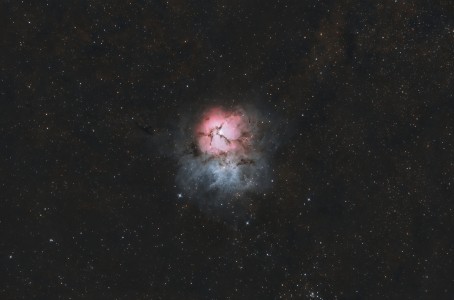
Image of the day

Captured by
Byron Davies

M-20 Trifid Nebula

My Account

New to Astromart?

Register an account...

Need Help?

Posts Made By: Hugh Bartlett

January 20, 2006 03:11 AM Forum: Equipment Talk

Mounting a very light scope

Posted By Hugh Bartlett

Yikes! You have some serious upgrading to do! I suggest a Micro-Star mount from Universal Astronomics on an Orion Paragon Plus tripod (you'll need a 1/4->3/8 adapter thingy that I got at my photo shop for $1). You'll also need some rings, which Orion has. Orion has that tripod on sale at the moment. You might be able to get by with the plain Paragon (there was one as a second on sale for about $65 on their website). The Micro-star is the most expensive part, but well worth it, and could work for your other scope as well. I see them occasionally on Astromart for about $150. They are very stable, smooth, and intuitively easy to use.

Hugh Bartlett

January 23, 2006 05:23 PM Forum: Beginning Astronomy?

Observing Locations near San Francisco

Posted By Hugh Bartlett

I've heard of a place called Monte Bello near there. It is a Ridge in the Santa Cruz Mountains just west of Cupertino. To get there, take I-280 to Page Mills Road in Palo Alto, and head south. About 6 miles up that windy road, turn left on Monte Bello Ridge Road (not sure of its real name, but if you get to State Route 35, you went about a mile too far). I'd look for a pull-out along the first 5 miles on that road, which are fairly level and tree-free. You will have great views to the south and west, with serious light domes to the north and east, but it is convenient to where you will be.

Hugh Bartlett

January 26, 2006 04:55 AM Forum: Beginning Astronomy?

best-at-(blank) telescope for $1,500?

Posted By Hugh Bartlett

The best scope is the one you will use the most. A lot of folks stick with an 8" SCT for their entire observing careers, so it is a legitimate choice.

There are a lot of factors to consider that I don't know about you: where you live, where you are going to observe, if you need to load it into a vehicle, what kind of vehicle you have, your physical ability to lift a scope, how far you have to move it to get it to where you can use it, what kind of storage space you have, etc.

If those are not limiting factors to your using a scope, I would take a long hard look at the Orion XT12i. I have a 12.5" Dob and truly enjoy the views of everything from planets to DSO's from either the city or a dark sky site, and feel it will last a long time before I want to move up again (if I ever do). It moves around easily on a 2-wheel hand cart, and slides into the back of my SUV for transport to the dark sky sites.

Aperture rules. For about $1,000 you would get your push-to scope and have change left over for some accessories (which often end up costing much more than your initial investment in the scope).

Hugh Bartlett

February 5, 2006 01:16 AM Forum: Equipment Talk

Re: Advice wanted

Posted By Hugh Bartlett

You might just give Larry a call at Universal Astronomics. If it does not exist, he'd be a good one to invent it! Maybe he'd let you beta-test the prototype, and keep it for inspiring the invention!

I like the idea of a mount for big binoculars. Someone surely has a design for a chair mount that could be adapted to a wheel chair. The tricky part, of course, is to vary the height of the instrument to keep the eyepiece at the same level for the scope/binoculars when observing objects at different altitudes.

Hugh (the lesser intellectual) Bartlett

February 5, 2006 01:42 AM Forum: Equipment Talk

Fujinon 16x70 vs 4" refractor

Posted By Hugh Bartlett

The best instrument (between the 101ED and the 16x70 Fujinons) for viewing open clusters depends on the cluster. Some clusters view better at lower powers (i.e., 16x). These include many of the showpieces of the sky (M45, M44, etc.). In these clusters, the binocular effect of viewing with both eyes would make the Fujinon's the instrument of choice (although the Borg would not be a shabby second choice by any means!).

A lot more clusters are better viewed at medium power (including some showpieces also such as M11), which leaves the binoculars a distant second for those objects.

For detecting, I'd give the edge to the binoculars due to their wider field of view.

There is also the effect of a larger aperture being able to better resolve the faintest stars in a cluster (which I believe is independent of the equivalent light gathering power of the binoculars, but am not enough of an optics expert to know for certain).

Hugh Bartlett

February 6, 2006 05:24 PM Forum: Equipment Talk

Advise in Tripods and Mounts

Posted By Hugh Bartlett

It would help if you could describe your scope in terms of aperture, overall length, and weight. Also, how you plan to use it, and if you prefer a tracking mount (which requires polar alignment and usually counterweights), or are happy with a simple slewing mount that moves in just the horizontal and vertical directions (a.k.a., alt-az).

IIRC, that is about 5-6" in aperture and a fast f/4-5 scope, so it should not be too taxing on a mount. Nevertheless, you should be prepared to spend several times what the scope cost for the mount & tripod. Otherwise, the views will be hard to focus and unusable at anything over low power. If you are handy with tools, you might consider making a Dobsonian (plywood alt-az) mount for it.

Hugh Bartlett

February 6, 2006 06:26 PM Forum: Deep Sky Observing

NGC1514 in Taurus

Posted By Hugh Bartlett

I agree! I was out last month with the same scope (12.5" Dob). Without the filter, it was just a star in between two field stars of similar magnitude. But pop in the O-III and this large circle of gas becomes easily visible. The guy next to me had an 8" and made the same observation.

Hugh Bartlett

February 7, 2006 03:38 PM Forum: Deep Sky Observing

Sagittarius DSO's

Posted By Hugh Bartlett

About 2 degrees north of the tip of the teapot's spout is my favorite non-M object in Sagittarius. It is actually two objects: a compact dark nebula, B86, and a beautiful circular open cluster right next to it visible in the same 1 degree field of view, NGC 6520. The cluster has a orange star in the center, and what looks like two perfect concentric circles of stars around it. The cluster looks like someone scooped the stars out of the pitch black nebula right next to it!

Hugh Bartlett

February 14, 2006 04:58 PM Forum: Equipment Talk

Question about mirror cleaning

Posted By Hugh Bartlett

Whoa boy - exactly what kind of solvents are you thinking of using? A drop of dishwashing detergent is all that is needed.

If the center spot comes off, it is no big deal. Clean the residual adhesive gently (you can be a little more aggressive in the center of the mirror, because it is in the secondary shadow). Cut a piece of paper the same diameter as the mirror, quarter fold it and cut the center point out, lay it over the mirror and lightly mark the center spot with a felt tip pen, and apply an adhesive hole protector (the kind for 3-hole punched notebook paper) over the dot. You can take a Q-tip with a little alcohol to remove the pen mark, and you are set to go.

Hugh Bartlett

February 14, 2006 09:30 PM Forum: Beginning Astronomy?

trying to decide

Posted By Hugh Bartlett

An 8" Dob is an excellent choice!

If you can afford the difference, it makes sense to me to get the intelliscope, and try it out for a while without the object locator.

On the other hand, you could spend the difference between the two scopes on some nice binoculars that would help her learn the sky to the point that the locator was not necessary. (My choice would be the 8x42 UltraViews.) Then, use the money saved by not getting the controller for a 1x viewer and a 9x50 Right Angle Correct Image finder (and a SkyAtlas 2000).

I'd base your decision on what would be the least frustrating for both of you. Personally, I find reading manuals and memorizing procedures for electronic devices frustrating, but you and your daughter may be different, and find star hopping more frustrating. Certainly, light pollution makes it more difficult to find guideposts naked-eye, but, IMHO, binoculars and a good finderscope can make up for that quite nicely.

Still, I would not call it foolish to think that the object finder could come in handy later on. I know the sky fairly well, and was gratified one evening that someone next to me had an intelliscope to help find a tiny nebula that I was just a little off in remembering where it was.

Hugh Bartlett
