My First "Deep Sky" AttemptPosted By Chuck Story |
Hi Everyone,
I'm a long time admirer of all the work that is being presented here on the forum, it is really teriffic stuff.
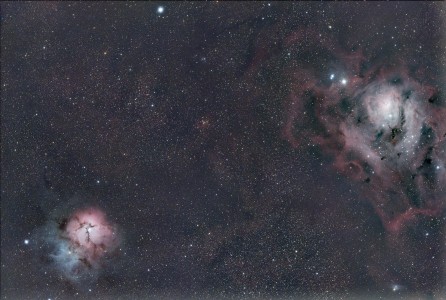
The photo attached is my first attempt to do a long exposure photo. The camera is a Nikon D70, and I sort of piggy backed it on our club's 16" f8 Newtonian. I don't have a mount of my own yet (11" f5.6 Starmaster) thus the reliance on the club scope. The shot was 2 minutes, ISO 800, 122mm, F5.6 using the Nikon 70-300mm ED lens, noise reduction was turned on.
My question to the group is, what would be the best way to improve the image? Is 2 minutes long enough, or should the exposures be longer? About how many photos would need to stack? I know that typical signal averaging improves the signal to the square root of the number of scans. For example 4 samples doubles the signal to noise, 16 would double it further etc. Does the same sort of statistics apply to staking photos?
Thanks in advance for any thoughts and advice.
Chuck
