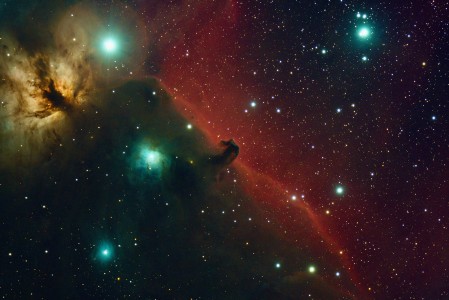
Image of the day

Captured by
Erwin Forbragd

Horsehead Nebula

My Account

New to Astromart?

Register an account...

Need Help?

Posts Made By: Mike Ricklin

March 18, 2003 09:48 PM Forum: Equipment Talk

Deep sky - SCT or APO?

Posted By Mike Ricklin

Hello all,
I am shopping and need help on my decision of SCT or APO. All the postings and reviews rave about APO contrast, portability, planetary observing, etc. And some seem to indicate that less than perfect seeing conditions or light pollution favor APOs. Well, in the high desert of New Mexico where I live, where many nights are crisp and dark, will an SCT do as well? What is best for galaxies? Can the 4" APO be used or is that good only on planets and nebulae? I want to spend about 3500 which could buy a Meade LX200 12" with UHTC, or a TAK 4" on a GP-DX.
Thanks,
Mike

June 28, 2003 10:44 PM Forum: Equipment Talk

interface for lxd55 autostar

Posted By Mike Ricklin

Does anyone use a laptop to drive their LXD55? I cannot find the cable interface specs for the autostar controller at meade or astromart.
Thanks!

November 3, 2003 11:12 PM Forum: Equipment Talk

New theory of GRBs

Posted By Mike Ricklin

I came up with my own (non-mathematical) theory of gamma ray bursts last weekend while puffing on a cigar and checking out the first quarter moon. smile It goes like this - a black hole is neither black nor a hole (get the picture? I think I had a beer also).... a black hole is a heavy star which still has fusion, thereby producing light and gamma photons, which can't escape and therefore go into some orbit or quantum frozen state. As the star burns enough of its core, the total mass goes below the blackhole threshold for light's escape velocity, and, voila, you get a giant burst of gamma photons.

Whatever beer that was, I want another...

November 3, 2003 11:20 PM Forum: Off Topic Discussions

new theory of GRBs

Posted By Mike Ricklin

I came up with my own (non-mathematical) theory of gamma ray bursts last weekend while puffing on a cigar and checking out the first quarter moon. smile It goes like this - a black hole is neither black nor a hole (get the picture? I think I had a beer also).... a black hole is a heavy star which still has fusion, thereby producing light and gamma photons, which can't escape and therefore go into some orbit or quantum frozen state. As the star burns enough of its core, the total mass goes below the blackhole threshold for light's escape velocity, and, voila, you get a giant burst of gamma photons.

Whatever beer that was, I want another...

January 26, 2004 09:39 PM Forum: Deep Sky Observing

Here's looking at you, kid (part 1)

Posted By Mike Ricklin

Ever wonder, while observing the Andromeda galaxy, if there is some one in Andromeda looking at you and wondering the same thing? Well, there likely is!

Start with the Drake equation, using very conservative estimates. Let the rate of (solar type) star formation be 0.3 stars per year. Assume only 20% of those develop planetary systems (again, very conservative). Now assume 20% of those are earth-like, meaning at the right distance from their sun to allow suitable atmospheric and temperature conditions. Now assume 5% of those develop life (again, conservative compared with some accepted estimations). For the probability of live evolving intelligent life, lets use a factor of 50%, since evolution favors intelligent life. The next factor is the lifetime of the technical civilization. Let's say it's 10,000 years, a guess since we really cannot logically estimate it. These numbers then result in a calculation of three intelligent civilizations in Andromeda (or the Milky Way, a similar spiral galaxy).

January 26, 2004 09:40 PM Forum: Deep Sky Observing

Here's looking at you, kid (part 2)

Posted By Mike Ricklin

Next we need to calculate the number of amateur or hobbyist astronomers. Earth has 6 billion people and let's use that number as a sustainable population of each of the three civilizations. Now, like here, not all populations are equal - many people do not have the resources to purchase or build an amateur telescope. And whether a civilization can ever reach a utopian state where all are "wealthy" (have spare time and resources), we cannot know. We certainly hope so, but for this calculation we will stay with conservative estimates. So, let's use the population of earth and its number of amateur astronomers as a basis for the estimate. Taking Albuquerque as an example, there are roughly 300 amateur astronomers in a population of roughly 500,000 residents - thats a factor of 0.0006 for our calculation. But not all cities on earth have the same standard of living. Assume the Albuquerque level of resources, or higher, represents only 1% of the population. So 1% of the 6 billion have the resources and time for amateur astronomy, and 0.0006% of that number actually is interested in the hobby.

January 26, 2004 09:41 PM Forum: Deep Sky Observing

Here's lookin at you, part 3

Posted By Mike Ricklin

OK, now we need to pretend we are on a planet in the Andromeda galaxy, out for a night of observing, and how often do we look at the Milky Way in our telescopes? For that estimate we can use the mirror calculation, that is, figure how often Earth's astronomers are looking at Andromeda, then draw the parallels. When we look at Andromeda, it has to be above the horizon, and it has to be the right time of year. Let's also say that an Andromedan would find that the Milky Way is an equally interesting object for amatuer viewing. A large spiral galaxy is a frequent target. For the numbers, we can use some realistic estimates. Andromeda has to be about 20 degrees above the horizon or better, and dividing the visible window by 360 degrees yields 40%. And the probability that we are in the right season is about 50% (we can always stay up very late or get up very early to see Andromeda during the "off" seasons, but let's say our prime time viewing (after work and before bed on a Saturday night) is affected by seasonal viewing windows. Next we calculate the odds that we are viewing tonight. Say its 5%, which is roughly 2 nights per month and biased because of our lunar cycle. I don't get out more than once per month, and diehards are out much more, and we don't know if our Andromedan neighbors have no moons or many moons, and they might not even sleep at night, so it's a guess. Now, on an observing night when Andromeda is in view, what are the chances we will look for it, and how long will we view it? I think it's maybe a 10% chance that we will select it for view, out of all the other interesting objects to look at, so let's assume the same for the Andromedans - when the Milky Way is up, it's one of many interesting objects, but a nice large galaxy target, so it's 1 in 10 that they look this way. Next, the probability of viewing "now" (or 3 million years ago considering the distance, take your pick). If I have a three hour viewing session, and I spend 2 minutes viewing each object that I slew to, that's roughly a 1% probability of viewing now. Assuming the same level of interest by our Andromedan neighbors, and plugging all the numbers in, we find that there are, on average, 1.08 Andromedan astronomers looking at us "while" we are peering at them. This amazing result means there is a fair chance "some one" is looking at our galaxy while you are looking at Andromeda. So the next time you are out observing Andromeda, you may be pleased to know that some one may be there looking toward you and enjoying the sight of our beautiful Milky Way galaxy.

Let's hope they have dark skies.
Mike Ricklin
Member, TAAS