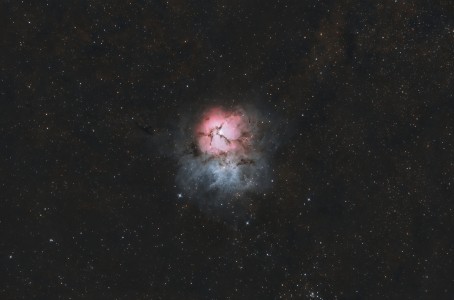
Image of the day

Captured by
Byron Davies

M-20 Trifid Nebula

My Account

New to Astromart?

Register an account...

Need Help?

Posts Made By: Ruslan Belikov

January 26, 2006 03:42 AM Forum: Beginning Astronomy?

best-at-(blank) telescope for $1,500?

Posted By Ruslan Belikov

Hi everyone,

I'm looking for a new telescope for $1,500 or less and I need help! Clearly, a good advice is to get an all-around telescope like an 8" cat. In fact, I was going to get the new celestron nexstar8i. However, after pondering the matter some more, I realized that eventually I would want something better and would have to retire the nexstar. Isn't there something I can get that I would never have to retire? Hmm, the implication is that I have to get a telescope that is best in the world at something, whatever that something is (not counting professional-grade telescopes, of course). Planetary views? Double-star splits? Wide-field vistas? Portability? Something. While an 8" cat is probably the ideal sweet spot of trade-offs, and is probably the ideal choice if you're only going to own a single telescope, I think what I would really like is to eventually have a collection of several best-at-something telescopes. So, is there such a telescope for less than $1,500 (new)? If not, what is the telescope that is the closest to being the best in the world at something, for less than $1,500? One further requirement -- goto or push-to is a must (mainly cause I like gadgets), and I don't care about telescopes that have the best-in-the-world go-to or push-to systems since I'll be using pocketSky anyway. And I'm not looking for a telescope that's best for solar or lunar observing.

Ok, clearly for DSOs, aperture is king (given a dark enough site) and things quickly go outside my budget. As for photography, you can easily spend 10K and still not be anywhere close to the best. How about wide field vistas? Well, I think really expensive eyepieces make a big difference there, and 2 of them for binocular views. Star-splits? I'm sure that in the near future, AO systems will become available to amateurs and those will be expensive as hell! What about planets? Hmm, the obvious answer is to get a 3-4" apo refractor. But, I think that a 5" apo is optimal in that respect, and that's out of my budget. (Any larger, and I think that to take advantage of the resolution afforded by the bigger aperture, the intermittent moments of exceptionally good seeing are a little too intermittent). But a 5-6" mak is within my budget, and I think it's pretty damn close to delivering the best amateur views of planets. What do people think? Also, it may be the best scope for portability. So looks like a 5-6" mak is what I want. Maybe a 7" if it has a good ergonomic case. Do people agree with this reasoning?

So, what about specific models? My requirement of go-to or push-to narrows down the list considerably. I'm mainly looking at the ETX125 w/UHTC vs. the Orion skyview pro 150 w/Intelliscope. That's a tough choice. Any suggestions? I'm leaning towards the Orion because of aperture, but the ETX has go-to instead of push-to, better coatings (or are they?), easier setup, and a hard carrying case. So, given the better coatings on the ETX, is the actual light throughput comparable to the Orion? Do people think a 6 inch aperture will give significant benefits in resolution, given the seeing? Is the extra resolution worth it? Is the orion mount better for photography than the ETX? Is having a hard case all that important, or is it overkill?

thanks

January 26, 2006 03:47 AM Forum: Equipment Talk

best-at-(blank) telescope for $1,500?

Posted By Ruslan Belikov

I posted this in the beginner forum, but then realized this forum may be a better choice since my question involves discussing advanced details of equipment. So here it is. Sorry for the redundancy.

Hi everyone,

I'm looking for a new telescope for $1,500 or less and I need help! Clearly, a good advice is to get an all-around telescope like an 8" cat. In fact, I was going to get the new celestron nexstar8i. However, after pondering the matter some more, I realized that eventually I would want something better and would have to retire the nexstar. Isn't there something I can get that I would never have to retire? Hmm, the implication is that I have to get a telescope that is best in the world at something, whatever that something is (not counting professional-grade telescopes, of course). Planetary views? Double-star splits? Wide-field vistas? Portability? Something. While an 8" cat is probably the ideal sweet spot of trade-offs, and is probably the ideal choice if you're only going to own a single telescope, I think what I would really like is to eventually have a collection of several best-at-something telescopes. So, is there such a telescope for less than $1,500 (new)? If not, what is the telescope that is the closest to being the best in the world at something, for less than $1,500? One further requirement -- goto or push-to is a must (mainly cause I like gadgets), and I don't care about telescopes that have the best-in-the-world go-to or push-to systems since I'll be using pocketSky anyway. And I'm not looking for a telescope that's best for solar or lunar observing.

Ok, clearly for DSOs, aperture is king (given a dark enough site) and things quickly go outside my budget. As for photography, you can easily spend 10K and still not be anywhere close to the best. How about wide field vistas? Well, I think really expensive eyepieces make a big difference there, and 2 of them for binocular views. Star-splits? I'm sure that in the near future, AO systems will become available to amateurs and those will be expensive as hell! What about planets? Hmm, the obvious answer is to get a 3-4" apo refractor. But, I think that a 5" apo is optimal in that respect, and that's out of my budget. (Any larger, and I think that to take advantage of the resolution afforded by the bigger aperture, the intermittent moments of exceptionally good seeing are a little too intermittent). But a 5-6" mak is within my budget, and I think it's pretty damn close to delivering the best amateur views of planets. What do people think? Also, it may be the best scope for portability. So looks like a 5-6" mak is what I want. Maybe a 7" if it has a good ergonomic case. Do people agree with this reasoning?

So, what about specific models? My requirement of go-to or push-to narrows down the list considerably. I'm mainly looking at the ETX125 w/UHTC vs. the Orion skyview pro 150 w/Intelliscope. That's a tough choice. Any suggestions? I'm leaning towards the Orion because of aperture, but the ETX has go-to instead of push-to, better coatings (or are they?), easier setup, and a hard carrying case. So, given the better coatings on the ETX, is the actual light throughput comparable to the Orion? Do people think a 6 inch aperture will give significant benefits in resolution, given the seeing? Is the extra resolution worth it? Is the orion mount better for photography than the ETX? Is having a hard case all that important, or is it overkill?

thanks

March 1, 2006 03:24 AM Forum: Equipment Talk

mid nineties LX200

Posted By Ruslan Belikov

I'm thinking of purchasing a mid-90s 10" lx200 from a friend and was wondering if someone could help me with a couple of questions:

1) How does this model compare to the new ones? (Optical and mechanical quality, mount stability and tracking accuracy)
2) What would be a reasonable price for the following, altogether:

Meade 10" LX200 - Older model from mid 90s Meade Piggy back camera mount Meade Counterweight JMI Crayford focuser Orion "Dew Zapper"
Meade dew shield
Meade heavy duty equatorial mount
Telrad
Meade tripod
Meade 26mm and 15mm eyepieces
Meade standard 1-1/4" diagonal
AC adaptor
Cigarette lighter cable

Thanks!

April 4, 2006 02:18 AM Forum: Meade

lx200R 8" vs 10": cooldown times and max TFOV

Posted By Ruslan Belikov

Can anyone please comment on

(1) The cooldown times of the LX200R 8" vs 10", when taking them out from an apartment at room temperature to outside, in winter and summer?

(2) The maximal TFOV possible with these instruments. I.e. what is the size of the opening in the backplate and focuser? 2" I hope?

thanks!

April 6, 2006 04:58 PM Forum: Equipment Talk

Meade wedge for 8" LX200: standard or ultra?

Posted By Ruslan Belikov

I'm trying to decide between 2 wedges for an 8" LX200R:

(1) Equatorial wedge for 7" & 8" LX-series for $150
(2) Ultrawedge for 7"-14" LX and 10-14"RCX for $500

Given an 8" LX200, is (2) worth it over (1), or is it overkill? Specifically, what FWHM of stars are achievable with (1) vs. (2)?

Come to think of it, what are people's experiences with field de-rotators vs. wedges on small scopes such as the 8"?

thanks!

April 7, 2006 05:41 AM Forum: Binoviewers

max TFOV with focal reduction on the big easy

Posted By Ruslan Belikov

The big easy manual ( http://www.denkmeier.com/pdf/Bigeasy.pdf ) on page 5 says that in the .66 focal reduction mode, on an 8" f/10 SCT, the TFOV can be as high as 1.3 degrees.

However, as far as I can tell, their focal reducer is a "1.25 optical nosepiece", meaning the field stop is a little less than 1.25, and the corresponding max TFOV is more like .8 degrees. Seems that using their focal reducer will just reduce magnification without increasing the FOV above .8 degrees.

So, how is it then that 1.3deg maxTFOV is possible in their setup? Have people actually observed 1.3deg FOV in the focal reduction mode on an 8" f/10 with the big easy?

April 17, 2006 09:23 PM Forum: CCD Imaging and Processing/Deep Sky

imaging with 8" vs. 10" LX200R

Posted By Ruslan Belikov

Has anybody imaged both with the 8 and 10" versions of the LX200? How do they compare in terms of tripod stability, sensitivity to wind, tracking/guiding accuracy and sensitivity to errors, cooldown times, temperature tracking, defocus due to tube expansion, etc? Seems like the 8" would have an edge on all these. (I figure the exposure times would be the same since both are f/10, so that's not a factor. The FOV would just be larger in the 8")

cheers

Rus

January 26, 2006 12:02 PM Forum: Beginning Astronomy?

best-at-(blank) telescope for $1,500?

Posted By Ruslan Belikov

Thanks for all the replies!

The consensus seems to be that aperture rules and that a large Dob or S-C is the way to go. I've been an avid amateur for over 5 years and been to tons of star parties and caught aperture fever as well. But, I'm also an optical engineer and recently started questioning some long-standing amateur beliefs (which is probably why I came off as a beginner to Jim, and why I started considering smaller instruments.) I would like to offer a few arguments against aperture fever, and I welcome comments.

1) Aperture gathers more light and lets you see dimmer objects, sure. However, no matter how large your aperture is, you cannot see an object whose surface brightness is less than skyglow. As you increase the aperture, at some point all that you're doing is making the background brighter. Where is this threshold, say, for suburban skies? I (for example) can only rarely make out the core in M33, so skyglow is roughly the surface brightness of M33 in my skies. The view does not get any better after 8" or so. I would even say that with fully dark-adapted eyes, a 6" gives a more pleasing darker background level.

2) Aperture gives you better resolution, yes. But, to take advantage of that higher resolution, one has to wait longer and longer for moments of better and better seeing (or use registax to do that!). Eventually the wait becomes too long. Where is the threshold? Well, it is a rare night indeed that a half-arcsecond double can be split, I think. A half an arcsecond is the theoretical resolution of an 8", so it would seem that's the resolution threshold (again, not counting image stacking in photography or sites with great seeing.)

3) Aperture limits the maximal field of view (visual, not photographic), independently of focal length or magnification. See Sky+Tel Oct. 2004, p. 127. The relationship is roughly FOV_max(degrees) = 12 / Aperture(inches). Higher FOVs are possible, but at the expense of light not making it into your eyeball, effectively reducing aperture. Thus, if you are a visual observer who likes to take in 2 degree swaths of the sky, then there would not be an improvement for anything above a 6" (admittedly 2 degrees is huuuuge.)

4) I'm an apartment dweller, fly a great deal, and nowhere near being permanently settled yet. Portability means more to me than to most other amateurs.

And, the 5th argument is what I was initially presenting in my first post:

5) I would probably like to get a serious telescope eventually, like a good big R-C. So, for right now, I would like an instrument that I would not have to retire once I get that monster. And I don't see myslef using the 8" S-C or a 12" dob if I have the R-C. I do see myslef using a portable instrument like the etx125 or the orion150 though. Seems to me that those are not far from being the best portable scopes. Right? Or, if there is another scope that's better at something than a top-of-the-line R-C, I'd like to consider those as well. I imagine a good apo is better at planets, but that's outside my budget for the moment.

So, am I making sense, or am I just not getting something?

February 1, 2006 02:30 AM Forum: Beginning Astronomy?

Naked eye rings?

Posted By Ruslan Belikov

That's a very interesting question, Bob! Can't help but do a few estimates...

The diffraction limit of a fully dilated pupil (assuming D=7mm and lambda = 500nm) is lambda/D = 15 arcseconds, while the size of Saturn is 46 arcsecsonds. In other words, an ideal camera with a 7mm aperture will be able to see saturn as decidedly non-circular, perhaps even with a hint of a gap between the orb and the rings.

But a human eye is far, far from ideal. First, the rods and cones of the human eye are not sampled tightly enough. According to google, the average focal length of the human eye is about f=17mm, so the size of a diffraction-limited spot on the human retina is f*lambda/D = 1.2 microns. In the fovea, the peak rod density is about 150,000/mm^2 (thank god for google!), so that the minimum "pixel size" on the retina is about 2.6 microns. However, the retina is a color mosaic, so the brain must somehow bins triplets of different-color cones into a single color image "pixel", so that the real pixel size of an ideal eye is probably, oh, twice that size, or 5 microns. The size of Saturn on the retina, however, will be 46arcseconds*17mm = 3.8 microns. Right on the borderline, but not quite good enough.

And, all this assumes a diffraction-limited eye lens, which it most definately is not. If it was, stars would appear as geometrical points, or perhaps tiny disks if they saturate the cones on the retina. Maybe among the 90 billion humans that have walked the earth, there were a few freaks with abnormally large iris diameters, focal lengths, cone density, AND perfect lenses who could resolve Saturn. However, I don't think your eyes are freakishly large and perfect, Bob. No offense.

By the way, Bob, I assume you are myopic, which (I think) should make images on your retina even smaller, depending on how far your glasses are from your eyes. So, myopic people are at a (very slight) disadvantage of being able to resolve saturn (unless they are wearing contacts). The opposite is true for hyperopic people though. If you can focus on the sky with your reading glasses, the image on your retina should be (ever so slightly) magnified, perhaps just enough to resolve saturn! Unless I made a sign error smile