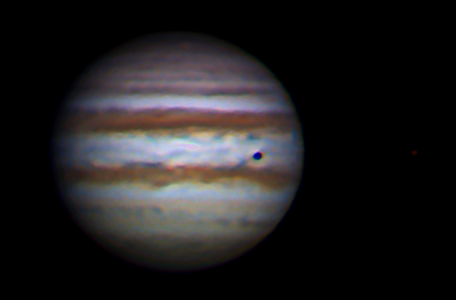
Image of the day

Captured by
John Roach

Jupiter IO Transit 12-10-26

My Account

New to Astromart?

Register an account...

Need Help?

Posts Made By: David Tandy

June 23, 2010 09:15 PM Forum: Equipment Talk

Collimation tool for Netwonian

Posted By David Tandy

Greetings,

I think I already know the answer to my question but I wanted to check here before I spend the $$ only to find out I'm wrong (wouldn't be the first time :S ).

I have built a Newtonian astrograph and the primary is a conical form that mounts to the mirror cell using a post that passes through the 3" diameter core at the center of the mirror. So, there is no optical surface at the center of the primary mirror at which to place a donut or triangle collimation aiming point. See the attached image for a CAD rendering of the scope.

Since the scope is F3.6 collimation is critical and I'd like to use a laser tool. I think the Glatter holographic collimator will work well in this situation but I thought I'd ask for some opinions in this forum.

There is the head of a 1/4-20 screw that is located dead center of the mirror post that I can use as an aiming point for a single beam laser to collimate the secondary. But, since the beam isn't reflected it doesn't help with collimating the primary. My question is this.. Can I use the image of the holographic projection from the Glatter tool that is reflected back on to the face of the laser collimator to collimate the primary? I think this should work but not having seen a holographic collimator in action I'm not positive.

Suggestions....

Thanks,

Dave

June 24, 2010 07:37 PM Forum: Equipment Talk

Re: Custom metal fabricator recommendation needed

Posted By David Tandy

Try Jon Savelle. He advertises on Astromart. I've had probably a dozen parts made in the size range you mentioned and he has done a nice job. I have found his rates very reasonable compared to my local machine shops and he typically turns around the part quickly. He doesn't anodize parts, though.

You can anodize the part yourself for what it will cost you at a local anodizer. I have a small setup in my garage that turns out parts just as black and consistent as professional jobs.

Dave


July 6, 2010 10:44 PM Forum: Telescope Making

Latest project: 18" f3.6 astrograph

Posted By David Tandy

After 9 months I have almost completed an 18" F3.6 astrograph project. I am waiting for a FLI Atlas focuser and it is supposed to be delivered any day now.

This has been a major undertaking but it has been a lot of fun. I've built several scopes over the years but nothing this ambitious.

The tube is a carbon fiber composite sandwich tube that uses a 3/4" Nomex honeycomb core. Instead of going with tube rings I built the tube such that the dovetail mounts directly to the tube using eight 1/4-20 screws. I prototyped the tube and mounting points and the carbon fiber never fails to impress me with its strength and rigidity. I also made the mirror backplate and collimation cell from carbon fiber composites.

Collimation is accomplished through three 1/2-20 coaxial screws (primary mirror) and three pairs of push pull screws for the secondary mirror.

The Zerodur primary mirror was made by Normand Fullum and has great numbers. It is 17.75" in diameter and has a conical form. I mounted the mirror to the collimation cell using a 3" diameter (0.5" wall) 6061 post with a lock ring that prevents the primary mirror from falling out of the ota. The 6" secondary is quartz and was made by Terry Ostahowski. The secondary mirror has an enhanced aluminum coating while the primary mirror has a "Max R" 98% coating from Spectrum.

Focusing duty will be performed by a FLI Atlas focuser (when it finally arrives).

To help cool the optics I installed three 80mm CPU fans using rubber washers to minimze vibration. I also installed a small pot that is used to adjust the speed of the fans.

The entire inside of the tube has been covered with flocking paper to help capture any stray photons.

For the finish, I applied a quality, gloss black automotive urethane paint to the tube and setup a small anodizing station to anodize all of the aluminum parts with a nice, black finish.

The entire OTA with the 3" Wynne corrector, focuser and a STL type CCD camera weighs about 85 lbs.

I'm very anxious to have first light with the scope. I have been able to view some trees across the street so I at least know the scope focuses. smile

I much prefer building scopes to using them so I'll most likely sell this one within the next few months and start on the next (optics on the way for a 16" F3.5 Newtonian astrograph).

I'll post a few more images.

Regards,

Dave


June 24, 2010 07:33 PM Forum: Equipment Talk

Collimation tool for Netwonian

Posted By David Tandy

Thanks for the input. I think I am going to try a barlowed laser and collimate the primary using the "hole" in the reflected image caused by the central post of the mirror.

July 6, 2010 10:45 PM Forum: Telescope Making

July 6, 2010 10:45 PM Forum: Telescope Making

July 6, 2010 10:46 PM Forum: Telescope Making

July 6, 2010 10:48 PM Forum: Telescope Making

Latest project: 18" f3.6 astrograph

Posted By David Tandy

Zerodur primary mirror on unfinished cell

September 21, 2010 05:19 PM Forum: Telescope Making

Minimum mirror thickness for "traditional" mirror

Posted By David Tandy

Steve,

You may already know this but you can Google "mirror plop" and download a simple application that is designed to help one design mirror cells. It will give you some insight into how much your 12.5" mirror will deflect using your "traditional" mirror cell.

Dave

Steve House said:

Hi all,
I have a 12.5" mirror that is 1.3" thick, or about 32.75mm. I was hoping to mount this in an older "tradional" mirror cell in an OTA that can be rotated any direction. Is this mirror too thin for a traditional cell (i.e., without nine point suspension and a sling)?

Thanks for the help.
Steve House

March 22, 2021 10:15 PM Forum: CCD Imaging and Processing/Deep Sky

Free image data from AG Optical Systems observatory

Posted By David Tandy

The AG Optical Systems observatory is up and running in northern Alabama.  We have uploaded to DropBox some initial data acquired over the past month for NGC 3628 The Hamburger Galaxy, M65, and Markarian's Chain that is available to anyone for free.  The data is raw (no processing at all) and includes bias, dark, flat, and light frames.  As we are still tweaking the 14.5" iDK imaging train a bit, the flat data relevant to a specific object is included in the object folder.  Please contact AG Optical Systems if you would like access to the data.  We'll need your email address so we can send you an invitation to the DropBox folder.  And don't worry, we're not going to send you any unsolicited email.  We hate that stuff as much as you do.

Please feel free to post your images anywhere you like but we ask that you credit AG Optical Systems.  Also, please send your processed images to AG Optical Systems so we can share them on our Facebook page.

While the data is free, you are on your own when it comes to processing the data so please do not contact AG Optical Systems with image processing questions.

As the AG Optical Systems observatory acquires more data we'll upload it to DropBox and announce it on our Facebook page.  The data will always be free with no catches.  AG Optical Systems values the amateur astronomy community and this is a way for us to show our appreciation.

The observatory currently houses two premium imaging systems.

   AG Optical Systems 14.5" F6.7 quartz astrograph

  • Software Bisque Paramount MEII equatorial mount on 10" Paramount pier
  • ZWO ASI6200 full frame camera with EFW LRGBHa filters (we're tweaking the filter setup to minimize vignetting)
  • Borg 50mm piggyback guidescope with ASI120 guide camera
  • Ultimate Power Box V2
  • The SkyX
  • TPoint pointing model
  • PHD2 guiding software
  • Optec TCF3 FocusLynx focuser

    Stellarvue SVX102T with flattener/reducer (535mm focal length), 3" Feathertouch with Optec focus control
  • Software Bisque Paramount MX+ equatorial mount on 8" Paramount pier
  • ZWO ASI6200 full frame camera with EFW LRGBHa filters
  • Williams Optics 50mm piggyback guidescope with ASI120 guide camera
  • Ultimate Power Box V2
  • The SkyX
  • TPoint pointing model
  • PHD2 guiding software

All of the data has been acquired using Voyager Astrophotography Automation Software.

The reducer on the Stellarvue SVX102T shows some star distortion towards the edges of full frame images so you will likely need to crop that data.  We have a flattener on order that should provide full frame correction and we'll get it installed when it arrives.

The observatory is a 24' x 10' roll off roof design with roof automation provided by the SkyRoof system from Interactive Astronomy.  Weather data is collected by the SkyAlert system from Interactive Astronomy.  We have some images and videos of the observatory on our Facebook page.

We have several other scopes that we plan to rotate through the observatory including an AG Optical Systems 12.5" F3.9 Harmer Wynne, an 8" F15 Mak with TEC optics, an 8" F20 Mak binoscope with TEC optics, a 280mm F12 SCT with Lichtenknecker optics, a 10" F15 Dall Kirkham with Ostahowski optics, and our lineup of 10" to 20" iDK F6.7 premium astrographs.

If you are in the area feel free to contact AG Optical Systems if you'd like to see the observatory.

Attached is the first light image from the observatory.  It consists of about 20 hours of LRGB data of NGC 3628 The Hamburger Galaxy collected using the AG Optical 14.5" system.  The data was processed by Patrick Sparkman ..... he did a great job!

Enjoy!

Dave Tandy
AG Optical Systems
