Cosmic Scale
- Date Posted: July 20, 2006
- Resolutions: 461x576 , 461x576 , 461x576
- Date:
- Time:
- Number of frames:
- FPS:
- Focal length:
- CMI/CMII/CMIII:
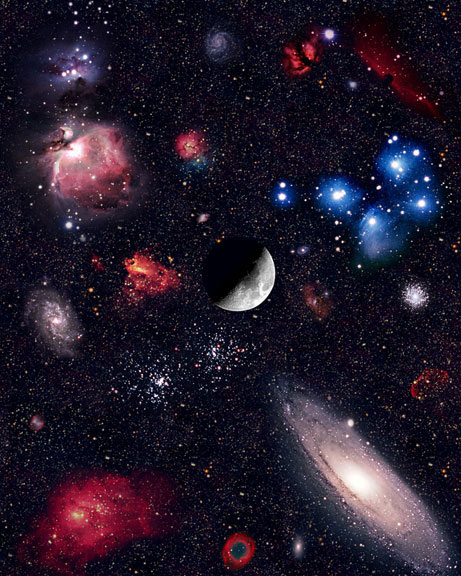
This collage was assembled from a collection of Deep Sky Objects that I photographed over 3 months. I then created a collage in which all objects are displayed at the exact same scale to each other as seen from Earth. This gives you a clear picture of how small and how large some objects are in the sky. I tossed in the Moon as a comparison. Yes - the Andromeda galaxy is really that big - and the Ring Nebula is that small (if you even find it)! The collage includes (left to right - top to bottom): M42/43 (Orion nebula) M101 (Galaxy in Ursa Major) NGC 2024 (Flame Nebula) Barnard 33 (Horsehead Nebula) M20 (Trifed Nebula) M45 (Pleiades Star Cluster) M33 (Galaxy in Triangulum) M17 (Omega/Swan Nebula) M1 (Crab Nebula) Luna M57 (Ring Nebula) M51 (Whirlpool Galaxy) NGC 7635 (Bubble Nebula) NGC 6207 (Galaxy in Hercules) M13 (Globular Cluster in Hercules) NGC 884 & NGC 869 (Double Cluster) NGC 6888 (Crescent Nebula) M27 (Dumbell Nebula) M8 (Lagoon Nebula) NGC 7293 (Helix Nebula) M31 (Andromeda Galaxy) M32 (Galaxy near Andromeda) These are all film exposures using Kodak Elite Chrome 200 and Fujichrome 400F Provia. The scope was a Meade LXD75 8 Schmidt Newtonian. I captured the images with an old Olympus OM-1 film camera and exposures ran from 20 minutes (M51) to 45 minutes (M31) - except the moon, which was much less! Peter kennett www.PetesAstrophotography.com
- User details
-
- Peter Kennett
- January 19, 2022
- Followers 0
