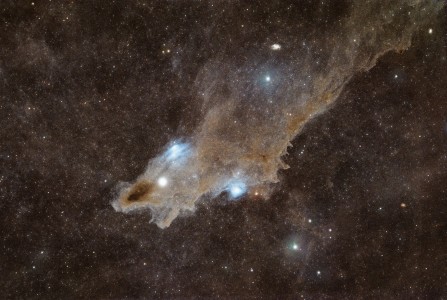

M-16 The Eagle Nebula
- Date Posted: October 5, 2012
- Resolutions: 800x450 , 800x450 , 800x450
- Date:
- Time:
- Number of frames:
- FPS:
- Focal length:
- CMI/CMII/CMIII:
Eagle Nebula - aka Messier 16 and IC 4703 - from Top of Mississippi Skies (T.O.M.S.) Observatory (lat 34.998°N, lon 88.276°W.) Captured Oct 3, 2012. TMB-130 F/7 Refractor, CGEM, AutoGuiding with Lodestar via PHD. SBIG ST-8300C, Astronomik CLS Filter, 9 of 23 subs @ 5 min (1 hr 55 min)min). Acquired with IP-CC v5. Calibrated, stacked and processed with Dark, Flat, and Bias Frames in IP v5.0, PhotoShop CS3, and Carboni Tools. From Wikipedia: The Eagle Nebula (catalogued as Messier 16 or M16, and as NGC 6611) is a young open cluster of stars in the constellation Serpens, discovered by Jean-Philippe de Cheseaux in 1745-46. Its name derives from its shape that is thought to resemble an eagle. It is the subject of the famous "Pillars of Creation" photograph by the Hubble Space Telescope that shows pillars of star-forming gas and dust within the nebula. Characteristics This region of active current star formation is about 6,500 light-years distant. The tower of gas that can be seen coming off the nebula is approximately 9.5 light-years or about 90 trillion kilometers high. The brightest star in the nebula (HD 168076) has an apparent magnitude of +8.24, easily visible with good binoculars. The cluster associated with the nebula has approximately 460 stars.
- User details
-

- Thomas Walker
- November 27, 2015
- Followers 0