
6-ton Satellite to Re-Enter Atmosphere and Crash into Earth Next Week
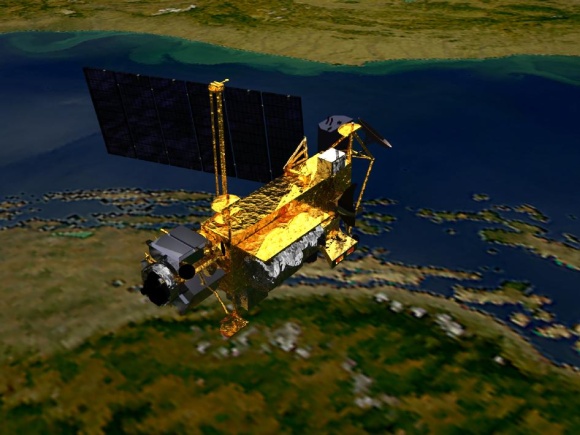
NASA's Upper Atmosphere Research Satellite (UARS) is expected to re-enter Earth's atmosphere on Sept. 23, 2011 (plus or minus a day), almost six years after the end of a productive scientific life. Although the spacecraft will break into pieces during re-entry, not all of it will burn up in the atmosphere.
The risk to public safety or property is extremely small, and safety is NASA's top priority. Since the beginning of the Space Age in the late-1950s, there have been no confirmed reports of an injury resulting from re-entering space objects. Nor is there a record of significant property damage resulting from a satellite re-entry.
It is too early to say what geographic area may be affected, but NASA is watching the satellite closely and will keep us informed.
"Things have been re-entering ever since the dawn of the space age; to date nobody has been injured by anything that's re-entered," Gene Stansbery of NASA.
"We simply will not know where it's going to come down until it comes down," Air Force Maj. Michael Duncan of the U.S. Strategic Command.
NASA will post updates daily until about 24 hours before re-entry, and then at about 12 hours, six hours and two hours before re-entry. The updates will come from the Joint Space Operations Center of U.S. Strategic Command at Vandenberg Air Force Base, Calif., which works around the clock detecting, identifying and tracking all man-made objects in Earth orbit, including space junk.
As of Sept. 16, 2011, the orbit of UARS was 140 mi by 155 mi (225 km by 250 km). Any surviving components of UARS will land within a zone between 57 degrees north latitude and 57 degrees south latitude (which incidentally covers nearly all of the inhabited land areas). It is impossible to pinpoint just where in that zone the debris will land, but NASA estimates the debris footprint will be about 500 miles long.
NASA advises that if you find something you think may be a piece of UARS, do not touch it. Contact a local law enforcement official for assistance.
Note: The US Navy shot down a malfunctioning US satellite on February 20, 2008 because of the likelihood that the satellite could release hydrazine, a toxic chemical used as a maneuvering fuel, if it re-entered the atmosphere and crashed in a populated area (see AstroMart News Item below for more details).
For more information:
http://www.nasa.gov/mission_pages/uars/index.html
http://abcnews.go.com/Technology/space-satellite-uars-adrift-heading-earth/story?id=14534076
http://www.cbsnews.com/stories/2011/09/16/scitech/main20107576.shtml
http://www.astromart.com/news/news.asp?news_id=904
http://www.astromart.com/news/news.asp?news_id=799
AstroMart News Archive:
http://www.astromart.com/news/search.asp?search=.+
Funding Member
