Adaptive Optics Pinpoints Two SuperMassive Black Holes in Colliding Galaxies
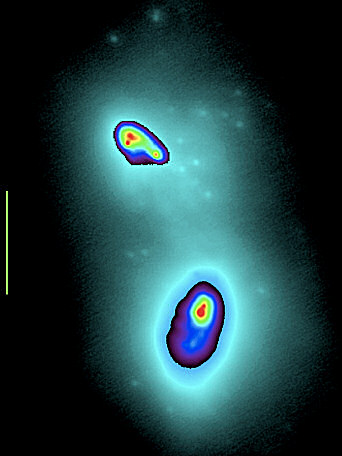
Astronomers have used powerful adaptive optics technology at the W. M. Keck Observatory in Hawaii to reveal the precise locations and environments of a pair of SuperMassive black holes at the center of NGC 6240, an ongoing collision between two galaxies 300 million light-years away.
Comments:
Jim:<br><br>The Adaptive Optics improves the view from Earth, but I don't think the article is saying that it makes the view better than what can be obtained from Hubble.<br><br>It is really a question of looking at NGC 6240 in visible light from the Hubble Space Telescope, by X-Ray through the Chandra X-ray Observatory, and through InfraRed using Adaptive Optics and the 10-meter Keck II Telescope.<br><br>Then, by matching up the data from one instrument with data obtained at different wavelengths by other instruments, the astronomers were able to pinpoint the features in NGC 6240 that are the black holes.<br><br>The resolution from a telescope on Earth with Adaptive Optics was really that good that they could utilize it with the views obtained from Hubble and Chandra.<br><br>Guy<br><br>------------------------------------------------<br><br>Jim Babcock said:<br><br>This implies that the adaptive optics at Keck are better than the optics on Hubble. Am I understanding this correctly? Or is more related to the wavelengths that each can see?<br><br>If adaptive optics have improved to the point that they are as good or better than the Hubble, then why do we need the Hubble (except on cloudy nights).
Funding Member
