Amateurs team with Hubble to produce extraordinary image
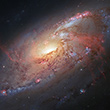
Working with astronomical image processors at the Space Telescope Science
Institute in Baltimore, Md., renowned astrophotographer Robert Gendler has
taken science data from the Hubble Space Telescope (HST) archive and
combined it with his own ground-based observations to assemble a photo
illustration of the magnificent spiral galaxy M106.
Gendler retrieved archival Hubble images of M106 to assemble a mosaic of the
center of the galaxy. He then used his own and fellow astrophotographer Jay
GaBany’s observations of M106 to combine with the Hubble data in areas where
there was less coverage, and finally, to fill in the holes and gaps where no
Hubble data existed.
The center of the galaxy is composed almost entirely of HST data taken by
the Advanced Camera for Surveys, Wide Field Camera 3, and Wide Field
Planetary Camera 2 detectors. The outer spiral arms are predominantly HST
data colorized with ground-based data taken by Gendler’s and GaBany’s
12.5-inch and 20-inch telescopes, located at very dark remote sites in New
Mexico. The image also reveals the optical component of the “anomalous arms”
of M106, seen here as red, glowing hydrogen emission.
Robert Gendler is a physician by profession but has been active in
astrophotography for two decades. Robert started taking astro-images from
his driveway in suburban Connecticut. He then spent several years imaging
remotely from places like New Mexico and Western Australia. More recently,
Robert has been spending his time assembling hybrid images from multiple
data sources including the Hubble Legacy Archive. Many of these images have
been featured on “Astronomy Picture of the Day”
(http://apod.nasa.gov/apod/astropix.html) and in various books and
magazines.
This portrait of M106 contains only the inner structure around the halo and
nucleus of this Seyfert 2 active galaxy. Large amounts of gas from the
galaxy are thought to be falling into and fueling a supermassive black hole
contained in the nucleus. Also known as NGC 4258, M106 lies 23.5 million
light-years away, in the constellation Canes Venatici.
Click here for more about this subject. -Ed.
Funding Member
