
An Exploding Star Detected in an "Exploding" Galaxy
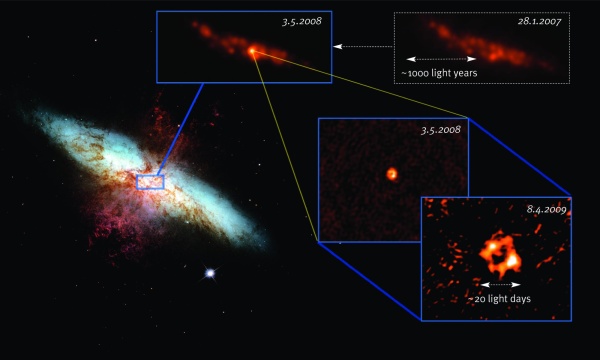
An international team of radio astronomers at the Max Planck Institut fur Radioastronomie (MPIfR) in Germany has discovered the secret explosion of a massive star, a new supernova, in the nearby galaxy M82. Despite being the closest supernovae discovered in the last five years, the explosion is detectable only at radio wavelengths and invisible from Earth in normal light due to the dense gas and dust surrounding the exploding star. Without the obscuration, this supernova would have been visible even with amateur telescopes.
Comments:
"By extrapolating this expansion back in time, we can estimate the explosion date. Our current data indicate that the star exploded in late January or early February 2008.", explains Dr. Andreas Brunthaler.<br><br>Minus 12 million years or so! 8O
<blockquote class="blockquote"><div class="italic"><i>Michael Gibbons said:</i><br><br>"By extrapolating this expansion back in time, we can estimate the explosion date. Our current data indicate that the star exploded in late January or early February 2008.", explains Dr. Andreas Brunthaler.<br><br>Minus 12 million years or so! 8O </div></blockquote><br>Is the implication that the "explosive" image of M82 with which we have all become familiar is actually a cascading series of Novas or Black hole feeding frenzies? Assuming that the "red blast" we all see in M82 is a long history of explosive events related to the nature of the galaxy's core, it would seem indicative of an previously unknown dynamic that occurs over thousands of years and overflowing with vast amounts of ejecta.
Funding Member
