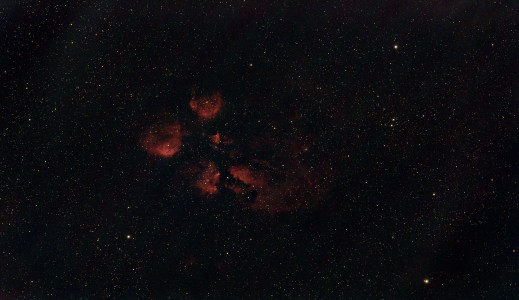
Asteroid the Size of the Tunguska Impactor of 1908 Just Missed the Earth Yesterday

A Near Earth Object designated 2009 DD45 buzzed the Earth early this morning, passing within 38,000 miles of the Earth's surface. To give an idea of just how close a shave this was, consider this: 38,000 miles is just one fifth of the distance from the Earth to the moon, and only twice the distance at which geostationary telecommunications satellites orbit.
The space rock was discovered only two days earlier by Rob McNaught at Siding Spring Observatory in Australia, when it was a dim speck about 1.5 million kilometers away. It became brightest when it passed closest to Earth at 13:44 Universal Time, which is 8:44am Eastern US Time, and has been getting dimmer ever since. At the point of closest approach 2009 DD45 was over the Pacific Ocean near Tahiti, which means it could be observed from Australia, Japan, and China, but not from North America or Europe.
According to NASA's NEO program 2009 DD45 is a sizable rock, between 21 and 47 meters in diameter. This is comparable to the size of the Tunguska impactor of 1908. Since the object is in a solar orbit that touches on Earth's orbit, astronomers predict that that 2009 will visit us again in future years.
"If discovered in advance and with enough lead time, there is the possibility of pushing it off course, if you have decades of advance warning," McNaught said. "If you have only a few days, you can evacuate the area of impact, but there's not a great deal [else] you can do."
The 2009 DD45 asteroid circles the sun every 18 months, but its path will not threaten this planet at least for the next century, he said.
For more information:
http://planetary.org/news/2009/0302_Space_Rock_Swoops_by_Earth.html
http://www.astromart.com/news/news.asp?news_id=847
http://www.astromart.com/news/news.asp?news_id=791
http://www.astromart.com/news/news.asp?news_id=401
AstroMart News Archive:
http://www.astromart.com/news/search.asp?search=.+&search_btn=Go
The space rock was discovered only two days earlier by Rob McNaught at Siding Spring Observatory in Australia, when it was a dim speck about 1.5 million kilometers away. It became brightest when it passed closest to Earth at 13:44 Universal Time, which is 8:44am Eastern US Time, and has been getting dimmer ever since. At the point of closest approach 2009 DD45 was over the Pacific Ocean near Tahiti, which means it could be observed from Australia, Japan, and China, but not from North America or Europe.
According to NASA's NEO program 2009 DD45 is a sizable rock, between 21 and 47 meters in diameter. This is comparable to the size of the Tunguska impactor of 1908. Since the object is in a solar orbit that touches on Earth's orbit, astronomers predict that that 2009 will visit us again in future years.
"If discovered in advance and with enough lead time, there is the possibility of pushing it off course, if you have decades of advance warning," McNaught said. "If you have only a few days, you can evacuate the area of impact, but there's not a great deal [else] you can do."
The 2009 DD45 asteroid circles the sun every 18 months, but its path will not threaten this planet at least for the next century, he said.
For more information:
http://planetary.org/news/2009/0302_Space_Rock_Swoops_by_Earth.html
http://www.astromart.com/news/news.asp?news_id=847
http://www.astromart.com/news/news.asp?news_id=791
http://www.astromart.com/news/news.asp?news_id=401
AstroMart News Archive:
http://www.astromart.com/news/search.asp?search=.+&search_btn=Go