Astronomers Finds 100 New Star Clusters in the Galactic Plane
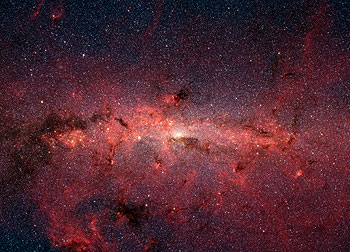
Boston University astronomers recently discovered nearly 100 new star clusters in the Milky Way, with each star cluster containing tens to hundreds of never before seen stars. Using the dust-piercing infrared eyes of NASA’s Spitzer Space Telescope, Emily Mercer, a BU doctoral student and the discovery team’s lead investigator, developed a computer method which used an algorithm to automatically sift through GLIMPSE (Galactic Legacy Infrared Mid-Plane Survey Extraordinaire) data and identify high star density areas to look for clusters. She believes the new clusters will tell astronomers a great deal about the structure of the Milky Way and star formation within the galaxy.
“These little guys were quite hard to find,” said Mercer. “The discovery required sophisticated computer sifting of GLIMPSE data and careful inspection of the Spitzer images.”
Because the Sun and the Solar System sit inside the Milky Way’s flat disk, most of the galaxy is seen from Earth to be concentrated in a blurry band of light that stretches across the sky, known to astronomers as the galactic plane. Many of the stars in the plane cannot be seen with visible-light or ultraviolet telescopes because the clouds of dust and gas that fill the galactic spiral arms block their starlight from view.
“Emily has done a great job,” said Astronomy Professor Dan Clemens, her BU advisor. “Her computer method for finding clusters has proved to be the most successful automated effort to date. The infrared light we’ve used is able to see through the dust better than optical light. It’s the difference between trying to see through fog and looking out on a clear day. But Emily’s computer program improved on that by telling us where in this huge data base to look for new clusters.”
By turning Spitzer’s heat-seeking infrared eyes on the Milky Way’s plane, the cold clouds of galactic gas and dust became transparent, revealing almost 100 new star clusters. Two-thirds of the new clusters were discovered through the computer method Mercer developed and the rest were found using the traditional method of visually scrutinizing GLIMPSE images for star clusters.
In addition to uncovering hundreds of hidden stars, Mercer also found that there are nearly twice as many star clusters in the portion of the galactic plane only visible from Earth's southern hemisphere, than in the northern galactic plane. She suspects that this observation may reveal to astronomers the location and nature of the Milky Way's spiral arms, the long, bright lanes of hot, massive stars seen in other galaxies, but hidden from our view by the dust in our own.
The multi-institutional GLIMPSE team is led by Professor Edward Churchwell of the University of Wisconsin-Madison, and includes Clemens, Mercer, and other researchers in the Boston University Institute for Astrophysical Research as well as researchers at other institutions. Thus far, more than 30 million stars in the inner Milky Way have been catalogued by GLIMPSE, and the team expects to identify more than 50 million stars by the end of the project.
“By making the galactic plane transparent, Spitzer opens a new door for astronomers to study the Milky Way,” said Churchwell. “Some of the most interesting science likely to come out of this project will be serendipitous discoveries, which opens up entirely new avenues of inquiry.”
For More Information:
http://www.bu.edu/phpbin/news/releases/display.php?id=1046
http://www.jpl.nasa.gov/news/features.cfm?feature=995
Funding Member
