At Least One in Six Stars Has an Earth-sized Planet
The quest for a twin Earth is heating up. Using NASA's Kepler spacecraft, astronomers are beginning to find Earth-sized planets orbiting distant stars. A new analysis of Kepler data shows that about 17 percent of stars have an Earth-sized planet in an orbit closer than Mercury. Since the Milky Way has about 100 billion stars, there are at least 17 billion Earth-sized worlds out there.
Kepler detects planetary candidates using the transit method, watching for a planet to cross its star and create a mini-eclipse that dims the star slightly. The first 16 months of the survey identified about 2,400 candidates. Astronomers then asked, how many of those signals are real, and how many planets did Kepler miss?
By simulating the Kepler survey, Francois Fressin, of the Harvard-Smithsonian Center for Astrophysics (CfA), and his colleagues were able to correct both the impurity and the incompleteness of this list of candidates to recover the true occurrence of planets orbiting other stars, down to the size of Earth.
"There is a list of astrophysical configurations that can mimic planet signals, but altogether, they can only account for one-tenth of the huge number of Kepler candidates. All the other signals are bona-fide planets," says Fressin.
Altogether, the researchers found that 50 percent of stars have a planet of Earth-size or larger in a close orbit. By adding larger planets, which have been detected in wider orbits up to the orbital distance of the Earth, this number reaches 70 percent.
Extrapolating from Kepler's currently ongoing observations and results from other detection techniques, it looks like practically all Sun-like stars have planets.
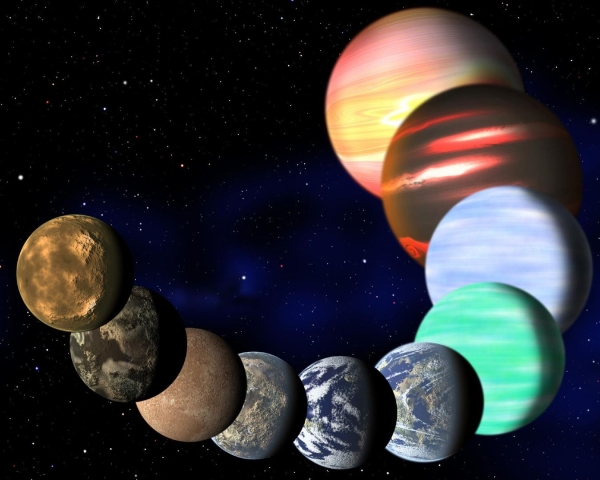
The team then grouped planets into five different sizes. They found that 17 percent of stars have a planet 0.8 - 1.25 times the size of Earth in an orbit of 85 days or less. About one-fourth of stars have a super-Earth (1.25 - 2 times the size of Earth) in an orbit of 150 days or less. (Larger planets can be detected at greater distances more easily.) The same fraction of stars has a mini-Neptune (2 - 4 times Earth) in orbits up to 250 days long.
Larger planets are much less common. Only about 3 percent of stars have a large Neptune (4 - 6 times Earth), and only 5 percent of stars have a gas giant (6 - 22 times Earth) in an orbit of 400 days or less.
The researchers also asked whether certain sizes of planets are more or less common around certain types of stars. They found that for every planet size except gas giants, the type of star doesn't matter. Neptunes are found just as frequently around red dwarfs as they are around sun-like stars. The same is true for smaller worlds. This contradicts previous findings.
"Earths and super-Earths aren't picky. We're finding them in all kinds of neighborhoods," says co-author Guillermo Torres of the CfA.
Planets closer to their stars are easier to find because they transit more frequently. As more data are gathered, planets in larger orbits will come to light. In particular, Kepler's extended mission should allow it to spot Earth-sized planets at greater distances, including Earth-like orbits in the habitable zone.
University of Califonia - Berkeley graduate student Erik Petigura, former UC - Berkeley post-doctoral fellow Andrew Howard (now on the faculty of the Institute for Astronomy at the University of Hawaii), and UC - Berkeley professor of astronomy Geoff Marcy reported that the fraction of stars having planets the size of Earth or slightly bigger orbiting within Earth-like orbits may amount to 50 percent.
"Our key result is that the frequency of planets increases as you go to smaller sizes, but it doesn't increase all the way to Earth-size planets – it stays at a constant level below twice the diameter of Earth," Howard said.
Planets one to two times the size of Earth are not necessarily habitable. Painstaking observations by Petigura's team show that planets two or three times the diameter of Earth are typically like Uranus and Neptune, which have a rocky core surrounded by helium and hydrogen gases and perhaps water. Planets close to the star may even be water worlds – planets with oceans hundreds of miles deep above a rocky core.
Nevertheless, planets between one and two times the diameter of Earth may well be rocky and, if located within the Goldilocks zone – not too hot, not too cold, just right for liquid water – could support life.
"Kepler's one goal is to answer a question that people have been asking since the days of Aristotle: What fraction of stars like the sun have an Earth-like planet?" Howard said. "We're not there yet, but Kepler has found enough planets that we can make statistical estimates."
The estimates are based on a better understanding of the percentage of big Earth-size planets that Kepler misses because of uncertainties in detection, which the team estimates to be about one in four, or 25 percent.
Searching for Earth-size planets in Earth-like orbits
To find planets, the Kepler telescope captured repeated images of 150,000 stars in a region of the sky in the constellation Cygnus. The data were then analyzed by computer software – the "Pipeline" - in search of stars that dim briefly as a result of a planet passing in front, called a transit. For planets as large as Jupiter, the star may dim by 1 percent, or one part in 100, which is easily detectable. A planet as small as Earth, however, dims the star by one part in 10,000, which is likely to be lost in the noise, Petigura said.
Petigura spent the past two years writing a software program called TERRA, for Transiting Exo-Earth Robust Reduction Algorithm, which is very similar to Kepler's "Pipeline." The UC Berkeley/Hawaii team then fed TERRA simulated planets to test how efficiently the software detects Earth-size planets.
"It may seem crazy to spend two years re-doing what the Kepler team has already done, but the question we are asking – How many Earth-size planets are we missing? – is so important that we wanted to do it separately for cross-validation," he said.
"Erik is really brilliant," said Marcy, who was Petigura's research mentor when he was still a UC Berkeley undergraduate student. "He has single handedly written data analysis software from scratch, drawing upon the NASA Kepler team's expertise with its Pipeline. The more people working on this, the more independent analyses, the better."
After carefully measuring the fraction of planets missed by TERRA, the team corrected for this and conducted a thorough analysis of 12 of the 13 quarters of Kepler observations freely available on the Internet. They identified 129 Earth-like planets ranging in size from nearly six times the diameter of Earth to the diameter of Mars. Thirty-seven of these planets were not identified in previous Kepler reports.
The analysis confirmed that the frequency of planets increases as the size decreases, which Howard and the Kepler team reported last year. Perhaps one percent of stars have planets the size of Jupiter, while ten percent have planets the size of Neptune. Marcy compared this to rocks on a beach – large boulders are rare, stones are more common, and pebbles extremely abundant.
Unlike the beach, where sand grains and flecks are even more abundant, Petigura's team now estimates that the abundance of planets stops rising at about twice Earth's diameter and remains the same until the size of Earth, the limit of their analysis. This corrects an impression left by Howard's earlier work that the frequency of Earth-size planets actually decreases below twice Earth's diameter.
"A year ago, Kepler had found only a few planets smaller than twice Earth's diameter, far fewer than would be expected if you extrapolate downward from the abundances of larger planets," Petigura said. Accounting for planets that Kepler misses still means that "big Earths" are one third as abundant as would be expected if the rising trend continued below twice the diameter of Earth.
Howard noted, however, that if 17 percent of all stars have Earth-size planets within the orbit of Mercury, "where are they in our solar system? Maybe our solar system is an anomaly compared to the great variety of stars."
For more information:
http://www.cfa.harvard.edu/news/2013/pr201301.html
http://newscenter.berkeley.edu/2013/01/08/earth-size-planets-common-in-galaxy/
http://www.astromart.com/news/news.asp?news_id=1300
http://www.astromart.com/news/news.asp?news_id=1108
http://www.astromart.com/news/news.asp?news_id=1025
http://www.astromart.com/news/news.asp?news_id=926
http://www.astromart.com/news/news.asp?news_id=852
AstroMart News Archive:
http://www.astromart.com/news/search.asp?search=.+
Funding Member
