Bright Star occultation of main belt astroid
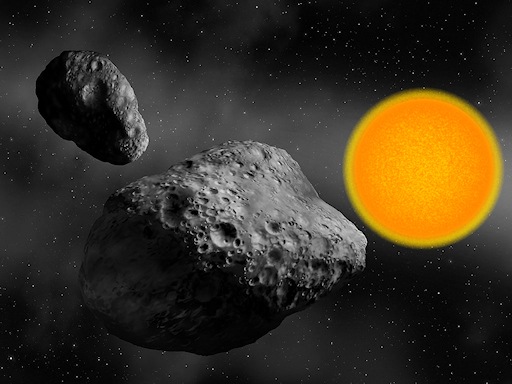
Early Tuesday morning, July 19th, the large binary asteroid (90)
Antiope will occult 6.7-mag. LQ Aquarii (ZC 3339 = SAO 165285 = HIP
112420) in a path about 200 km wide extending from western
Saskatchewan to northern California. This occultation involves the
brightest star ever predicted to be occulted by a large binary
asteroid, making it perhaps the most important event that IOTA will
observe during its history through this year. Observers in and near
the path, as well as throughout western North America, are
encouraged to observe this rare event, to help determine the
detailed outline of this binary pair and to check the wider area
around the Antiope system for possible smaller objects in the
Antiope system. Please let me, other coordinators of this
occultation, or the Occult Watcher software (see below) know if you
might try to observe this event from home or another convenient
nearby location, and specify the location either with a postal
address, detailed description, or (best) latitude and longitude
specified to at least an accuracy of 0.1' or 0.001 degree. About
three dozen mobile stations will be set up in California's Central
Valley to record the occultation, and we want to coordinate the
placement of the mobile stations so that they don't just duplicate
your observation, but rather best fill in gaps in the coverage that
will be provided by all fixed-site observers. If you might be
interested in being mobile for this event, perhaps traveling to the
predicted path from outside of it (even binoculars should give a
good view of the star), let me know and I'll recommend a line from
which you can observe (see below) to help build up our observational
fence.
THE OCCULTATION AND THE ANTIOPE COMPONENTS PATH GEOMETRY
The Web site says that the occultation will last up to 40 seconds
for a central event, but that's not right, it assumes a single
object with a diameter of 120 km. Actually, Antiope consists of
two nearly equal objects, each about 90 km in diameter, so each will
produce an occultation with a duration of about 30 seconds (less, of
course, for a non-central event). The predicted orientation of the
objects, and projection of the shadows on the Earth's surface,
indicates that an occultation by one of the objects should be
visible in a path about 200 km wide, with the disappearance by the
first object occurring about 40 seconds before the predicted central
time and the reappearance of the second object occurring about 40
seconds after the predicted central time. Since there could be
other small objects in the system, observation from at least 3
minutes before to 3 minutes after the central time for your area is
recommended. Most observers within the 200-km path will have an
occultation by just one component, with the leading component
occulting the star for observers in the southern part of the path,
and the following component occulting in the northern part.
According to the current prediction, there should be a 30-km-wide
zone at the center where both components will occult the star. In
addition, a large crater is predicted to be on the leading edge of
the leading component; it is expected to cause the first
disappearance for observers from about 10 km north to about 50 km
south of the central line.
It is important to realize that these predictions have errors; the
path for a recent occultation of an 8th-mag. star by the asteroid
(217) Eudora ended up almost 100 km north of the prediction, causing
nearly all, of about two dozen stations deployed for that May 29th
event, to have no occultation, and there are similar issues with
Antiope's star, LQ Aquarii, as there were with Eudora (proper motion
discrepancies between catalogs and suspected close stellar
duplicity, that was confirmed for the Eudora star). Also, the
orientation of the Antiope pair predicted for the time of the
occultation may be in error; it's possible that the Antiope
components will be more widely separated such that observers close
to the actual central line, wherever it may be, might thread between
the components with no occultation by either. Observations are
planned to try to improve both aspects of the prediction, and if
they are successful, we may be able to update the path prediction a
few days before the event. But any update will have its own errors,
so observations from an area much wider than the predicted path are
needed to have a reasonable chance to map the profiles of both
Antiope components.
The Star's Alt/Az and the Bright Moon Nearby
The Moon will be 83% sunlit, just 10 degrees above the target star,
and that will be either a help or a hindrance depending on your
equipment and frame of mind. In the San Francisco Bay area, the
star will be 39 deg. above the south-southeastern horizon (azimuth
165 deg.). For observers farther northeast in the path, the
altitude above the horizon will be similar, but strong twilight
becomes an issue, as noted above, east of the Rocky Mountains.
STELLAR DIAMETER AND PREVENTING SATURATION OF VIDEO RECORDINGS
When LQ Aquarii is occulted, the event should be a sudden spectacular
6-magnitude drop in brightness to Antiope's 12th mag. But the drop
will not be instantaneous because the star is a spectral class M red
giant with an estimated angular size of 0.002" that subtends 2.7 km
at Antiope, or 10 times the Fresnel diffraction spacing, which
consequently is insignificant. The disappearance and reappearance
for a central occultation should last 0.9 second, enough to notice
even with visual observations, and this will be prolonged for
grazing events; an observer near the edges of the path for a
component could have a grazing or even partial occultation of the
star that might last even ten seconds. The geometrical occultation
(occultation of the center of the star) will occur at the 50% level
of the occultation light curve. LQ Aquarii is a "slow red" (LB)
variable, period apparently unknown or indeterminate; the mag. range
is only 0.07 mag., from 6.71 to 6.78.
It will be important for video observers to slightly defocus the
light of the bright star to prevent saturation; this will be most
important for those with medium-sized and large telescopes (where
more defocusing is recommended), but even well-focused mighty mini's
could saturate. So after finding the target (or after pre-
pointing), I would recommend defocusing so that your limiting
magnitude is near 10. If you can see 11th-mag. stars on your video
monitor, the target star's image will probably be saturated. Those
using instead CCD's with a wider dynamic range can defocus less.
Video and CCD observers can perform some experiments on the target
star, or one of similar brightness, before the event to find the
minimum defocusing that you can achieve to prevent saturation (which
will be obvious as a truncated top on the Limovie 3-D display of the
star). If your image is saturated, determining the 50% level for
your geometric occultation times will be significantly less
accurate. Another issue is the possible duplicity of the star; the
Hipparcos observations indicated that the star might not be single,
but couldn't determine duplicity parameters. So rather than a 6-
mag. drop, we might have two drops of smaller size at the
disappearance, or maybe only one component of the star will be
occulted, with a mag. drop of less than 6. If the star has a faint
secondary, there may be only a small mag. drop, maybe only a few
tenths of a mag., that wouldn't be seen at all if the image is
saturated. Duplicity of the star could help us, by providing two
chords for each station (so, with the duplicity of Antiope, 4
shadows may be involved rather than just two).
THE OCCULTATION PATH
The occultation path is shown in a small-scale map of North America
on Steve Preston's Web page for the event at
http://www.asteroidoccultation.com/2011_07/0719_90_23903.htm .
Working backwards in time, the path is over northern California,
with the southern limit passing through San Jose and Stockton at
10:25 UT (3:25 am PDT) [note that with errors as large as 100 km,
the actual s. limit for the southern component could be much farther
north or south, we think anywhere from Vallejo and Sacramento to
Soledad and Merced]; over the northern Sierra region of n.e. Calif.
and the Reno (near the predicted s. limit) region of Nevada at 10:24
UT; s. cen. Oregon & n.w. corner of Nevada at 10:23 UT; eastern Ore.
and west-central Idaho (Boise region) at 10:22 UT (4:22 am MDT);
Challis Nat'l Forest, Idaho at 10:21 UT; n.w. Montana at 10:20 UT
(some morning twilight, Sun alt. -10 to -12 deg.); s. Alberta
(Lethbridge & Medicine Hat) & n.cen. Montana (Cut Bank) at 10:19 UT
(4:19am MDT, dawn with Sun alt. -7 to -10 deg.); and s.e. Alberta
and s.w. Saskatchewan (n.w. of Saskatoon, which could have an occ'n)
at 10:18 UT (4:18 am CST). Although the Sun alt. is only about -6
deg. at Saskatoon, that shouldn't be a problem, since with this
bright a star, you can just find it 20 minutes or more before the
occultation, when the sky will be dark enough to see the fainter
stars near it, and follow the target in the brightening sky. The
83% sunlit waning gibbous Moon will be 10 deg. north of the target
star, so you many need a dark dew shield, or make one out of stiff
black paper, to decrease possible glare from the Moon.
Much information about the Antiope occultation is given on our Web
site it, and about our IOTA annual meeting before it, at
http://www.asteroidoccultation.com/observations/NA/2011Meeting/index.htm
. About 2/3rds down this long page are six maps showing the path in
more detail. The green line is the predicted central line. Ignore
the blue and light red lines, which are based on the old assumption
of a single asteroid. Above these maps is a sky-plane view of the
Antiope system showing the components as they are predicted to
appear at the time of the occultation, with a diagonal line showing
the motion relative to the star. This was used to figure out the
predicted northern and southern limits of the occultation, which are
shown by the gray lines on the maps on the left side. But as noted
above, large errors are possible in both the location of the central
line, and in the orientation of the components, so a wider area,
shown by the gray lines on the maps on the right side, shows the
much wider area that we plan to cover with mobile stations to have a
good chance of covering both components of Antiope well. But there
is a chance of even larger erros, so observers living in locations
somewhat outside the gray lines, such as in Klamath Falls & Bend,
Ore.; Spokane; and Calgary on the north side, and in locations such
as Madera and even Fresno, Calif. on the south side, are strongly
encouraged to observe. Observers over a much wider area of western
North America are urged to watch for occultations by possible
additional small satellites in the vicinity of Antiope, if they
can't travel into the predicted path and uncertainty range for the
binary objects occultation. Below the six maps is another map, by
Roger Venable, showing effectively the shadows of the two components
projected on the map of northern Calif. The maps were generated
using the google map for the event set up by Derek Breit at
http://www.poyntsource.com/New/Google/20110719_23903.HTM - that site
is recommended for mobile observers, who can specify two distances
from the central line in the boxes above the map and zoom in on
aerial images ("Satellite" or "Hybrid") to find possible observing
sites.
LOCATING LQ Aquarii
The target star is in Aquarius, about halfway between the "Water
Jug" and Fomalhaut, at J2000 RA 22h 46m 14.2s, Dec -11 deg. 09' 59".
Finder charts of different scales show the target in the center on
Steve Preston's Web page for the event at
http://www.asteroidoccultation.com/2011_07/0719_90_23903.htm . The
target star will be 10 deg. south of the Moon, so you can start
there, then find 3.7-mag. lambda Aquarii six deg. south (below and a
little to the right) of the Moon [the Moon is shown only on
Preston's wide-view chart, as a faint smudge above the central
rectangle (that shows the area of the 15-deg. chart) and left of
the "Water Jug" of 4 bright stars in a "Y" pattern]. Another six
deg. south (continuing away from the Moon) of lambda Aquarii is the
wide pair tau 1 and tau 2 Aquarii [mag. 5.7 and 4.0, respectively;
2.5 deg. southeast of this pair is 3.3-mag. delta Aquarii (Skat),
the brightest star in the area]. Three deg. almost due north of tau
2 Aquarii is 6.2-mag. 70 Aquarii; the target LQ Aquarii is 0.8 deg.
southwest of 70 Aquarii. See the finder charts noted above, or the
somewhat better, less detailed views in the pre-point charts by
Ernie Iverson (you can get them by clicking on "PDF" in the "Pre-
Point Charts for areas near 122 W longitude:" about 2/5ths of the
way down Brad Timerson's IOTA meeting/Antiope occultation Web page
at
http://www.asteroidoccultation.com/observations/NA/2011Meeting/index.htm
- see the "Overview 3" (naked-eye view, but it does not show the
Moon), "Chart 4-6" (finder scope or binoculars view), and "End
Event" (small telescopic view, to mag. 11) with the target at the
center of those charts.
PRE-POINTING YOUR TELESCOPE
Earlier in the night, brighter stars that have nearly the same
declination as LQ Aquarii will be at the same altitude and azimuth
that LQ Aquarii will have at the time of the occultation, and
moonlight will affect their visibility less than the target star
area since these other pre-point areas are farther from the Moon.
These pre-point opportunities are useful to tell if a tree or
building might obstruct the view from your intended site (this
shouldn't be too much of a problem with the almost 40 deg.
altitude), and they can also be used to pre-point your telescope, an
ability especially important for running remote stations. In this
case, the target star is brighter than many of the pre-point stars.
But the target is not close to a bright star and is in a
constellation not as familiar to some as more prominent zodiacal
constellations like Taurus and Scorpius. So if your telescope
doesn't have a robust go-to system, it may be easier to locate the
target star by pre-pointing to one of the pre-point stars in the
list below that should be fairly easy to find since they are close
to relatively bright stars. For example, you could point your
telescope to 9.2-mag. SAO 163455 2h 25m 49s before the occultation;
for observers in Calif.'s Central Valley, that's at 7:59:31 UT or
12:59:31 am PDT. At J2000 RA 20h 20.0m, Dec. -11 deg. 08', SAO
163455 is just 1.5 deg. north of the 4th-mag. wide double star alpha
Capricorni (Algedi), which in turn is 2 deg. north of 3rd-mag. beta
Capricorni (Dabih). At the above time, turn off all tracking and
clamp the telescope so that it can't move; the target star will
appear only 0.4' south of where SAO 163455 was, when it is occulted
by Antiope.
This and a few other pre-point opportunities are in the list below:
Occultation of HIP 112420 (LQ Aquarii, ZC 3339, SAO 165285)
by 90 Antiope on 2011 Jul 19, pre-point times for Central Valley
Univ. J2000 Dec local Time
Time Star RA Dec Offset P. D. T. Offset Star
h m s mag h m o ' ArcMin h m s h m s Designation
10 25 20 6.7 22 46.2 -11 10 star 3 25 20 am 0 0 0 LQ Aqr = target
10 5 51 7.0 22 26.7 -11 14 3.8 3 5 51 am 0 19 29 54 Aqr = SAO 165079
10 4 45 9.7 22 25.6 -11 11 0.7 3 4 45 am 0 20 35 SAO 165064
10 3 41 7.8 22 24.5 -11 9 -0.5 3 3 41 am 0 21 39 SAO 165048
8 53 24 9.0 21 14.0 -11 11 1.7 1 53 24 am 1 31 56 SAO 164236
8 44 22 9.0 21 5.0 -11 5 -3.9 1 44 22 am 1 40 58 double star
8 43 14 9.4 21 3.8 -11 10 1.2 1 43 14 am 1 42 6 SAO 164108
8 41 55 8.2 21 2.5 -11 11 1.8 1 41 55 am 1 43 25 SAO 164083
8 24 39 8.7 20 45.2 -11 7 -1.9 1 24 39 am 2 0 41 SAO 163850
7 59 31 9.2 20 20.0 -11 8 -0.4 12 59 31 am 2 25 49 SAO 163455
6 19 45 7.3 18 39.9 -11 6 -0.6 11 19 45 pm 4 5 35 SAO 161706
6 14 51 5.1 18 35.0 -10 59 -8.3 11 14 51 pm 4 10 29 SAO 161632
5 18 8 5.7 17 38.2 -10 56 -10.4 10 18 8 pm 5 7 12 SAO 160708
5 14 45 5.5 17 34.8 -11 15 8.6 10 14 45 pm 5 10 35 SAO 160653
4 44 37 6.9 17 4.6 -11 5 -0.1 9 44 37 pm 5 40 43 SAO 160264
4 9 58 6.9 16 29.8 -11 8 2.9 9 9 58 pm 6 15 22 SAO 159949
Notes about individual pre-point stars:
(in chronological order, from earliest to latest, opposite the order
of the list above)
SAO 159949: This star is 1.8 deg. west-southwest of 2.5-mag. zeta
Ophiuchi. Normally, it would be easy to find, but evening twilight
will still be very bright for this pre-point in n. California.
SAO 160264: This is very good with only a tiny offset from the
target star's declination, and similar in brightness to the target,
but easier to find, in a distinctive line of stars stretching due
east of zeta Ophiuchi (it's about 7 deg. east of zeta).
SAO 160653 and SAO 160708: These bright stars are not very close to
the pre-point line of declination, but they are fairly close in time
and on opposite sides of the line, so you could offset north from
the first star, then just over three minutes later check that the
second star is farther north by about the same amount from where
you're pointing. The pair is just over 2 deg. northwest of 5th-mag.
omicron Serpentis, which in turn is 2.7 deg. north and a little
east of 4th-mag. xi Serpentis.
SAO 161632: This bright pre-point is too far from the pre-point
line for narrow fields of view, but it can be refined with the 7th-
mag. pre-point with SAO 161706 only five minutes later. The star
should be easy to find in a finder scope, being only 2.7 deg. south
of 4th-mag. alpha Scuti.
SAO 161706: See above; this small-offset pre-point opportunity
occurs only 4m 54s after the bright SAO 161632 pre-point.
SAO 163455: This relatively faint but good, small offset pre-point
star is just 1.5 deg. north of the 4th-mag. wide double alpha
Capricorni (Algedi), which in turn is 2 deg. north of 3rd-mag. beta
Capricorni (Dabih).
SAO 163850: This star is 1.7 deg. south and a little west of 4th-
mag. epsilon Aquarii (Albali).
SAO 164083: This star is 1.7 deg. west and a little north of 4th-
mag. nu Aquarii, and is 0.4 deg. northwest of the Saturn Nebula.
See the next one, SAO 164108 might be used to check this.
SAO 164108: This pre-point is only 1m 19s after the previous pre-
point, being 1.3 deg. west and a little north of nu Aquarii, and
only about 15' north and a little west of the Saturn Nebula.
SAO 164236: This relatively faint pre-point shouldn't be too hard
to find, only 1.1 deg. east and a little north of nu Aquarii.
SAO 165048 and 165064: These good pre-point opportunities, only
1m 04s apart and only about 21m before the occultation, are close to
and on opposite sides of the pre-point line of declination, and are
only 0.7 deg. west of the brighter pre-point opportunity with 54
Aquarii a minute later, which could serve as a good check (you would
probably star hop to these stars from 54 Aquarii, anyway).
54 Aquarii = SAO 165079: This is farther from the pre-point line
than the previous two, so this one is not as good for narrow-angle
fields of view. The star is only 1.2 deg. west-southwest of 4 1/2-
mag. sigma Aquarii.
The above table should be displayed with a fixed-space font such as
Courier. For locations outside the Central Valley, find the
predicted time for your location, and apply the difference of that
time, minus the target star time in the list above (10:25:20 UT =
3:25:20 am PDT), to the times in the table. For example, if you are
in the San Francisco Bay region, the time is within about 10s of
10:25:50, so you would add 30s to all of the times in the table
above. The predicted (central) time for your, or a nearby, location
can be obtained from the station list that you can find at
http://www.poyntsource.com/New/Google/20110719_23903_Sites.txt . You
should download this plain text file, then edit it with Word,
Notepad, or any other word processor, and use the "Find" search
function of the editor to find your name or the name of a nearby
observatory or city. A more extensive pre-point list, in the same
form as the table above, will be placed later today on the IOTA
Meeting/Antiope occultation Web page at
http://www.asteroidoccultation.com/observations/NA/2011Meeting/index.htm
As mentioned earlier, a complete set of pre-point charts showing the
pre-point line of declination with the pre-point times labeled
along it, is also available at that site, created by Ernie Iverson
in Texas and posted by Brad Timerson in New York.
IOTA MEETING, SIERRA COLLEGE, ROCKLIN, CALIF., JULY 16-17
You are invited to attend the 29th meeting of the International
Occultation Timing Association that will be held at the planetarium
of Sierra College in Rocklin, Calif., northeast of Sacramento, on
July 16 and 17, the weekend before the Antiope occultation.
Astronomers from as far away as France will be attending the free
meeting, open to all who might be interested in occultations. We'll
be discussing results from other asteroidal occultations, lunar
events, and observing techniques, including a workshop on making
observations from unattended video stations. For more about the
meeting, see
http://www.asteroidoccultation.com/observations/NA/2011Meeting/index.htm
.
HOW TO TIME ASTEROIDAL OCCULTATIONS, AND REPORT THEM TO US
Information about how to time occultations is at
http://iota.jhuapl.edu/timng920.htm . If you have an astronomical
CCD, the best way to use it to time occultations is by taking a long
exposure while letting the stars trail; for information about this
technique, see
http://www.asteroidoccultation.com/observations/DriftScan/Index.htm
. Those who don't have GPS or short-wave (for WWV) receivers for
accurate time can use the time at http://www.time.gov/ .
Reports of observations of the occultation, whether an occultation
happened (positive) or not (negative), should be sent to
[email protected] . You should use the Excel report
form at
http://www.asteroidoccultation.com/observations/NA/2011Meeting/20110719_90_Antiope_HIP_112420_LastName.xls
. When you save the file to your computer, change the name of the
file, replacing "LastName" to your last name. If you can't open or
otherwise use the Excel file, write to the above reporting e-mail
address; if necessary, a plain text version of the report form can
be used.
Results of observed asteroidal occultations in North America are
posted at
http://www.asteroidoccultation.com/observations/Results/index.html .
IOTA'S COORDINATED EFFORT TO COVER THE PREDICTED PATH
This is perhaps the most important occultation that IOTA has ever
deployed for, a unique chance to profile in detail the largest
main-belt binary asteroid. I don't want to screw it up, like we did
for the May 29th Eudora occultation, with almost all stations
crowding into the predicted path, netted only one positive result
(maybe two if the star's duplicity is confirmed) because the actual
path was entirely north of the predicted one.
The only way we can succeed with Antiope is with a systematic
approach organized by one person. I'll take responsibility for this
effort. My plan, described below, should optimize the overall
coverage of the occultation with the finite resources that we can
deploy, and give a good result even if a shift significantly larger
than predicted occurs. And the possibility of a large shift may be
high; Steve Preston notes that the star has "proper motion issues"
and may be a previously unknown double, the same recipe for disaster
that preceded the Eudora occultation (but that was a much smaller
asteroid, so if we have a similar shift for Antiope, it will not be
nearly as disastrous).
Observatories and Other Fixed-Site Observers
Those at fixed observatories are encouraged to sign up with Occult
Watcher (OW), a free download from
http://www.hristopavlov.net/OccultWatcher/publish.htm , or let me or
Scotty Degenhardt ([email protected]) know your plans, so
you can be added, and the mobile stations positioned around you to
optimize the coverage. It would help us if you could also use Derek
Breit's google map Web page for this event at
http://www.poyntsource.com/New/Google/20110719_23903.HTM to zoom in
on your area and place the cursor on your observing location; then
provide us with the distance given at the bottom of the map (as
explained below, that's the distance we need to use for station
planning, and it is a little different from distances given in
station lists like those from OW).
Information and Directions for Mobile Observers
Those planning mobile stations should first let me know (email
[email protected] or cell 301-526-5590), and I will specify lines
that you should aim for, and you can then use OW (or let Scotty do
this for you) to select a site (or sites for those with mobile
stations). But you might need to change a site if a fixed observer
later says that he/she will observe at a site within 2 km of your
line. I will maintain the actual plan offline (OW will just be used
as a site selection tool), but will post updated versions of it
periodically in Brad Timerson's IOTA meeting section Web site. A
final version of it might not be determined until our meeting for
the occultation Monday morning, July 18, in Rocklin; that will be
our last "horse trading" session, to finalize the plan. If you
can't be there in person, we plan to have EVO running so that you
could attend virtually; I think most mobile observers for this event
will be in northern California. On Monday, I expect to have
internet access up to noon, but soon after that, I'll leave for my
sites and will not have internet access again until after the event;
if you need to reach me then, call my cell phone, 301-526-5590.
The plan is meant to maximize the number of stations that those
deploying multiple remote stations can set up, while optimizing the
overall coverage of the event, as explained below. The orientation
of the two components of Antiope make this a very wide (expected 221
km) path, but the 1-sigma uncertainty range, including coverage of
the PPMXL star position path as well as the HIP2 path, is half again
larger, 336 km; to have a reasonable chance of good coverage of the
event, we need to cover that entire range uniformly (actually, a
370-km range since we want to use a spacing of 10 km between
stations and want to extend a little beyond the 1-sigma error
limit). This should maximize the change for covering both components
of Antiope well, but if we have a very large shift, like the
approximately 90-km (almost 3-sigma) shift that we had for the May
29th Eudora occultation, we will still cover one of the components
completely, and at least 1/3rd (and probably 1/2 or more) of the
other component. Although this plan I hope results in success, I
don't want to spread resources too thinly by spreading out more for
a less likely larger shift; as it is, covering the 370 km range will
result in 1/3rd of the stations having no occultation - I don't want
to increase that fraction by spreading out more. Fixed-site
observers within a 100 km outside the 370-km range, north and south,
will be strongly encouraged to observe in order to extend the
coverage to guard against a possible very large shift, as well as to
look for other small satelloids that might be in the Antiope system.
More Directions for Mobile Observers
Specifically, I want to cover the range from 175 km north to 195 km
south (farther south to cover the PPMXL path) at 10-km intervals;
that makes a total of 38 stations. None of them will be at the
center, and each observer should cover only lines on one side of the
predicted central line. The lines will start at 5 km north and 5 km
south of center, then go out at 10-km intervals, until 175 km north
and 195 km south are reached (that's now the case). Observers
should select sites for their stations within +/-2 km of their
assigned line(s); Derek Breit's google map Web page for this event
at http://www.poyntsource.com/New/Google/20110719_23903.HTM is best
for this. For example, if you are given the 25 km north line, just
enter +27 and +23 in the boxes at the top of the map, and select the
best site you can find between the two gray lines that are displayed
as you zoom in on the path.
Scotty Degenhardt and I will each be planning on ten stations, and
we will take the outer reaches, so that others, most or all of whom
will be deploying fewer stations, will be in the higher probability
areas. Scotty plans to take the northern side, lines +85 to +175,
while I'll cover the southern part, from -100 (not -95 since a
fixed-site observer is there) to -185. Scotty hopes to run up to
eight additional stations, and I'm going to try to run a couple
more, too.
Mobile stations over 38 are now being given locations halfway
between the others already assigned, at + and -10 km, + and -20 km,
etc., so we can accommodate up to 74 stations at 5-km intervals.
Some of the fixed sites don't fit nicely into this plan (that is,
they are not close to an integral 5-km line); in these cases, mobile
stations are placed away from them by at least 3 km. If you have a
station within 4 km or less of your line, you should select a site
within +/-1 km of your assigned line rather than within +/-2 km.
The station plan as of July 5th is below:
According to this plan, you should select sites within +2 and -2 km
(or better, within +1 and -1 km) of the following distances (I
indicate the current Occult Watcher, or OW, station #'s that already
comply with these well enough):
Google
map
dist.,
km Observer
+175 Degenhardt
+166 Degenhardt (OW#8)
+155 Degenhardt
+145 Degenhardt
+135 Degenhardt (OW#11)
+125 Degenhardt (OW#5)
+118 Degenhardt
+112.14 Fleishman
+105 Degenhardt (OW#10)
+95 Degenhardt
+90 IMCCE/SETI station 1
+85 Degenhardt
+75 T. George
+65 Lyzenga (OW#18)
+60 Preston
+54.96 Maley
+50 Preston
+46.45 Maley
+40 Garlitz
+34.04 Maley
+30 IMCCE/SETI station 2
+24.05 Maley (OW#9)
+20.6 Maley (OW#7)
+14.43 Maley (OW#6)
+10 IMCCE/SETI station 3
+5.53 Maley (OW#4)
-4.38 Maley (OW#3)
-10 Venable
-14.64 Maley (OW#2)
-20 IMCCE/SETI station 4
-26.85 Davis Ted Swift
-29 Univ. Calif. Davis (possible fixed site)
-35 Venable
-40 Venable
-45 Venable
-49 Kenyon Obs., Blue Canyon, CA (probable fixed site)
-52 Becker
-55.8 Shelton fixed home visual
-58 Venable
-62 Venable
-66.0 Westfall, Antioch, CA (definite fixed site)
-75 IMCCE/SETI station 5
-79.89 Morgan (OW#12, home, could be mobile, to -70; home ok, too)
-85.18 Morgan (OW#13) fixed site
-89.47 Morgan (OW#14) fixed site
-95.5 Nolthenius
-100.56 Dunham
-105 IMCCE/SETI station 6
-110 Dunham
-113 Okasaki 1
-116 Davis Obs., Carson City, NV (probable fixed site)
-120 Dunham
-123 Okasaki 2
-126 Sumner, Dayton, NV (probable fixed site)
-132.11 Breit (OW#17) fixed site, Morgan Hill, CA
-135 Okasaki 3
-138 Dunham
-142 Okasaki 4
-145 Dunham
-150 Dunham
-155 Dunham
-165 Dunham
-175 Dunham
-185 Dunham
-195 Nye
Note that distances on this map are on the ground, and need to be
determined with the google map either in OW, or on D. Breit's site
at http://www.poyntsource.com/New/Google/20110719_23903.HTM - the OW
station list, and the sites file on D. Breit's Global web site give
different answers, at least at distances more than about 20 km from
the central line, since they use distances on a plane (actually, a
cone) tangent to the Earth's surface at the central line, while the
google map distances are more accurate great circle distances on the
oblate spheroidal surface of the Earth. Observers who have selected
sites are requested to send me the google map distance for their
site, and I will enter that number with more precision in the list,
as I've done already for several stations where this information has
been reported.
Brian Mason notes that the Hipparcos mission observations indicated
that this star might not be single, but no high-resolution ground-
based observations have been made to determine that. So we could
end up with a shift as large as the approximate 90-km shift we had
for Eudora. If that happens for Antiope, our coverage would cover
one of the Antiope components completely, and the other one mostly
(some 70% - 80%). New observations are planned to try to improve
the current position of LQ Aquarii = HIP 112420; determine parameters
of the star's duplicity, if it is a close double; and to better
predict the orientation of the Antiope system at the time of the
occultation.
With the star catalog comparison using HIP1 data for the star
for the nominal prediction now used on all prediction sites and by
Occult Watcher (OW), and using the orientation of the components of
Antiope provided by Jerome Berthier of IMCCE on June 15,
The north edge = +97 +15 (HIP2) +46 (1 sigma) = +158 km
The south edge = -101 -21 (PPMXL) -46 (1sigma) = -168 km
but we will continue to use +175 km for the northern end of our
fence and -195 km for the southern end.
Updates to the plan will be posted on the IOTA meeting/Antiope
occultation Web site at
http://www.asteroidoccultation.com/observations/NA/2011Meeting/index.htm
Besides adding more stations (if you're not in the list, let me know
so we can add you!), the coverage plan might be modified to take
into account later information that we might learn about the
prediction.
David, email [email protected], cell 301-526-5590
Antiope will occult 6.7-mag. LQ Aquarii (ZC 3339 = SAO 165285 = HIP
112420) in a path about 200 km wide extending from western
Saskatchewan to northern California. This occultation involves the
brightest star ever predicted to be occulted by a large binary
asteroid, making it perhaps the most important event that IOTA will
observe during its history through this year. Observers in and near
the path, as well as throughout western North America, are
encouraged to observe this rare event, to help determine the
detailed outline of this binary pair and to check the wider area
around the Antiope system for possible smaller objects in the
Antiope system. Please let me, other coordinators of this
occultation, or the Occult Watcher software (see below) know if you
might try to observe this event from home or another convenient
nearby location, and specify the location either with a postal
address, detailed description, or (best) latitude and longitude
specified to at least an accuracy of 0.1' or 0.001 degree. About
three dozen mobile stations will be set up in California's Central
Valley to record the occultation, and we want to coordinate the
placement of the mobile stations so that they don't just duplicate
your observation, but rather best fill in gaps in the coverage that
will be provided by all fixed-site observers. If you might be
interested in being mobile for this event, perhaps traveling to the
predicted path from outside of it (even binoculars should give a
good view of the star), let me know and I'll recommend a line from
which you can observe (see below) to help build up our observational
fence.
THE OCCULTATION AND THE ANTIOPE COMPONENTS PATH GEOMETRY
The Web site says that the occultation will last up to 40 seconds
for a central event, but that's not right, it assumes a single
object with a diameter of 120 km. Actually, Antiope consists of
two nearly equal objects, each about 90 km in diameter, so each will
produce an occultation with a duration of about 30 seconds (less, of
course, for a non-central event). The predicted orientation of the
objects, and projection of the shadows on the Earth's surface,
indicates that an occultation by one of the objects should be
visible in a path about 200 km wide, with the disappearance by the
first object occurring about 40 seconds before the predicted central
time and the reappearance of the second object occurring about 40
seconds after the predicted central time. Since there could be
other small objects in the system, observation from at least 3
minutes before to 3 minutes after the central time for your area is
recommended. Most observers within the 200-km path will have an
occultation by just one component, with the leading component
occulting the star for observers in the southern part of the path,
and the following component occulting in the northern part.
According to the current prediction, there should be a 30-km-wide
zone at the center where both components will occult the star. In
addition, a large crater is predicted to be on the leading edge of
the leading component; it is expected to cause the first
disappearance for observers from about 10 km north to about 50 km
south of the central line.
It is important to realize that these predictions have errors; the
path for a recent occultation of an 8th-mag. star by the asteroid
(217) Eudora ended up almost 100 km north of the prediction, causing
nearly all, of about two dozen stations deployed for that May 29th
event, to have no occultation, and there are similar issues with
Antiope's star, LQ Aquarii, as there were with Eudora (proper motion
discrepancies between catalogs and suspected close stellar
duplicity, that was confirmed for the Eudora star). Also, the
orientation of the Antiope pair predicted for the time of the
occultation may be in error; it's possible that the Antiope
components will be more widely separated such that observers close
to the actual central line, wherever it may be, might thread between
the components with no occultation by either. Observations are
planned to try to improve both aspects of the prediction, and if
they are successful, we may be able to update the path prediction a
few days before the event. But any update will have its own errors,
so observations from an area much wider than the predicted path are
needed to have a reasonable chance to map the profiles of both
Antiope components.
The Star's Alt/Az and the Bright Moon Nearby
The Moon will be 83% sunlit, just 10 degrees above the target star,
and that will be either a help or a hindrance depending on your
equipment and frame of mind. In the San Francisco Bay area, the
star will be 39 deg. above the south-southeastern horizon (azimuth
165 deg.). For observers farther northeast in the path, the
altitude above the horizon will be similar, but strong twilight
becomes an issue, as noted above, east of the Rocky Mountains.
STELLAR DIAMETER AND PREVENTING SATURATION OF VIDEO RECORDINGS
When LQ Aquarii is occulted, the event should be a sudden spectacular
6-magnitude drop in brightness to Antiope's 12th mag. But the drop
will not be instantaneous because the star is a spectral class M red
giant with an estimated angular size of 0.002" that subtends 2.7 km
at Antiope, or 10 times the Fresnel diffraction spacing, which
consequently is insignificant. The disappearance and reappearance
for a central occultation should last 0.9 second, enough to notice
even with visual observations, and this will be prolonged for
grazing events; an observer near the edges of the path for a
component could have a grazing or even partial occultation of the
star that might last even ten seconds. The geometrical occultation
(occultation of the center of the star) will occur at the 50% level
of the occultation light curve. LQ Aquarii is a "slow red" (LB)
variable, period apparently unknown or indeterminate; the mag. range
is only 0.07 mag., from 6.71 to 6.78.
It will be important for video observers to slightly defocus the
light of the bright star to prevent saturation; this will be most
important for those with medium-sized and large telescopes (where
more defocusing is recommended), but even well-focused mighty mini's
could saturate. So after finding the target (or after pre-
pointing), I would recommend defocusing so that your limiting
magnitude is near 10. If you can see 11th-mag. stars on your video
monitor, the target star's image will probably be saturated. Those
using instead CCD's with a wider dynamic range can defocus less.
Video and CCD observers can perform some experiments on the target
star, or one of similar brightness, before the event to find the
minimum defocusing that you can achieve to prevent saturation (which
will be obvious as a truncated top on the Limovie 3-D display of the
star). If your image is saturated, determining the 50% level for
your geometric occultation times will be significantly less
accurate. Another issue is the possible duplicity of the star; the
Hipparcos observations indicated that the star might not be single,
but couldn't determine duplicity parameters. So rather than a 6-
mag. drop, we might have two drops of smaller size at the
disappearance, or maybe only one component of the star will be
occulted, with a mag. drop of less than 6. If the star has a faint
secondary, there may be only a small mag. drop, maybe only a few
tenths of a mag., that wouldn't be seen at all if the image is
saturated. Duplicity of the star could help us, by providing two
chords for each station (so, with the duplicity of Antiope, 4
shadows may be involved rather than just two).
THE OCCULTATION PATH
The occultation path is shown in a small-scale map of North America
on Steve Preston's Web page for the event at
http://www.asteroidoccultation.com/2011_07/0719_90_23903.htm .
Working backwards in time, the path is over northern California,
with the southern limit passing through San Jose and Stockton at
10:25 UT (3:25 am PDT) [note that with errors as large as 100 km,
the actual s. limit for the southern component could be much farther
north or south, we think anywhere from Vallejo and Sacramento to
Soledad and Merced]; over the northern Sierra region of n.e. Calif.
and the Reno (near the predicted s. limit) region of Nevada at 10:24
UT; s. cen. Oregon & n.w. corner of Nevada at 10:23 UT; eastern Ore.
and west-central Idaho (Boise region) at 10:22 UT (4:22 am MDT);
Challis Nat'l Forest, Idaho at 10:21 UT; n.w. Montana at 10:20 UT
(some morning twilight, Sun alt. -10 to -12 deg.); s. Alberta
(Lethbridge & Medicine Hat) & n.cen. Montana (Cut Bank) at 10:19 UT
(4:19am MDT, dawn with Sun alt. -7 to -10 deg.); and s.e. Alberta
and s.w. Saskatchewan (n.w. of Saskatoon, which could have an occ'n)
at 10:18 UT (4:18 am CST). Although the Sun alt. is only about -6
deg. at Saskatoon, that shouldn't be a problem, since with this
bright a star, you can just find it 20 minutes or more before the
occultation, when the sky will be dark enough to see the fainter
stars near it, and follow the target in the brightening sky. The
83% sunlit waning gibbous Moon will be 10 deg. north of the target
star, so you many need a dark dew shield, or make one out of stiff
black paper, to decrease possible glare from the Moon.
Much information about the Antiope occultation is given on our Web
site it, and about our IOTA annual meeting before it, at
http://www.asteroidoccultation.com/observations/NA/2011Meeting/index.htm
. About 2/3rds down this long page are six maps showing the path in
more detail. The green line is the predicted central line. Ignore
the blue and light red lines, which are based on the old assumption
of a single asteroid. Above these maps is a sky-plane view of the
Antiope system showing the components as they are predicted to
appear at the time of the occultation, with a diagonal line showing
the motion relative to the star. This was used to figure out the
predicted northern and southern limits of the occultation, which are
shown by the gray lines on the maps on the left side. But as noted
above, large errors are possible in both the location of the central
line, and in the orientation of the components, so a wider area,
shown by the gray lines on the maps on the right side, shows the
much wider area that we plan to cover with mobile stations to have a
good chance of covering both components of Antiope well. But there
is a chance of even larger erros, so observers living in locations
somewhat outside the gray lines, such as in Klamath Falls & Bend,
Ore.; Spokane; and Calgary on the north side, and in locations such
as Madera and even Fresno, Calif. on the south side, are strongly
encouraged to observe. Observers over a much wider area of western
North America are urged to watch for occultations by possible
additional small satellites in the vicinity of Antiope, if they
can't travel into the predicted path and uncertainty range for the
binary objects occultation. Below the six maps is another map, by
Roger Venable, showing effectively the shadows of the two components
projected on the map of northern Calif. The maps were generated
using the google map for the event set up by Derek Breit at
http://www.poyntsource.com/New/Google/20110719_23903.HTM - that site
is recommended for mobile observers, who can specify two distances
from the central line in the boxes above the map and zoom in on
aerial images ("Satellite" or "Hybrid") to find possible observing
sites.
LOCATING LQ Aquarii
The target star is in Aquarius, about halfway between the "Water
Jug" and Fomalhaut, at J2000 RA 22h 46m 14.2s, Dec -11 deg. 09' 59".
Finder charts of different scales show the target in the center on
Steve Preston's Web page for the event at
http://www.asteroidoccultation.com/2011_07/0719_90_23903.htm . The
target star will be 10 deg. south of the Moon, so you can start
there, then find 3.7-mag. lambda Aquarii six deg. south (below and a
little to the right) of the Moon [the Moon is shown only on
Preston's wide-view chart, as a faint smudge above the central
rectangle (that shows the area of the 15-deg. chart) and left of
the "Water Jug" of 4 bright stars in a "Y" pattern]. Another six
deg. south (continuing away from the Moon) of lambda Aquarii is the
wide pair tau 1 and tau 2 Aquarii [mag. 5.7 and 4.0, respectively;
2.5 deg. southeast of this pair is 3.3-mag. delta Aquarii (Skat),
the brightest star in the area]. Three deg. almost due north of tau
2 Aquarii is 6.2-mag. 70 Aquarii; the target LQ Aquarii is 0.8 deg.
southwest of 70 Aquarii. See the finder charts noted above, or the
somewhat better, less detailed views in the pre-point charts by
Ernie Iverson (you can get them by clicking on "PDF" in the "Pre-
Point Charts for areas near 122 W longitude:" about 2/5ths of the
way down Brad Timerson's IOTA meeting/Antiope occultation Web page
at
http://www.asteroidoccultation.com/observations/NA/2011Meeting/index.htm
- see the "Overview 3" (naked-eye view, but it does not show the
Moon), "Chart 4-6" (finder scope or binoculars view), and "End
Event" (small telescopic view, to mag. 11) with the target at the
center of those charts.
PRE-POINTING YOUR TELESCOPE
Earlier in the night, brighter stars that have nearly the same
declination as LQ Aquarii will be at the same altitude and azimuth
that LQ Aquarii will have at the time of the occultation, and
moonlight will affect their visibility less than the target star
area since these other pre-point areas are farther from the Moon.
These pre-point opportunities are useful to tell if a tree or
building might obstruct the view from your intended site (this
shouldn't be too much of a problem with the almost 40 deg.
altitude), and they can also be used to pre-point your telescope, an
ability especially important for running remote stations. In this
case, the target star is brighter than many of the pre-point stars.
But the target is not close to a bright star and is in a
constellation not as familiar to some as more prominent zodiacal
constellations like Taurus and Scorpius. So if your telescope
doesn't have a robust go-to system, it may be easier to locate the
target star by pre-pointing to one of the pre-point stars in the
list below that should be fairly easy to find since they are close
to relatively bright stars. For example, you could point your
telescope to 9.2-mag. SAO 163455 2h 25m 49s before the occultation;
for observers in Calif.'s Central Valley, that's at 7:59:31 UT or
12:59:31 am PDT. At J2000 RA 20h 20.0m, Dec. -11 deg. 08', SAO
163455 is just 1.5 deg. north of the 4th-mag. wide double star alpha
Capricorni (Algedi), which in turn is 2 deg. north of 3rd-mag. beta
Capricorni (Dabih). At the above time, turn off all tracking and
clamp the telescope so that it can't move; the target star will
appear only 0.4' south of where SAO 163455 was, when it is occulted
by Antiope.
This and a few other pre-point opportunities are in the list below:
Occultation of HIP 112420 (LQ Aquarii, ZC 3339, SAO 165285)
by 90 Antiope on 2011 Jul 19, pre-point times for Central Valley
Univ. J2000 Dec local Time
Time Star RA Dec Offset P. D. T. Offset Star
h m s mag h m o ' ArcMin h m s h m s Designation
10 25 20 6.7 22 46.2 -11 10 star 3 25 20 am 0 0 0 LQ Aqr = target
10 5 51 7.0 22 26.7 -11 14 3.8 3 5 51 am 0 19 29 54 Aqr = SAO 165079
10 4 45 9.7 22 25.6 -11 11 0.7 3 4 45 am 0 20 35 SAO 165064
10 3 41 7.8 22 24.5 -11 9 -0.5 3 3 41 am 0 21 39 SAO 165048
8 53 24 9.0 21 14.0 -11 11 1.7 1 53 24 am 1 31 56 SAO 164236
8 44 22 9.0 21 5.0 -11 5 -3.9 1 44 22 am 1 40 58 double star
8 43 14 9.4 21 3.8 -11 10 1.2 1 43 14 am 1 42 6 SAO 164108
8 41 55 8.2 21 2.5 -11 11 1.8 1 41 55 am 1 43 25 SAO 164083
8 24 39 8.7 20 45.2 -11 7 -1.9 1 24 39 am 2 0 41 SAO 163850
7 59 31 9.2 20 20.0 -11 8 -0.4 12 59 31 am 2 25 49 SAO 163455
6 19 45 7.3 18 39.9 -11 6 -0.6 11 19 45 pm 4 5 35 SAO 161706
6 14 51 5.1 18 35.0 -10 59 -8.3 11 14 51 pm 4 10 29 SAO 161632
5 18 8 5.7 17 38.2 -10 56 -10.4 10 18 8 pm 5 7 12 SAO 160708
5 14 45 5.5 17 34.8 -11 15 8.6 10 14 45 pm 5 10 35 SAO 160653
4 44 37 6.9 17 4.6 -11 5 -0.1 9 44 37 pm 5 40 43 SAO 160264
4 9 58 6.9 16 29.8 -11 8 2.9 9 9 58 pm 6 15 22 SAO 159949
Notes about individual pre-point stars:
(in chronological order, from earliest to latest, opposite the order
of the list above)
SAO 159949: This star is 1.8 deg. west-southwest of 2.5-mag. zeta
Ophiuchi. Normally, it would be easy to find, but evening twilight
will still be very bright for this pre-point in n. California.
SAO 160264: This is very good with only a tiny offset from the
target star's declination, and similar in brightness to the target,
but easier to find, in a distinctive line of stars stretching due
east of zeta Ophiuchi (it's about 7 deg. east of zeta).
SAO 160653 and SAO 160708: These bright stars are not very close to
the pre-point line of declination, but they are fairly close in time
and on opposite sides of the line, so you could offset north from
the first star, then just over three minutes later check that the
second star is farther north by about the same amount from where
you're pointing. The pair is just over 2 deg. northwest of 5th-mag.
omicron Serpentis, which in turn is 2.7 deg. north and a little
east of 4th-mag. xi Serpentis.
SAO 161632: This bright pre-point is too far from the pre-point
line for narrow fields of view, but it can be refined with the 7th-
mag. pre-point with SAO 161706 only five minutes later. The star
should be easy to find in a finder scope, being only 2.7 deg. south
of 4th-mag. alpha Scuti.
SAO 161706: See above; this small-offset pre-point opportunity
occurs only 4m 54s after the bright SAO 161632 pre-point.
SAO 163455: This relatively faint but good, small offset pre-point
star is just 1.5 deg. north of the 4th-mag. wide double alpha
Capricorni (Algedi), which in turn is 2 deg. north of 3rd-mag. beta
Capricorni (Dabih).
SAO 163850: This star is 1.7 deg. south and a little west of 4th-
mag. epsilon Aquarii (Albali).
SAO 164083: This star is 1.7 deg. west and a little north of 4th-
mag. nu Aquarii, and is 0.4 deg. northwest of the Saturn Nebula.
See the next one, SAO 164108 might be used to check this.
SAO 164108: This pre-point is only 1m 19s after the previous pre-
point, being 1.3 deg. west and a little north of nu Aquarii, and
only about 15' north and a little west of the Saturn Nebula.
SAO 164236: This relatively faint pre-point shouldn't be too hard
to find, only 1.1 deg. east and a little north of nu Aquarii.
SAO 165048 and 165064: These good pre-point opportunities, only
1m 04s apart and only about 21m before the occultation, are close to
and on opposite sides of the pre-point line of declination, and are
only 0.7 deg. west of the brighter pre-point opportunity with 54
Aquarii a minute later, which could serve as a good check (you would
probably star hop to these stars from 54 Aquarii, anyway).
54 Aquarii = SAO 165079: This is farther from the pre-point line
than the previous two, so this one is not as good for narrow-angle
fields of view. The star is only 1.2 deg. west-southwest of 4 1/2-
mag. sigma Aquarii.
The above table should be displayed with a fixed-space font such as
Courier. For locations outside the Central Valley, find the
predicted time for your location, and apply the difference of that
time, minus the target star time in the list above (10:25:20 UT =
3:25:20 am PDT), to the times in the table. For example, if you are
in the San Francisco Bay region, the time is within about 10s of
10:25:50, so you would add 30s to all of the times in the table
above. The predicted (central) time for your, or a nearby, location
can be obtained from the station list that you can find at
http://www.poyntsource.com/New/Google/20110719_23903_Sites.txt . You
should download this plain text file, then edit it with Word,
Notepad, or any other word processor, and use the "Find" search
function of the editor to find your name or the name of a nearby
observatory or city. A more extensive pre-point list, in the same
form as the table above, will be placed later today on the IOTA
Meeting/Antiope occultation Web page at
http://www.asteroidoccultation.com/observations/NA/2011Meeting/index.htm
As mentioned earlier, a complete set of pre-point charts showing the
pre-point line of declination with the pre-point times labeled
along it, is also available at that site, created by Ernie Iverson
in Texas and posted by Brad Timerson in New York.
IOTA MEETING, SIERRA COLLEGE, ROCKLIN, CALIF., JULY 16-17
You are invited to attend the 29th meeting of the International
Occultation Timing Association that will be held at the planetarium
of Sierra College in Rocklin, Calif., northeast of Sacramento, on
July 16 and 17, the weekend before the Antiope occultation.
Astronomers from as far away as France will be attending the free
meeting, open to all who might be interested in occultations. We'll
be discussing results from other asteroidal occultations, lunar
events, and observing techniques, including a workshop on making
observations from unattended video stations. For more about the
meeting, see
http://www.asteroidoccultation.com/observations/NA/2011Meeting/index.htm
.
HOW TO TIME ASTEROIDAL OCCULTATIONS, AND REPORT THEM TO US
Information about how to time occultations is at
http://iota.jhuapl.edu/timng920.htm . If you have an astronomical
CCD, the best way to use it to time occultations is by taking a long
exposure while letting the stars trail; for information about this
technique, see
http://www.asteroidoccultation.com/observations/DriftScan/Index.htm
. Those who don't have GPS or short-wave (for WWV) receivers for
accurate time can use the time at http://www.time.gov/ .
Reports of observations of the occultation, whether an occultation
happened (positive) or not (negative), should be sent to
[email protected] . You should use the Excel report
form at
http://www.asteroidoccultation.com/observations/NA/2011Meeting/20110719_90_Antiope_HIP_112420_LastName.xls
. When you save the file to your computer, change the name of the
file, replacing "LastName" to your last name. If you can't open or
otherwise use the Excel file, write to the above reporting e-mail
address; if necessary, a plain text version of the report form can
be used.
Results of observed asteroidal occultations in North America are
posted at
http://www.asteroidoccultation.com/observations/Results/index.html .
IOTA'S COORDINATED EFFORT TO COVER THE PREDICTED PATH
This is perhaps the most important occultation that IOTA has ever
deployed for, a unique chance to profile in detail the largest
main-belt binary asteroid. I don't want to screw it up, like we did
for the May 29th Eudora occultation, with almost all stations
crowding into the predicted path, netted only one positive result
(maybe two if the star's duplicity is confirmed) because the actual
path was entirely north of the predicted one.
The only way we can succeed with Antiope is with a systematic
approach organized by one person. I'll take responsibility for this
effort. My plan, described below, should optimize the overall
coverage of the occultation with the finite resources that we can
deploy, and give a good result even if a shift significantly larger
than predicted occurs. And the possibility of a large shift may be
high; Steve Preston notes that the star has "proper motion issues"
and may be a previously unknown double, the same recipe for disaster
that preceded the Eudora occultation (but that was a much smaller
asteroid, so if we have a similar shift for Antiope, it will not be
nearly as disastrous).
Observatories and Other Fixed-Site Observers
Those at fixed observatories are encouraged to sign up with Occult
Watcher (OW), a free download from
http://www.hristopavlov.net/OccultWatcher/publish.htm , or let me or
Scotty Degenhardt ([email protected]) know your plans, so
you can be added, and the mobile stations positioned around you to
optimize the coverage. It would help us if you could also use Derek
Breit's google map Web page for this event at
http://www.poyntsource.com/New/Google/20110719_23903.HTM to zoom in
on your area and place the cursor on your observing location; then
provide us with the distance given at the bottom of the map (as
explained below, that's the distance we need to use for station
planning, and it is a little different from distances given in
station lists like those from OW).
Information and Directions for Mobile Observers
Those planning mobile stations should first let me know (email
[email protected] or cell 301-526-5590), and I will specify lines
that you should aim for, and you can then use OW (or let Scotty do
this for you) to select a site (or sites for those with mobile
stations). But you might need to change a site if a fixed observer
later says that he/she will observe at a site within 2 km of your
line. I will maintain the actual plan offline (OW will just be used
as a site selection tool), but will post updated versions of it
periodically in Brad Timerson's IOTA meeting section Web site. A
final version of it might not be determined until our meeting for
the occultation Monday morning, July 18, in Rocklin; that will be
our last "horse trading" session, to finalize the plan. If you
can't be there in person, we plan to have EVO running so that you
could attend virtually; I think most mobile observers for this event
will be in northern California. On Monday, I expect to have
internet access up to noon, but soon after that, I'll leave for my
sites and will not have internet access again until after the event;
if you need to reach me then, call my cell phone, 301-526-5590.
The plan is meant to maximize the number of stations that those
deploying multiple remote stations can set up, while optimizing the
overall coverage of the event, as explained below. The orientation
of the two components of Antiope make this a very wide (expected 221
km) path, but the 1-sigma uncertainty range, including coverage of
the PPMXL star position path as well as the HIP2 path, is half again
larger, 336 km; to have a reasonable chance of good coverage of the
event, we need to cover that entire range uniformly (actually, a
370-km range since we want to use a spacing of 10 km between
stations and want to extend a little beyond the 1-sigma error
limit). This should maximize the change for covering both components
of Antiope well, but if we have a very large shift, like the
approximately 90-km (almost 3-sigma) shift that we had for the May
29th Eudora occultation, we will still cover one of the components
completely, and at least 1/3rd (and probably 1/2 or more) of the
other component. Although this plan I hope results in success, I
don't want to spread resources too thinly by spreading out more for
a less likely larger shift; as it is, covering the 370 km range will
result in 1/3rd of the stations having no occultation - I don't want
to increase that fraction by spreading out more. Fixed-site
observers within a 100 km outside the 370-km range, north and south,
will be strongly encouraged to observe in order to extend the
coverage to guard against a possible very large shift, as well as to
look for other small satelloids that might be in the Antiope system.
More Directions for Mobile Observers
Specifically, I want to cover the range from 175 km north to 195 km
south (farther south to cover the PPMXL path) at 10-km intervals;
that makes a total of 38 stations. None of them will be at the
center, and each observer should cover only lines on one side of the
predicted central line. The lines will start at 5 km north and 5 km
south of center, then go out at 10-km intervals, until 175 km north
and 195 km south are reached (that's now the case). Observers
should select sites for their stations within +/-2 km of their
assigned line(s); Derek Breit's google map Web page for this event
at http://www.poyntsource.com/New/Google/20110719_23903.HTM is best
for this. For example, if you are given the 25 km north line, just
enter +27 and +23 in the boxes at the top of the map, and select the
best site you can find between the two gray lines that are displayed
as you zoom in on the path.
Scotty Degenhardt and I will each be planning on ten stations, and
we will take the outer reaches, so that others, most or all of whom
will be deploying fewer stations, will be in the higher probability
areas. Scotty plans to take the northern side, lines +85 to +175,
while I'll cover the southern part, from -100 (not -95 since a
fixed-site observer is there) to -185. Scotty hopes to run up to
eight additional stations, and I'm going to try to run a couple
more, too.
Mobile stations over 38 are now being given locations halfway
between the others already assigned, at + and -10 km, + and -20 km,
etc., so we can accommodate up to 74 stations at 5-km intervals.
Some of the fixed sites don't fit nicely into this plan (that is,
they are not close to an integral 5-km line); in these cases, mobile
stations are placed away from them by at least 3 km. If you have a
station within 4 km or less of your line, you should select a site
within +/-1 km of your assigned line rather than within +/-2 km.
The station plan as of July 5th is below:
According to this plan, you should select sites within +2 and -2 km
(or better, within +1 and -1 km) of the following distances (I
indicate the current Occult Watcher, or OW, station #'s that already
comply with these well enough):
map
dist.,
km Observer
+175 Degenhardt
+166 Degenhardt (OW#8)
+155 Degenhardt
+145 Degenhardt
+135 Degenhardt (OW#11)
+125 Degenhardt (OW#5)
+118 Degenhardt
+112.14 Fleishman
+105 Degenhardt (OW#10)
+95 Degenhardt
+90 IMCCE/SETI station 1
+85 Degenhardt
+75 T. George
+65 Lyzenga (OW#18)
+60 Preston
+54.96 Maley
+50 Preston
+46.45 Maley
+40 Garlitz
+34.04 Maley
+30 IMCCE/SETI station 2
+24.05 Maley (OW#9)
+20.6 Maley (OW#7)
+14.43 Maley (OW#6)
+10 IMCCE/SETI station 3
+5.53 Maley (OW#4)
-4.38 Maley (OW#3)
-10 Venable
-14.64 Maley (OW#2)
-20 IMCCE/SETI station 4
-26.85 Davis Ted Swift
-29 Univ. Calif. Davis (possible fixed site)
-35 Venable
-40 Venable
-45 Venable
-49 Kenyon Obs., Blue Canyon, CA (probable fixed site)
-52 Becker
-55.8 Shelton fixed home visual
-58 Venable
-62 Venable
-66.0 Westfall, Antioch, CA (definite fixed site)
-75 IMCCE/SETI station 5
-79.89 Morgan (OW#12, home, could be mobile, to -70; home ok, too)
-85.18 Morgan (OW#13) fixed site
-89.47 Morgan (OW#14) fixed site
-95.5 Nolthenius
-100.56 Dunham
-105 IMCCE/SETI station 6
-110 Dunham
-113 Okasaki 1
-116 Davis Obs., Carson City, NV (probable fixed site)
-120 Dunham
-123 Okasaki 2
-126 Sumner, Dayton, NV (probable fixed site)
-132.11 Breit (OW#17) fixed site, Morgan Hill, CA
-135 Okasaki 3
-138 Dunham
-142 Okasaki 4
-145 Dunham
-150 Dunham
-155 Dunham
-165 Dunham
-175 Dunham
-185 Dunham
-195 Nye
Note that distances on this map are on the ground, and need to be
determined with the google map either in OW, or on D. Breit's site
at http://www.poyntsource.com/New/Google/20110719_23903.HTM - the OW
station list, and the sites file on D. Breit's Global web site give
different answers, at least at distances more than about 20 km from
the central line, since they use distances on a plane (actually, a
cone) tangent to the Earth's surface at the central line, while the
google map distances are more accurate great circle distances on the
oblate spheroidal surface of the Earth. Observers who have selected
sites are requested to send me the google map distance for their
site, and I will enter that number with more precision in the list,
as I've done already for several stations where this information has
been reported.
Brian Mason notes that the Hipparcos mission observations indicated
that this star might not be single, but no high-resolution ground-
based observations have been made to determine that. So we could
end up with a shift as large as the approximate 90-km shift we had
for Eudora. If that happens for Antiope, our coverage would cover
one of the Antiope components completely, and the other one mostly
(some 70% - 80%). New observations are planned to try to improve
the current position of LQ Aquarii = HIP 112420; determine parameters
of the star's duplicity, if it is a close double; and to better
predict the orientation of the Antiope system at the time of the
occultation.
With the star catalog comparison using HIP1 data for the star
for the nominal prediction now used on all prediction sites and by
Occult Watcher (OW), and using the orientation of the components of
Antiope provided by Jerome Berthier of IMCCE on June 15,
The north edge = +97 +15 (HIP2) +46 (1 sigma) = +158 km
The south edge = -101 -21 (PPMXL) -46 (1sigma) = -168 km
but we will continue to use +175 km for the northern end of our
fence and -195 km for the southern end.
Updates to the plan will be posted on the IOTA meeting/Antiope
occultation Web site at
http://www.asteroidoccultation.com/observations/NA/2011Meeting/index.htm
Besides adding more stations (if you're not in the list, let me know
so we can add you!), the coverage plan might be modified to take
into account later information that we might learn about the
prediction.
David, email [email protected], cell 301-526-5590
Funding Member
