Caltech Listens for Cosmic Gravitational Background Waves Created by the Big Bang
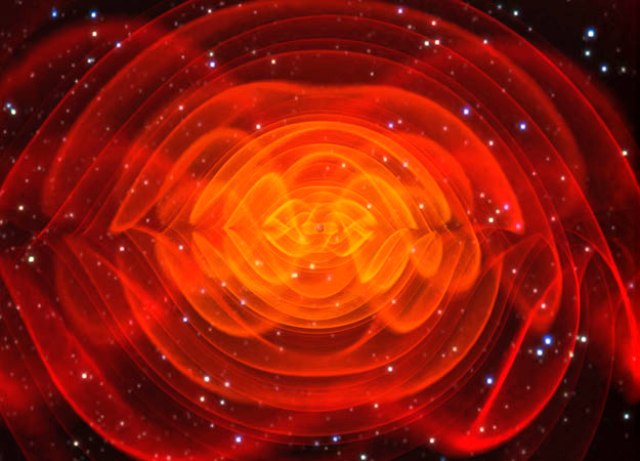
Analysis of data taken over a two-year period, from 2005 to 2007, by Caltech has set the most stringent limits yet on the amount of gravitational waves that could have come from the Big Bang. In doing so, the gravitational-wave scientists have put new constraints on the details of how the universe looked in its earliest moments. The research also constrains models of cosmic strings, objects that are proposed to have been left over from the beginning of the universe and subsequently stretched to enormous lengths by the universe's expansion. The strings, some cosmologists say, can form loops that produce gravitational waves as they oscillate, decay, and eventually disappear.
Comments:
I understand what this is all about, and all, but I have to say that this article contains highly-enthusiastic quotes from gravity-wave scientists who, so far as I can tell from this article, are reporting that they have, as yet, not ever seen so much as *one single* gravitational wave ...<br><br>Yes, I understand that a negative result can be, in and of itself, significant, but the back of my mind keeps saying that their results are *also* entirely consistent with gravitational waves being nonexistent. I'll feel a lot better if and when they start actually *detecting* some.<br><br>Terry (astrotrf)<br>
Terry:<br><br>You are correct. Another interpretation is that these new results can be used to gradually prove that gravitational waves do not exist.<br><br>What I found intriguing in this news item is that researchers are also contemplating the possibility of cosmic strings stretched to enormous lengths by the universe's expansion. "The strings, some cosmologists say, can form loops that produce gravitational waves as they oscillate, decay, and eventually disappear." <br><br>To me, this sounds a lot like String Theory with one-dimensional strings and multi-dimensional branes. Up to now strings have been considered so small that they cannot be detected and measured (to the frustration of many physicists).<br><br>Is it possible that another form of strings can be too big to be detected too?<br><br>Guy Pirro<br><br><br><br><blockquote class="blockquote"><div class="italic"><i>Terry Friedrichsen said:</i><br><br>I understand what this is all about, and all, but I have to say that this article contains highly-enthusiastic quotes from gravity-wave scientists who, so far as I can tell from this article, are reporting that they have, as yet, not ever seen so much as *one single* gravitational wave ...<br><br>Yes, I understand that a negative result can be, in and of itself, significant, but the back of my mind keeps saying that their results are *also* entirely consistent with gravitational waves being nonexistent. I'll feel a lot better if and when they start actually *detecting* some.<br><br>Terry (astrotrf)<br></div></blockquote>
I get the impression that the utility of the LIGO and VIGO instruments is just assumed by everyone involved. IOW "Our magnificent machines haven't found a darned thing after five years, but that just means the gravity waves are really, really, really hard to detect. Give us more money".<br><br>This wouldn't be the first time a lot of money was wasted (Gravity Probe B anyone?), but somebody needs to police these programs and ask hard questions especially when they tout negative results as an accomplishment.
Gravity's tug is observed but not defined. We see its manifestation from our point in space. It is a balanced force in all directions alowing us to aim spacecraft with great accuarcy over long distances. <br><br>In order to detect one ot these imaginary "waves" we would need to find a reference point unaffected by gravity which is DUH IMPOSSIBLE.<br><br>How is gravity a relativistic issue? It has no observable/testable waveform or particulate character. So - Is it governed by Einstein's speed limit? <br><br>[COLOR="Red"]No, Darlene - we can't set up gravity detectors and all of a sudden "delete" the sun and look at the gravity meters to see what happens.[/COLOR]<br><br>Gravity's understanding exists within areas remaining undiscovered evidenced by the extrapolation of dark matter and energy. <br><br>"C" @ 300,000 KM/S yields a simple clue: Why not 200,000 or 400,000. Might radiation actually be conduction through a medium? Is our universe "soup". Ask a photon or Gamma ray.<br><br>Th assertion that "string theorists" are stepping out in thinly veiled philosophical pursuit may be wholly true. In recognizing this we can certainly relate our place in time to that of Ptolomy. No doubt, there is an answer down the road that is not fully derivative of scientific process.<br><br>In simpler terms: a patent attorney might even be able to figure it out what a scientist can't.<br><br>Again I respectfully suggest we stretch out interferometric baseline as far as possible. A second JWST beyond Neptune might be nice.
