Cassini Views Saturn from a Never-Before-Seen Perspective
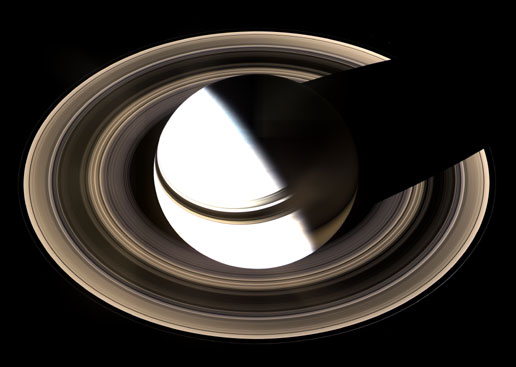
Saturn's beautiful rings are what set it apart from the other planets. It is the most extensive and complex ring system in our solar system, extending hundreds of thousands of miles from the planet. Made up of billions of particles of ice and rock - ranging in size from grains of sugar to houses - the rings orbit Saturn at varying speeds.
There are hundreds of individual rings, believed to be made of pieces of shattered moons, comets and asteroids. Each of the billions of rings particles orbits the planet on its own path.
Like Jupiter, Uranus, and Neptune, Saturn is a gas giant. It is made mostly of hydrogen and helium.With its stunning rings and dozens of moons, Saturn is an intriguing planet for many reasons. The giant planet has a huge magnetosphere and a stormy atmosphere with winds clocked at about 1,800 kilometers per hour (1,118 mph) near the equator. These super-fast winds, combined with heat rising from within the planet's interior, cause the yellow and gold bands visible in its atmosphere.
The Cassini spacecraft has captured never-before-seen views of Saturn from perspectives high above and below the planet's rings. Over the last several months, the spacecraft has climbed to higher and higher inclinations, providing its cameras with glimpses of the planet and rings that have scientists gushing.
"Finally, here are the views that we've waited years for," said Dr. Carolyn Porco, Cassini imaging team leader at the Space Science Institute in Boulder, Colo. "Sailing high above Saturn and seeing the rings spread out beneath us like a giant, copper medallion is like exploring an alien world we've never seen before. It just doesn't look like the same place. It's so utterly breath-taking, it almost gives you vertigo."
The images taken over last two months include black and white and color mosaics, as well as a dramatic movie sequence showing the rings as they appeared to Cassini while it sped from south to north, rapidly crossing the ring plane.
Cassini's highly inclined orbits around Saturn will be progressively lowered so that, by late June-- three years after entering orbit -- the spacecraft will once more be orbiting in the ring plane.
The Cassini-Huygens mission is a cooperative project of NASA, the European Space Agency, and the Italian Space Agency. The Jet Propulsion Laboratory (JPL) manages the mission for NASA. The Cassini orbiter and its two onboard cameras were designed, developed and assembled at JPL. The imaging operations center is based at the Space Science Institute in Boulder, Colo.
For more info:
http://saturn.jpl.nasa.gov/home/index.cfm
http://www.jpl.nasa.gov/news/news.cfm?release=2007-022
http://www.nasa.gov/mission_pages/cassini/multimedia/pia08362.html
Funding Member
