Cast Your Vote to Name Pluto's Two Newest Moons
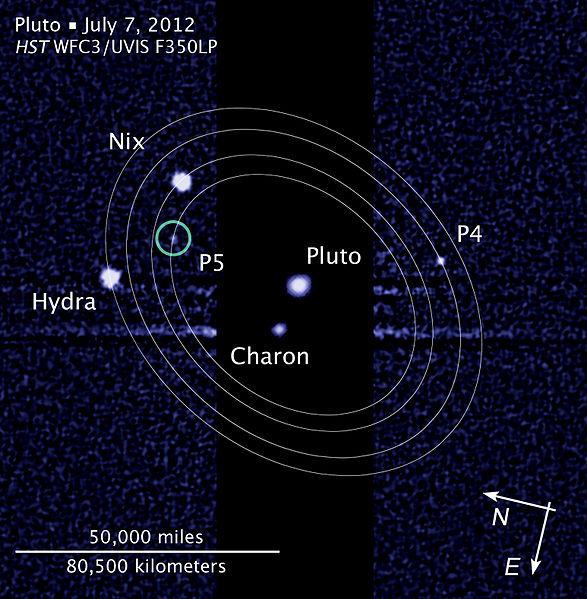
Images taken by the Hubble Space Telescope in 2011 and 2012 revealed two previously unknown moons of Pluto. So far, the moons are referred to as P4 and P5, but the time has come to give them permanent names. By tradition, the names of Pluto's moons come from Greek and Roman mythology and are related to the ancient tales about Hades and the Underworld. Dr. Mark Showalter, of the Carl Sagan Center for the Study of Life in the Universe - SETI Institute, will be proposing names for P4 and P5 to the International Astronomical Union (IAU), and is asking for your help in picking the names.
Pick your favorite names on the ballot at the following site:
https://sites.google.com/a/plutorocks.com/voting/home
Voting ends at noon EST on Monday, February 25th, 2013.
As background, Pluto is the Roman name for the Greek god Hades, master of the underworld. The underworld was the place where the souls of the departed go after they die. After Clyde Tombaugh discovered Pluto from the Lowell Observatory in 1930, a little girl named Venetia Burney from Oxford, England suggested that he name it "Pluto." Tombaugh liked the idea, in part because the initial letters "PL" reminded him of Percival Lowell, namesake for the obsevatory and the first to propose the existence of a "Planet X."
Charon is the name of Pluto's largest and innermost moon. It was discovered in 1978 by James Christy. In mythology, Charon was the boatsman who ferried the souls of the dead across the river Styx into the underworld.
Nix and Hydra are the names of Pluto's next two moons, discovered in 2005 in Hubble telescope images by a team of astronomers led by Hal Weaver and Alan Stern. Nix is the goddess of the night and Hydra is the name of the many-headed monster that guarded one of entrances to the underworld. These names, with initials "NH," were chosen to match the initials of New Horizons, the NASA spacecraft now on its way to Pluto.
This poll is being conducted by the SETI Institute and Dr. Mark Showalter on behalf of the P4/P5 Discovery Team. It is not affiliated with NASA, the Space Telescope Science Institute, the New Horizons Mission, or the International Astronomical Union.
The P4/P5 Discovery Team will take into consideration the results of the voting, but they are not binding. The P4/P5 Discovery Team, in consultation with the Nomenclature Working Groups of the International Astronomical Union, reserves the right to propose the names, but the International Astronomical Union has final authority over the naming of Pluto's moons.
For more information:
https://sites.google.com/a/plutorocks.com/voting/home
http://www.astromart.com/news/news.asp?news_id=1282
http://www.astromart.com/news/news.asp?news_id=857
http://www.astromart.com/news/news.asp?news_id=645
http://www.astromart.com/news/news.asp?news_id=436
http://www.astromart.com/news/news.asp?news_id=420
AstroMart News Archive:
http://www.astromart.com/news/search.asp?search=.+
Funding Member
