Charting the Slow Death of Our Universe
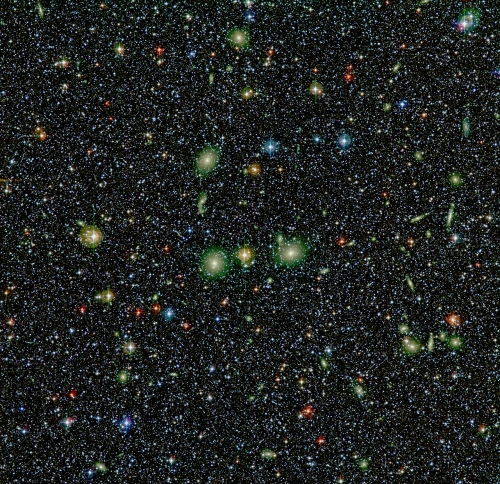
The fact that our Universe is slowly fading has been known since the late 1990s. Now, an international team of astronomers studying more than 200,000 galaxies has measured the energy generated within a large portion of space more precisely than ever before, representing the most comprehensive assessment of the energy output of the nearby Universe. They confirm that the energy produced in the Universe today is only about half of what it was two billion years ago. They also find that this fading is occurring across all wavelengths from ultraviolet to the far infrared. Their conclusion -- Our Universe is slowly dying.
The study, which is part of the Galaxy And Mass Assembly (GAMA) project -- the largest multi-wavelength survey ever put together -- involved many of the world's most powerful telescopes.
"We used as many space and ground based telescopes as we could get our hands on to measure the energy output of over 200,000 galaxies across as broad a wavelength range as possible," said Simon Driver of the University of Western Australia, who heads the large GAMA team.
The survey data, recently released to astronomers around the world, includes measurements of the energy output of each galaxy at 21 wavelengths, from the ultraviolet to the far infrared. This dataset will help scientists to better understand how different types of galaxies form.
All the energy in the Universe was created in the Big Bang, with some portion locked up as mass. Stars shine by converting mass into energy, as described by Einstein's famous equation E=mc^2. Much of the Universe's energy output comes from nuclear fusion in stars, when mass is slowly converted into energy. Another major source is the very hot discs around black holes at the centers of galaxies, where gravitational energy is converted to electromagnetic radiation in quasars and other active galactic nuclei. Much longer wavelength radiation comes from huge dust clouds that re-radiate the energy from stars within them. The GAMA study set out to map and model all of the energy generated within a large volume of space today and at different times in the past.
"While most of the energy sloshing around in the Universe arose in the aftermath of the Big Bang, additional energy is constantly being generated by stars as they fuse elements like hydrogen and helium together," Simon Driver said. "This new energy is either absorbed by dust as it travels through the host galaxy or escapes into intergalactic space and travels until it hits something, such as another star, a planet, or very occasionally, a telescope mirror."
The fact that the Universe is slowly fading has been known since the late 1990s, but this work shows that it is happening across all wavelengths from the ultraviolet to the infrared, representing the most comprehensive assessment of the energy output of the nearby Universe.
"The Universe will decline from here on in, sliding gently into old age. The Universe has basically sat down on the sofa, pulled up a blanket and is about to nod off for an eternal doze," concludes Simon Driver.
The team of researchers hope to expand the work to map energy production over the entire history of the Universe, using an arsenal of new facilities, including the world's largest radio telescope, the Square Kilometer Array, which is due to be built in Australia and South Africa over the next decade.
Founded in 1919, the International Astronomical Union (IAU) is the world's largest professional body for astronomers. The IAU brings together more than 10,000 professional astronomers from almost 100 countries. Its mission is to promote and safeguard the science of astronomy in all its aspects through international cooperation. The IAU also serves as the internationally recognized authority for assigning designations to celestial bodies and the surface features on them.
For more information:
http://www.iau.org/news/pressreleases/detail/iau1509/
http://www.astromart.com/news/news.asp?news_id=1020
AstroMart News Archive:
http://www.astromart.com/news/search.asp?search=.+
Funding Member
