COMET FIREBALL
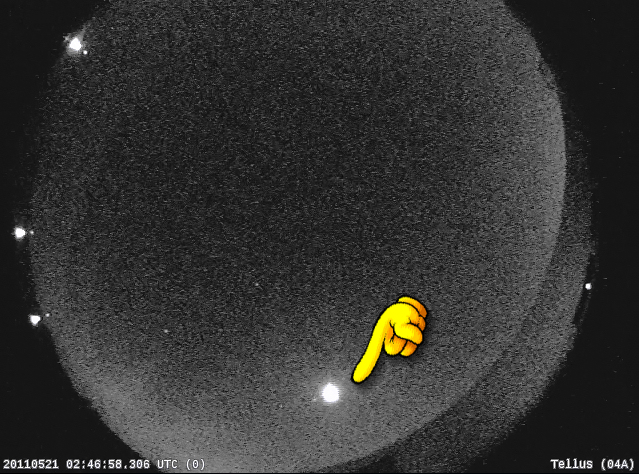
Residents of Atlanta, Georgia, and surrounding areas were startled on Friday night, May 20th around 10:47 EDT, when an object brighter than a full Moon streaked across the southern sky. "It appears to have been a disintegrating piece of comet," reports Bill Cooke of NASA's Meteoroid Environment Office. In a 1/3-speed video, recorded by a NASA fireball camera at the Tellus Science Museum in Cartersville, GA, fragments can be seen flying away from the bright exploding core.
Using data from multiple cameras, Cooke was able to triangulate the fireball's flight path. "Before it hit Earth, this object was in an orbit much like that of Halley's Comet." That doesn't mean the fireball came from Halley's Comet itself, but rather that it belongs to the Halley Family. Cooke continues: "This icy, fragile object was about 2 meters wide, hit the atmosphere at a speed of 38.5 km/s (86,000 mph), and completely disintegrated about 60 km above ground." Observers along the ground track reported bright blue-green flashes, luminous sparkles, and distinct fireball-shadows. "It was the brightest event we've seen in the three year history of our meteor network," adds Cooke.
The comet-chunk broke into at least four fragments. Cooke is analyzing the dynamics of each one to learn more about the parent body and to find out if any pieces might have reached the ground.
Click here for more about this subject. -Ed.
Funding Member
