Construction to Begin on the World's Largest Optical Telescope
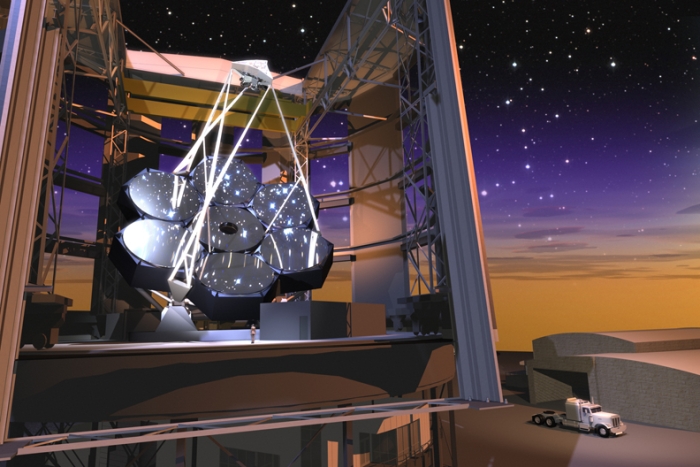
The Giant Magellan Telescope (GMT) is slated to be the first in a new class of extremely large telescopes, capable of producing images with 10 times the clarity of those captured by the Hubble Space Telescope. The GMT aims to discover Earth-like planets around nearby stars and the tiny distortions that black holes cause in the light from distant stars and galaxies. It will reveal the faintest objects ever seen in space, including extremely distant and ancient galaxies, the light from which has been travelling to Earth since shortly after the Big Bang, 13.8 billion years ago. The telescope will be built at the Carnegie Institution for Science's Las Campanas Observatory in the dry, clear air of Chile's Atacama Desert, in a dome 22 stories high. GMT is expected to see first light in 2021 and be fully operational by 2024.
The telescope's 25.4 meter (82 feet) primary mirror will comprise seven separate 8.4 meter (27 feet) diameter segments. Each mirror segment weighs 17 tons and takes one year to cast and cool, followed by more than three years of surface generation and meticulous polishing at the Richard F. Caris Mirror Lab of the Steward Observatory of the University of Arizona in Tucson, Ariz. Funding for the project comes from the partner institutions, governments and private donors.
The Giant Magellan Telescope Organization (GMTO) has announced that its 11 international partners have committed more than 500 million US Dollars to begin construction of the first of this extremely large telescope. Once it is built, the Giant Magellan Telescope is poised to be the largest optical telescope in the world.
The Giant Magellan Telescope's seven mirrors will focus more than six times the amount of light of the current largest optical telescopes into images up to 10 times sharper than those of the Hubble Space Telescope. The GMT will enable astronomers to look deeper into space and further back in time than ever before.
"The GMT will herald the beginning of a new era in astronomy. It will reveal the first objects to emit light in the universe, explore the mysteries of dark energy and dark matter, and identify potentially habitable planets in the Earth's galactic neighborhood," said Wendy Freedman, chair of the Giant Magellan Telescope Organization Board of Directors and University Professor of Astronomy and Astrophysics at the University of Chicago. "The decision by the GMTO partner institutions to start construction is a crucial milestone on our journey to making these amazing discoveries using state-of-the-art science, technology, and engineering."
GMTO President Edward Moses said, "The GMT is a global scientific collaboration, with institutional partners in Australia, Brazil, Korea, the United States, and in the host nation Chile. The construction approval means work will begin on the telescope's core structure and the scientific instruments that lie at the heart of this 1 billion US Dollar project. Early preparation for construction has included groundwork at the mountaintop site at Las Campanas in northern Chile, and initial fabrication of the telescope's seven enormous primary mirror segments."
The Giant Magellan Telescope -- A New Window on the Universe. Perspectives from leading astronomers. (Video Credit: University of Texas at Austin and Texas A&M)
Professor Matthew Colless, Vice Chair of the Board of Directors and Director of the Research School of Astronomy and Astrophysics at The Australian National University, said the construction approval was an exciting moment for astronomy.
"Plans that have existed only in two dimensions or as computer models are about to become a three dimensional reality in glass, steel, and high tech semiconductor and composite materials," said Colless. "The Giant Magellan Telescope will provide astronomers and astrophysicists with the opportunity to truly transform our view of the universe and our place within it."
For more information:
http://www.gmto.org/2015/06/giant-magellan-telescopes-international-partners-approve-start-of-construction-phase/
http://uanews.org/story/construction-to-begin-on-largest-telescope
http://www.astromart.com/news/news.asp?news_id=1329
http://www.astromart.com/news/news.asp?news_id=1150
http://www.astromart.com/news/news.asp?news_id=1063
AstroMart News Archive:
http://www.astromart.com/news/search.asp?search=.+
Funding Member
