Counting Down to a Liquid Mirror Telescope on the Moon
An international team of researchers at Université Laval in Quebec Canada has just solved a problem which threatened to cut short a NASA-funded project aimed at installing a liquid reflecting telescope on the Moon. The researchers managed to find a combination of materials which makes it possible to manufacture a liquid mirror with high reflective properties that is capable of functioning even in the difficult lunar environment.
This work was carried out by Ermanno Borra and Omar Seddiki of the Université Laval, and by their Canadian, American, and British collaborators.
"It's the breakthrough that we need," lead researcher Ermanno Borra said. "If you want to have a liquid mirror telescope on the moon, you need the right liquid. If you don't have the right liquid, forget it. It's as simple as that."
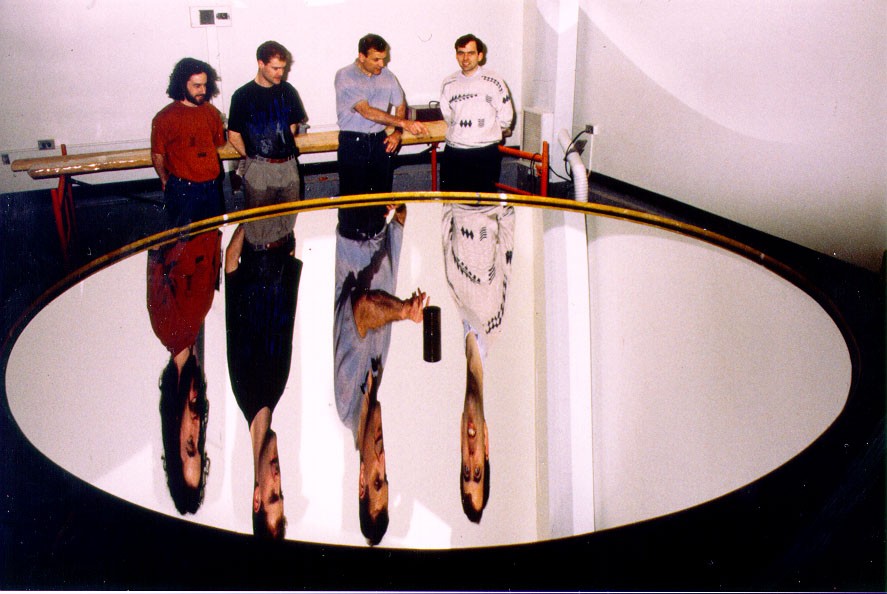
The reflecting telescopes liquid telescopes are distinguished from conventional telescopes by their primary mirror, which is made of a reflective liquid rather than manufactured out of glass. The reflective liquid is placed in a spinning container and the liquid is spread out in a thin perfectly smooth parabolic film. During two last decades, Professor Borra proved the feasibility of this process by manufacturing increasingly larger mirrors. Most recent, in 2003, the University of British Columbia built a liquid mirror with a diameter of 6 meters, which makes of it the 13th larger astronomical mirror in the world.
"We have shown how the moon is ideal ( for ) using liquid mirror technology to build a telescope much larger than we can affordably build in space," said S. Pete Worden, director of NASA Ames Research Center in California. "Such telescopes, perhaps 100 meters in diameter can see back to the early phases of the universe after the Big Bang," Worden added.
"The lunar, liquid-mirror project was supported by the NASA Institute for Advanced Concepts. It enabled a team of scientists including myself to show how the moon might support astronomy," Worden explained.
In 1991, Ermanno Borra proposed the installation of a liquid reflecting telescope on the Moon. Such an instrument, he stated, would have enormous practical and economic advantages compared to the conventional earth-based telescopes. Released from the disturbances created by the Earth's atmosphere, a lunar observatory equipped with such a mirror could deliver new information on the origin of the Universe and astronomers hope that such an instrument could allow them to study the early phases of the universe after the Big Bang.
The idea, which seemed like science fiction at the time, took on new life in 2004 when the NASA Institute for Advanced Concepts, an organization which supports projects that have the potential to greatly advance the limits of space science and technology, granted its financial support to the project.
The principal challenge of the project consisted in finding a liquid able to resist the conditions which prevail on the surface of the moon and to function at a temperature of -143 degrees Celsius to allow the observation in the infra-red spectrum. “Heat does not pose a problem because the observatory would be installed in the South Pole of the moon, in a crater which is never exposed to the Sun" according to Ermanno Borra. "On the other hand, it was necessary to find reflective liquids which remain liquid at temperatures of about -150 degrees Celsius and which do not evaporate.”
The solution came from the work undertaken by the student-researcher Omar Seddiki. The researchers managed to deposit, by vacuum vaporization, a coating on an ionic liquid. The resulting surface is perfectly smooth, has good reflectivity, and remains stable for months. The ionic liquid on which the layer of reflective silver rests does not evaporate and has a melting point is of - 98 degrees Celsius. “We used a commercial ionic liquid for our tests," announces professor Borra. With further research, "we believe we can find materials which will remain liquid even at temperatures much lower.”
The liquid mirror for the lunar telescope would have a diameter of between 20 and 100 meters, which would provide a sensitivity up to 1000 times more than that of the next generation James Webb Space Telescope, due for a 2013 launch. The researchers think any liquid-mirror telescope on the moon would not come before 2020 at the earliest.
A large telescope on the moon would be more cheaply and easily built using a liquid mirror rather than a conventional glass one. In addition to the advanced optical qualities of such an instrument, Ermanno Borra puts forward its practical side. “Instead of transporting mirror of a heavy, expensive, and complex glass, whose installation would require painful adjustments, we will be able to bring the liquid mirror in bottles and to assemble the whole thing on the Moon.”
For more information:
http://www.nasa.gov/centers/ames/news/releases/2007/07_36AR.html
http://www.aufil.ulaval.ca/articles/pas-plus-vers-lune-665.html
http://www.int.iol.co.za/index.php?click_id=31&art_id=nw20070622014234147C308352&set_id=
Funding Member
