Crashing Comets Not Likely the Cause of Earth's Mass Extinctions
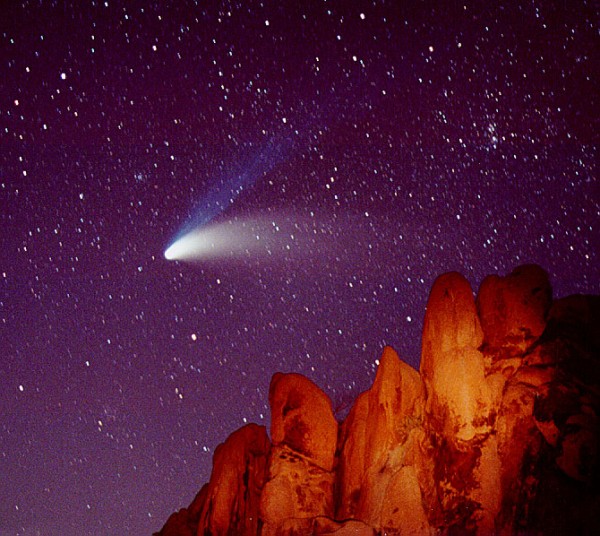
Scientists have debated how many mass extinction events in Earth's history were triggered by a space body crashing into the planet's surface. For example, most agree that an asteroid collision 65 million years ago brought an end to the age of dinosaurs. New University of Washington research indicates, however, that it is highly unlikely that comets have caused any mass extinctions.
Comments:
Does anybody here know something about the 40 million years ago comet shower mentioned in the article (3 major impacts that occurred nearly simultaneously) and the subsequent extinction event? This is the first time I've heard any mention of this ...<br><br>Terry<br>
Never heard of the comet shower either. Maybe not comets but meteors for sure.
Terry:<br><br>Here's an interesting theory postulated by folks at Cardiff University in the UK that as the Solar System revolves around the Milky Way, it oscillates up and down through the galactic plane. <br><br>http://www.caerdydd.ac.uk/news/mediacentre/mediareleases/May08/did-the-solar-system-bounce-finish-the-dinosaurs.html<br><br>"The Cardiff team says that when we pass through the galactic plane every 35 to 40 million years, the chances of a comet collision are increased tenfold. Intriguingly, evidence from craters on Earth also suggests we suffer more collisions approximately every 36 million years."<br><br>"It's a beautiful match between what we see on the ground and what is expected from the galactic record," noted Cardiff's Professor William Napier.<br><br>Of course it's all speculative, but the idea sounds plausible to me.<br><br>Guy Pirro<br><br>http://www.scienceagogo.com/news/20080404234031data_trunc_sys.shtml<br><br><br><br><br><br><blockquote class="blockquote"><div class="italic"><i>Terry Friedrichsen said:</i><br><br>Does anybody here know something about the 40 million years ago comet shower mentioned in the article (3 major impacts that occurred nearly simultaneously) and the subsequent extinction event? This is the first time I've heard any mention of this ...<br><br>Terry<br></div></blockquote>
Earth is moving around the sun at over 12 miles per second. Considering potential closing velocities with a huge ball of ice that could range up to several times that velocity, it is conceivable that Tunguska and other massive "craterless" impacts have the character of the so called dissolving assasins bullet.<br><br>Steam and water at standard atm. pressure have a volumetric ratio of 1000:1. An icy pourous atm. impact could generate enough heat and expansion to puverize everything in it's path like a hydrogen bomb. <br><br>The earth passing through a much less dense portion of a comet - like falling wet snow - could still create a disaster like the impact of Hurricane Katrina.<br><br>1,000,000 tons of water spead over an area 100,000 times larger carries the same energy as an equivalent mass rock, but finding trace evidence of water impacts is difficult.<br><br>Moon basins may be where giant "clouds" hit the moon at incredible velocities blasting fine debris into space, and may be responsible for the soil's consistency.<br><br>Our atmosphere mitigates external forces acting on earth by by reflection, absorbtion, conversion, etc.<br><br>The presence of non-indigenous elements, isotopes, and minerals often identify ET impacts, so suborbital balloons with rocket assist for hovering and sustaining "flight" at 120K to 300K ft for long periods might discover evidence might make sense. <br><br>Do we have any of those? Don't we need some?
Have astronomers thoroughly surveyed the neighborhood for smoking-gun artifacts of long-ago Gamma Ray Bursters or Super-Nova cinders which may have been at the right place and the right time to correlate with any of the extinctions in the geological record?<br><br>Maybe this is so obvious that such surveys were done long ago? Or maybe it isn't yet possible to accurately calculate where everything 'in the neighborhood' happened to be located millions of years ago? I am ignorant of what the current state of the art in astronomy is capable of calculating.<br><br>Then there is such as this:<br><br>http://www.centauri-dreams.org/?p=1378<br><br>http://discovermagazine.com/2008/whole-universe/30-how-a-cloud-of-dust-could-wipe-out-life-on-earth<br><br>If we can see a dust cloud ahead that might rain-down x-rays thousands of years in the future, has anyone 'looked in the rear view mirror' to find any dust clouds we may have passed through about the correct time in the past, to coincide with extinctions? Or is it currently beyond our ability to look very accurately far back in the rear view mirror?
We know little about comet impacts. 100 years from now we will have likely classified comets from rocky core to soft ice core and be a bit better off.<br><br>Stars reveal much more information - enough so that we can anticpate by reviewing history of similar stars what they might do and when. Comets, however, differ greatly and defy classification; you neva know what ya gonna git.<br><br>I'll risk scorn by interjecting a philosophical angle.<br><br>If I take into account the foundation of my own family two generations preceding and two after, change appears slow. In historical perspective it changes much more quickly. <br><br>Much of our infrastructure - lasts on average - from one to two human lifespans. Most road surfaces, wire cables, many residences and buildings will be gone in 90 years. That's one chapter in a textbook.<br><br>The longer cycles on a cosmic scale are two: statistical chance, and naturally recurring. With the political and social history of earth looking like a deadly freee for all, there has never been a time where being concerned about the distant future might benefit 4 and more generations ahead. <br><br>We may lose New Orleans to the sea, but even concrete evidence would not justify the monumental cost - in light of all the other costly problems we have - of building on higher ground.<br><br>Mass extinction is not earth's problem. I am not worried about a giant red sun consuming earth, but it is fun imagining liberals and conservatives debating the issue.
Funding Member
