DESTINY Space Telescope to Study Mysterious Dark Energy
The discovery of a mysterious force now known as Dark Energy was announced in 1998 by two independent teams of astronomers who were studying distant supernovae as a way to measure how the expansion rate of the Universe has changed over time. These teams (both of whom used NOAO telescopes in Chile to discover the supernovae) were surprised to discover that, rather than slowing down, as had been expected, the expansion rate of the Universe is actually speeding up as the Universe ages. To explain this surprising phenomenon, scientists have been forced to conclude that the Universe contains not only ordinary matter and dark (invisible) matter, but also an ingredient called Dark Energy that permeates all of space and propels this expansion. Understanding the origin and properties of Dark Energy is probably the most outstanding problem in cosmology today.
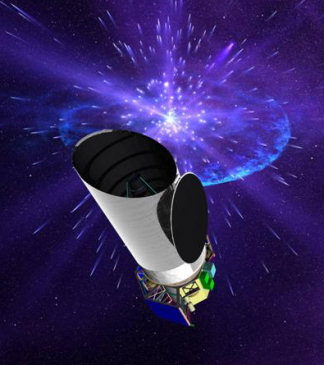
Destiny, the Dark Energy Space Telescope, will detect and observe more than 3,000 supernovae over its two-year primary mission to measure the expansion history of the Universe, followed by a year-long survey of 1,000 square-degrees of the sky at near-infrared wavelengths to measure how the large-scale distribution of matter in the Universe has evolved since the Big Bang.
Used together, the data from these two surveys will have 10 times the sensitivity of current ground-based projects to explore the properties of Dark Energy, and will provide data critical to understanding the origin of Dark Energy, which is poorly explained by existing physical theories.
“Destiny’s strength is that it is a simple, low-cost mission designed to attack the puzzling problem of Dark Energy directly with high statistical precision,” said Tod R. Lauer, the Principal Investigator for Destiny and an astronomer at NOAO. “We build upon technology used in the Hubble Space Telescope’s Advanced Camera for Surveys to help us provide spectra of the supernovae as well as images. Spectra are critical to diagnosing the properties of the supernova, but are very difficult to obtain with more traditional cameras. Destiny’s camera, however, will take simultaneous spectra of all objects in its field. This is a major advantage of our approach, which greatly increases the ability to detect and characterize these distant stellar explosions.”
“Destiny is designed to exploit two complementary paths — supernovae and large scale distribution of matter — to measure Dark Energy in a manner that is less susceptible to unknowns than any single technique,” said Dominic J. Benford of NASA Goddard, the Deputy Principal Investigator for Destiny.
If the Destiny project is ultimately selected to proceed, the spacecraft and its 1.65-meter telescope would be launched into a stable orbit at the second Earth-Sun Lagrangian point as soon as 2013. This location allows for stable and continuous operation of the instrument. Initially Destiny would continuously observe two patches of the sky for distant supernovae. Destiny’s observations are planned to coordinate closely with those from current large ground-based telescopes and emerging facilities such as the Large Synoptic Survey Telescope (LSST).
For more information:
http://www.noao.edu/outreach/press/pr06/pr0610.html
Funding Member
