Did FermiLab Researchers Get a First Glimpse of Dark Matter?
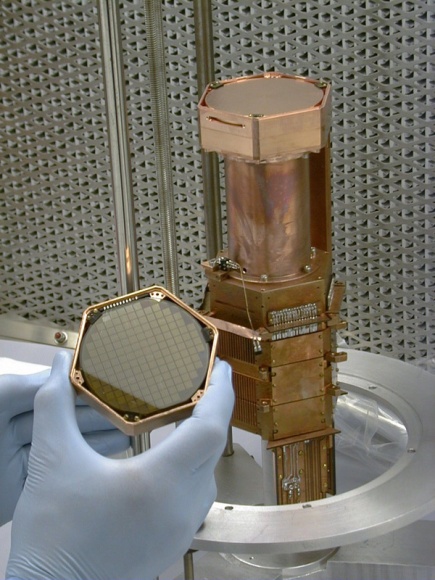
Scientists from the Cryogenic Dark Matter Search experiment, managed by the Department of Energy's Fermi National Accelerator Laboratory, have detected two events that have characteristics consistent with the particles that physicists believe make up dark matter.
However, there is a chance that both events could be the signatures of background particles – other particles with interactions that mimic the signals of dark matter candidates. Scientists have a strict criterion when determining whether a discovery has been made. There must be less than one chance in 1,000 that the observed events could be due to background. This result does not yet pass that test, so CDMS experimenters do not claim to have detected dark matter. Nevertheless, the result has caused considerable excitement in the scientific community.
"This is a very intriguing result. We really don't know if this is a background or a signal," said Lauren Hsu, a CDMS researcher at Fermilab who announced the experiment's results in a talk at Fermilab on Thursday. "As an experimenter you always wish you had more data. I'm really interested to see what our next results will be."
"While this result is consistent with dark matter, it is also consistent with backgrounds,” said Fermilab Director Pier Oddone. “In 2010, the collaboration is installing an upgraded detector (SuperCDMS) at Soudan with three times the mass and lower backgrounds than the present detectors. If these two events are indeed a dark matter signal, then the upgraded detector will be able to tell us definitively that we have found a dark matter particle."
Astronomical observations from telescopes, satellites and measurements of the cosmic microwave background have led scientists to believe that most of the matter in the universe neither emits nor absorbs light. This dark matter may have provided the gravitational scaffolding that allowed normal matter to coalesce into the galaxies we see today. In particular, scientists think our own galaxy is embedded within an enormous cloud of dark matter. As our solar system rotates around the galaxy, it moves through this cloud.
Particle physics theories suggest that dark matter is composed of Weakly Interacting Massive Particles (WIMPs). Scientists expect these particles to have masses comparable to, or perhaps heavier than, atomic nuclei. Although such WIMPs would rarely interact with normal matter, they may occasionally bounce off, or scatter from, an atomic nucleus like billiard balls, leaving a small amount of energy that is detectable under the right conditions.
The CDMS experiment, located a half-mile underground at the Soudan mine in northern Minnesota, has been searching for WIMPs since 2003. The experiment uses 30 detectors made of crystals of germanium and silicon in an attempt to detect WIMP scatters. The detectors are cooled to temperatures very near absolute zero. Particle interactions in the crystalline detectors deposit energy as heat and as charges that move in an applied electric field. Special sensors detect these signals, which are then amplified and recorded for later study. By comparing the size and relative timing of these two signals, experimenters can distinguish whether the particle that interacted in the crystal was a WIMP or a background particle. Layers of shielding materials, as well as the half-mile of rock above the experiment, are used to prevent most of the background particles from reaching the detector.
Previous CDMS data did not yield evidence for WIMPs, but did assure physicists that the backgrounds have been suppressed to the level where as few as one WIMP interaction per year could have been detected.
CDMS collaborators are now reporting on their new data set, taken in 2007-2008, which approximately doubles the sum of all past data sets. With each new data set, collaborators must carefully evaluate each detector's performance, excluding periods when the detectors were not operating properly.
Physicists assess detector operation by frequently exposing the detector to sources of two types of radiation: gamma rays and neutrons. Gamma rays are the principal source of normal matter background in the experiment. Neutrons are the only known type of particle that will interact with germanium nuclei in the billiard ball style that WIMPs would. Neutrons frequently hit more than one of the CDMS detectors, while WIMPs would only hit one.
Experimenters use data from these studies as a baseline for determining how well a WIMP-like signal (produced by neutrons) is visible over a background (produced by gamma rays). Based on this information, physicists predict that no more than one background event will be visible in the data region where WIMP signals would appear. Since background and signal regions overlap somewhat, achievement of this background level required experimenters to throw out roughly 2/3 of the data that might contain WIMPs, because these data would contain too many background events.
CDMS experimenters do all of their data analysis without looking at the data region that might contain WIMP events. This standard scientific technique, sometimes referred to as ‘blinding’, is used to avoid the unintentional bias that might lead a scientist to keep background events that have some of the characteristics of WIMP interactions that are really from background sources. After collaborators have made detailed estimates of background ‘leakage’ into the WIMP signal region, they ‘open the box’, or look in that region, and see if there are any WIMP events present.
A signal of about five events would meet criteria to claim a discovery. With only two events detected in this data set, there is about a one in four chance that these could be due to backgrounds. Therefore, CDMS experimenters do not claim to have discovered WIMPs. Previous results have established a rate of interaction between WIMPs and nuclei that varies depending on WIMP mass. The new result improves upon these limits for WIMPs with a large mass. Such upper limits are quite valuable in eliminating a number of theories that might explain dark matter. For examples, the results rule out some parameter values that the theory of supersymmetry could have.
What comes next? While physicists could operate the same set of detectors at Soudan for many more years to look for more WIMP events, this would not take advantage of new detector developments and would try the patience of even the most stalwart experimenters (not to mention theorists). A better way to increase sensitivity to WIMPs is to boost the size of detectors that might see the particles, while still maintaining the ability to keep backgrounds under control. This is precisely what CDMS experimenters are now in the process of doing. By summer of 2010, collaborators hope to have about three times more germanium nuclei sitting near absolute zero at Soudan, patiently waiting for WIMPs to provide the perfect billiard ball shots that will offer compelling evidence for dark matter.
For more information:
http://www.fnal.gov/pub/today/Special_Edition121709.html
http://www.astromart.com/news/news.asp?news_id=979
http://www.astromart.com/news/news.asp?news_id=853
http://www.astromart.com/news/news.asp?news_id=831
http://www.astromart.com/news/news.asp?news_id=489
AstroMart News Archive:
http://www.astromart.com/news/search.asp?search=.+&search_btn=Go
Funding Member
