Did the Dino-Meteor Have Help From a Super Volcano?
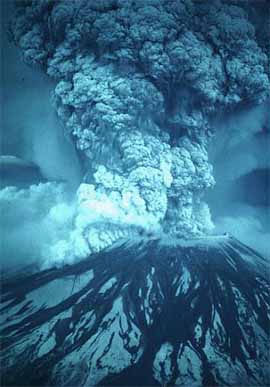
A series of monumental Super Volcanic eruptions in India may have killed the dinosaurs 65 million years ago, not a meteor impact in the Gulf of Mexico. The eruptions, which created the gigantic Deccan Traps lava beds of India, are now the prime suspect in the most famous and persistent paleontological murder mystery, say scientists who have conducted a slew of new investigations honing down eruption timing.
"It's the first time we can directly link the main phase of the Deccan Traps to the mass extinction," said Princeton University paleontologist Gerta Keller. The main phase of the Deccan eruptions spewed 80 percent of the lava which spread out for hundreds of miles. It is calculated to have released ten times more climate altering gases into the atmosphere than the nearly concurrent Chicxulub meteor impact, according to volcanologist Vincent Courtillot from the Physique du Globe de Paris.
Keller's crucial link between the eruption and the mass extinction comes in the form of microscopic marine fossils that are known to have evolved immediately after the mysterious mass extinction event. The same telltale fossilized planktonic foraminifera were found at Rajahmundry near the Bay of Bengal, about 1000 kilometers from the center of the Deccan Traps near Mumbai. At Rajahmundry there are two lava "traps" containing four layers of lava each. Between the traps are about nine meters of marine sediments. Those sediments just above the lower trap, which was the mammoth main phase, contain the incriminating microfossils.
Previous work had first narrowed the Deccan eruption timing to within 800,000 years of the extinction event using paleomagnetic signatures of Earth's changing magnetic field frozen in minerals that crystallized from the cooling lava. Then radiometric dating of argon and potassium isotopes in minerals narrowed the age to within 300,000 years of the 65-million-year-old Cretaceous-Tertiary boundary, sometimes called the K-T boundary.
The microfossils are far more specific, however, because they demonstrate directly that the biggest phase of the eruption ended right when the aftermath of the mass extinction event began. That sort of clear-cut timing has been a lot tougher to pin down with Chicxulub-related sediments, which predate the mass extinction.
"Our results are consistent and mutually supportive with a number of new studies... that reveal a very short time for the main Deccan eruptions at or near the K-T boundary and the massive carbon dioxide and sulfur dioxide output of each major eruption that dwarfs the output of Chicxulub," explained Keller. "Our K-T age control combined with these results strongly points to Deccan volcanism as the likely leading contender in the K-T mass extinction." Keller's study was funded by the National Science Foundation.
For more information:
http://www.geosociety.org/news/pr/07-59.htm
http://www.astromart.com/news/news.asp?news_id=492
http://www.geosociety.org/news/pr/06-14.htm
http://www.geosociety.org/news/pr/05-27.htm
Astromart Archives:
http://www.astromart.com/news/search.asp?search=.+&search_btn=Go
