Image of the day

Captured by
Michael Scherman

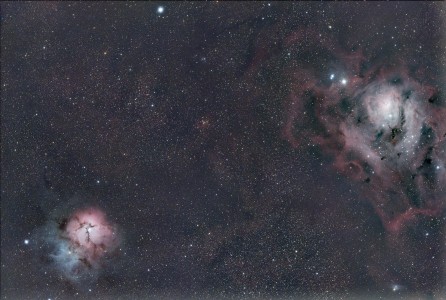
Lagoon and Triffid Celestron C6 Hyperstar4

My Account

New to Astromart?

Register an account...

Need Help?

Discovery of the Most Distant Galaxy in the Cosmic Dawn
06/17/2012 04:05PM

Discovery of the Most Distant Galaxy in the Cosmic Dawn

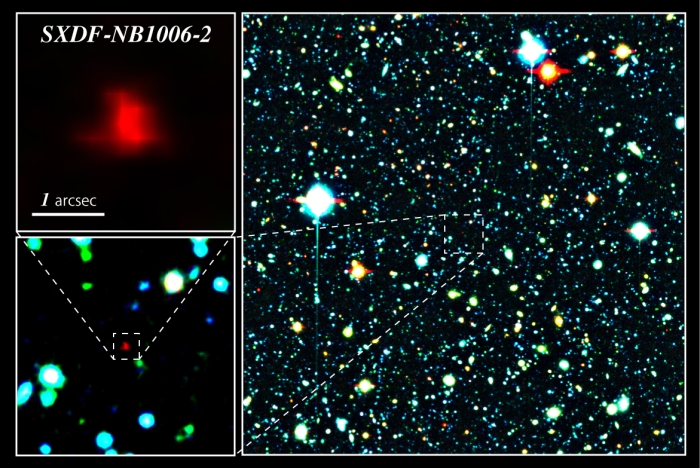
A team of astronomers has used the Subaru and Keck Telescopes to discover the most distant galaxy ever found, SXDF-NB1006-2, at a distance of 12.91 billion light years from the Earth. Astronomers think that the our Universe began 13.7 billion years ago at the Big Bang. The exteme temperature and density of this fireball decreased rapidly as its volume increased. Hot cosmic plasma composed mainly of protons and electrons recombined to form neutral hydrogen atoms within 380,000 years after the Big Bang. This was the beginning of the cosmic "dark age." From then on, the gas continued to cool and fluctuated in density. These findings help us to understand the nature of the early Universe during the "cosmic dawn," when the light of ancient celestial objects and structures first appeared from obscurity.


Comments:

  • davelump [David Lumpkin]
  • 06/19/2012 08:06AM
Is scale on the 3rd photo wrong? If it is correct then the object is around 2.0 million light years across. (late nite math error)<br><br>David

  • doctor y [John Yurechko]
  • 06/19/2012 05:58PM
OK cosmologists, please rescue us normal humans from the twisted tangle of space time. This article is excellent, but every time I read about the "most distant object" I ponder the imponderable. If the object is almost 13 billion light years away, and we are just now detecting its light, then (1) where is it "now"?; and (2) if it has taken that long to reach "us" then have we been moving faster than light to get to "where we are 'now'" so that we can see the 13 billion light year old light "ago"? My head hurts . . . now . . . 8O
