Image of the day

Captured by
Michael Scherman

Dual Clusters near Antares

My Account

New to Astromart?

Register an account...

Need Help?

Distant Galaxy Cluster Found in Plain View
07/21/2012 07:26PM

Distant Galaxy Cluster Found in Plain View

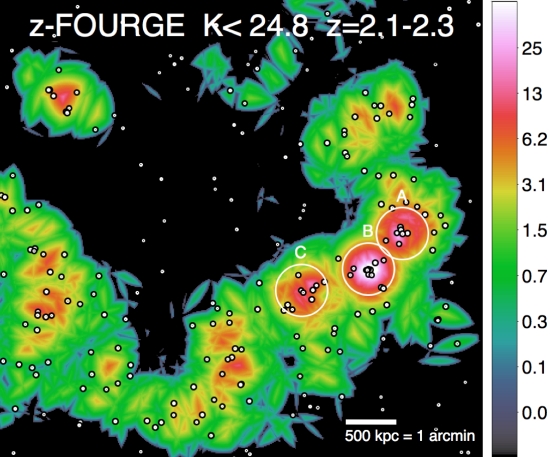
A team of astronomers has discovered the most distant example of a galaxy cluster lying in the middle of one of the most well-studied regions in the sky. Galaxy clusters are the "urban centers" of the universe and may contain thousands of galaxies. This cluster is located 10.5 billion light-years away from the Milky Way galaxy and is made up of a dense concentration of 30 galaxies. The discovery of this early system will help astronomers understand how galaxies are influenced by their environment. We see the end result of this process in nearby galaxy clusters, but it is critical to study distant clusters to develop a broad timeline of how galaxies were transformed in densely packed regions.


Comments:

Hi - A couple sentences describing just what the color image is showing us in relation to the news story would be really helpful in understanding the article. Otherwise, it might just as well be a fingerpainting project somebody's 3-year-old did. ernie spragg fresno ca
  • tbennett [Thomas Bennett]
  • 07/27/2012 12:49AM
They appear to be using narrow-band IR filters to detect faint galaxies at specific distances. The Z range of 2.1-2.3 corresponds to recession velocities a little over 0.8c (light speed) or a distance (using Hubble's Law that correlates recession speed with distance) of about 10.5 billion light years. Galaxies more or less distant than 10.5 billion light years will be filtered out. The small circles are probably the galaxies detected at this specific distance and the 3 large circles are where these galaxies cluster.<br><br>The coloring may be a galaxy density map but this can't be just the galaxies at 10.5 billion light years since the colors indicate a density range much larger than what's indicated by the small circles.<br><br>I'd guess the coloring represents the density of galaxies observed at all ranges but there's no way to tell for sure without additional info.
