Dwarf Galaxy on Collision Course with the Milky Way has Already Breached the Perimeter
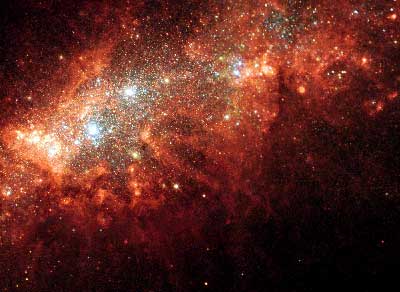
The “Local Group” of galaxies, to which the Milky Way and Andromeda belong, contains more dwarf galaxies than any other type. An example is the Small Magellanic Cloud (SMC) visible from the southern hemisphere. The low surface brightness and lack of bright stars makes many of these dwarf galaxies difficult to study, even with a large telescope. A team of astronomers, using data obtained from the Sloan Digital Sky Survey (SDSS), has discovered a dwarf galaxy companion to the Milky Way that is so close in proximity that until now it has been undetected. It appears to be a classic case of “not being able to see the forest for the trees.”
The study, lead by Mario Juric of Princeton and Zeljko Ivezic of the University of Washington, found a collection of stars in the constellation Virgo that “is located only 30,000 light years from Earth," noted Penn State Professor of Astronomy and Astrophysics Donald Schneider, a contributor to the investigation. "This is the same distance from us as is the Galactic Center, although the cluster lies in a different direction from the Center. It is likely that the cluster is the remnant of a small galaxy that has been captured and disrupted by the gravitational field of our galaxy."
The galaxy is a huge but very faint structure, containing hundreds of thousands of stars. Although the structure lies well within the confines of the Milky Way Galaxy, at an estimated distance of 30,000 light years from Earth, it does not follow any of Milky Way's three main components: 1) a flattened disk of stars in which the Sun resides, 2) a bulge of stars at the center of the Galaxy, and 3) an extended, roughly spherical, stellar halo. Instead, the discoverers believe that the most likely interpretation of the new structure is a dwarf galaxy that is in the process of merging into the Milky Way.
"Some of the stars in this Milky Way companion have been seen with telescopes for centuries," explained Mario Juric of Princeton University. "But because the galaxy is so close, its stars are spread over a huge swath of the sky, and they always used to be lost in the sea of more numerous Milky Way stars. This galaxy is so big, we couldn't see it before."
The discovery was made possible by the unprecedented depth and photometric accuracy of the Sloan Digital Sky Survey (SDSS), which to date has imaged roughly 1/4 of the northern sky. "We used the SDSS data to measure distances to 48 million stars and build a 3-D map of the Milky Way," explained Zeljko Ivezic of the University of Washington.
"It's like looking at the Milky Way with a pair of 3-D glasses," said Princeton University contributor Robert Lupton. "This structure that used to be lost in the background suddenly snapped into view.”
Preliminary evidence for the new dwarf galaxy, found toward the constellation Virgo, appeared in previous maps of variable stars by the SDSS. "With so much irregular structure in the outer Galaxy, it looks as though the Milky Way is still growing, by cannibalizing smaller galaxies that fall into it," said Juric.
While the SDSS originally was designed to study the distant universe, its wide area, high precision maps of faint stars have made it an invaluable tool for studying the Milky Way and its immediate neighborhood. The 3-D map created by Juric, Ivezic, and their collaborators also provides strong new constraints on the shape and extent of the Milky Way's disk and stellar halo.
For More Information:
http://www.science.psu.edu/alert/Schneider1-2006.htm
http://www.sdss.org/news/releases/20060109.virgooverdensity.html
Funding Member
