
Einstein@Home Volunteers Discover New Radio Pulsar
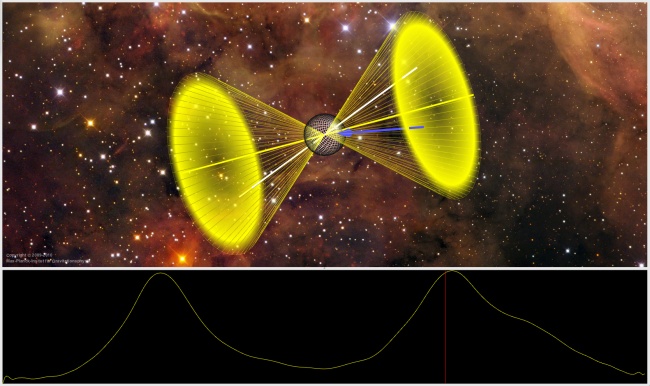
Three citizen scientists, a German and an
American couple, have discovered a new radio pulsar hidden in data gathered by the Arecibo
Observatory. This is the first deep-space discovery by Einstein@Home, which uses donated time from the home and office computers of 250,000 volunteers from 192 different countries.
The citizens credited with the discovery are Chris and Helen Colvin, of Ames, Iowa and Daniel
Gebhardt, of Universität Mainz, Musikinformatik, Germany. Their computers, along with 500,000
others from around the world, analyze data for Einstein@Home.
The new pulsar called PSR J2007+2722 is a neutron star that rotates 41 times per second. It is in the Milky Way, approximately 17,000 light years from Earth in the constellation Vulpecula. Unlike most pulsars that spin as quickly and steadily, PSR J2007+2722 sits alone in space, and has no orbiting companion star. Astronomers consider it especially interesting since it is likely a recycled pulsar that lost its companion. However they can not rule out that it may be a young pulsar born with a lower-than-usual magnetic field.
Einstein@Home (based at the Center for Gravitation and Cosmology at the University of Wisconsin, Milwaukee, and at the Max Planck Institute for Gravitational Physics in Germany),
has been searching for gravitational waves in data from the US LIGO Observatory since 2005. Starting in March 2009, Einstein@Home also began searching for signals from radio pulsars in astronomical observations from the Arecibo Observatory in Puerto Rico. Arecibo is the world’s largest and most sensitive radio telescope, and is managed by Cornell University.
About one-third of Einstein@Home's computing capacity is used to search Arecibo data. "This is a thrilling moment for Einstein@Home and our volunteers. It proves that public participation can discover new things in our universe. I hope it inspires more people to join us to help find other secrets hidden in the data," says Bruce Allen, leader of the Einstein@Home project.
James M. Cordes, Cornell professor of astronomy said "No matter what else we find out about it, this pulsar is bound to be extremely interesting for understanding the basic physics of neutron stars and how they form. Its discovery has required a complex system that includes the Arecibo Telescope and computing resources at the Albert Einstein Institute, at the Cornell Center for Advanced Computing, and at the University of Wisconsin to be able to send data out worldwide to Einstein@Home volunteers."
The Arecibo Observatory is funded by the National Science Foundation, which collaborates with the Max Planck Gesellschaft to support Einstein@Home.
For more information:
http://einstein.phys.uwm.edu/radiopulsar/html/discovery_page/docs/Einstein@Home_pulsar_engl.pdf
http://einstein.phys.uwm.edu/radiopulsar/html/discovery_page/firstdiscovery.html
http://www.astromart.com/news/news.asp?news_id=1046
http://www.astromart.com/news/news.asp?news_id=955
http://www.astromart.com/news/news.asp?news_id=920
http://www.astromart.com/news/news.asp?news_id=898
http://www.astromart.com/news/news.asp?news_id=874
http://www.astromart.com/news/news.asp?news_id=432
AstroMart News Archive:
http://www.astromart.com/news/search.asp?search=.+&search_btn=Go
Funding Member
