Excuse Me While I Kiss the Sky -- Month of June 2025

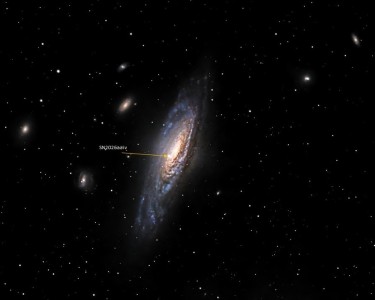
M100 (NGC 4321) is a stunning example of a grand-design spiral galaxy. The galaxy’s prominent spiral arms swirl around the galaxy’s nucleus and are marked by a flurry of star formation. M100’s characteristic arms also host several small black holes, including the youngest one ever observed in our cosmic neighborhood. The galaxy was discovered in 1781 by the French astronomer Pierre Méchain, Charles Messier’s fellow comet hunter who discovered eight comets in his lifetime. M100 is located 56 million light-years away from Earth and appears dim in the night sky. Its apparent magnitude of 10.1 means that, while it can be seen through small telescopes, it will appear only as a faint patch of light. Larger telescopes can resolve more details of this galaxy. M100 is located in the constellation Coma Berenices. [Video and Content Credits: NASA, the Office of Public Outreach – Space Telescope Science Institute (STScI) and JPL Caltech: Preston Dyches, Christopher Harris, and Lisa Poje, with subject matter guidance provided by JPL’s Bill Dunford and Lyle Tavernier, and the Night Sky Network’s Kat Troche] [Image Credit: Stephen Fry - Astromart Gallery Contributor – Telescope: 12" LX200R (ACF) scope on Paramount ME housed in a 2.3m Sirius dome at Sierra Skies Observatory in northern California, Camera: STL-11000M – See some of his beautiful work at https://www.astromart.com/gallery/user/1507 ]
Excuse Me While I Kiss the Sky -- Month of June 2025
Welcome to the night sky report for June 2025 -- Your guide to the constellations, deep sky objects, planets, and celestial events that are observable during the month. Mercury, Venus, Mars, Jupiter, and Saturn make appearances during the month. The bright central bulge of our home galaxy, the Milky Way, is visible all night in June, continuing through August. It is best observed from dark sky locations far from bright city lights and appears as a faint, cloud-like band arching across the sky toward the south. During the month, look for the Hercules constellation, which will lead you to a globular star cluster with hundreds of thousands of densely packed stars. Globular cluster M13 (the Hercules Cluster, NGC 6205) is best observed with a telescope, but binoculars will reveal it as a fuzzy spot. You can also spot Draco the dragon, which will point you to the Cat’s Eye Nebula (C6, NGC 6543). The night sky is truly a celestial showcase. Get outside and explore its wonders from your own backyard.
Starting with planet observing for this month, find Saturn and Venus in the eastern sky during the couple of hours before dawn each morning throughout the month. Saturn rises around 3:00 AM in early June, and around 1:00 AM by the end of the month. Saturn begins the month near Venus in the dawn sky, but rapidly pulls away, rising higher as June goes on. Saturn rapidly climbs higher in the sky each day as the month goes on. You'll find the third quarter moon next to Saturn on June 19th and a crescent moon next to Venus on June 22nd. Venus rises about 2 hours before the Sun in June, and shines very brightly, low in the eastern sky, in the morning all month.
For those with a clear view to the western horizon, Mercury becomes visible for a brief period each evening at the end of June. Look for it quite low in the sky starting 30 to 45 minutes after the Sun sets as the glow of sunset is fading. It's highest and most visible on June 27th.
Mars is still visible in the couple of hours after sunset toward the west, though it's noticeably fainter than it was in early May as Earth speeds away in its orbit, putting greater distance between the two worlds. Over several days in mid-June, Mars passes quite close to Regulus, the bright star at the heart of the constellation Leo, the lion. Have a peek on the 16th and 17th with binoculars or a small telescope to see them as close as the width of the full moon.
Jupiter is visible quite low in the west after sunset for the first week of June, then lost in the Sun's glare after. Jupiter will re-appear in July in the morning sky.
What is that?
When you spot bright or moving objects in the night sky, it might not be immediately clear what you're looking at. Is that a planet, or just a bright star? Is it a satellite, or maybe just an airplane? Here are a few quick tips on how to tell the difference.
First, there are five planets that are easily observed with the unaided eye. Of these, two planets – Venus and Jupiter – can sometimes appear incredibly bright, like shining beacons in the sky. The other planets are much less bright, but still generally shine as brightly as bright stars.
The big tipoff that you're looking at a star and not a planet is that planets tend to shine steadily, whereas stars twinkle. Stars are so far away that they're just points of light, and ripples in our atmosphere easily distort them, causing the familiar flicker. The planets are relatively closeby, being here in our solar system. Through binoculars or a telescope, instead of a single point, planets show us a tiny disk or crescent that's illuminated by the Sun. So even though they appear star-like to the eye, the light from a planet is coming from a slightly more spread-out area, making planets appear more constant in brightness. Both planets and stars rise in the east and set in the west, and they move very slowly across the sky during the night.
But what if you see an object that's moving? Distant aircraft are usually pretty easy to identify, because they follow a slow, steady path that's straight or gently curving. They have exterior lights that flash in a regular pattern, often including a red beacon.
Satellites tend to be most visible in the hour or so after dark or before dawn, when it's night here on the surface, but the satellites are high enough in the sky to be illuminated by sunlight. They're generally fainter than aircraft, and move in slow, very steady, very straight paths. They might briefly flare in brightness, but they don't have lights that blink.
The International Space Station is an exception, because it's very bright, and is often visible for long enough to observe the curving path of its orbit. But it doesn't have flashing lights you can see from the ground, and it does something else satellites do: Satellites often fade out of view as they travel into Earth's shadow, or fade into view as they emerge. And occasionally you might see a train of satellites moving slowly and silently in formation.
One other sight that's sometimes confusing is rocket launches that happen soon after sunset or before sunrise. Similar to spotting satellites, this is when it's darker here on the ground, but launching rockets climb high enough to be illuminated by sunlight. When rockets launching at these times of day get really high in altitude, their exhaust can be brilliantly illuminated, and sometimes you might even see spiral or circular shapes that slowly grow and then dissipate, as a spent rocket stage empties its propellant into space.
With so much to see in the night sky, it's helpful to be familiar with some of these common sights, so you can get on with your skywatching and investigate whatever mysteries and wonders you're in search of.
June Solstice – The Longest Day in the North and the Shortest Day in the South
June brings the summer solstice for those north of the equator, which is the winter solstice for those south of the equator. In the Northern Hemisphere, this is when the Sun is above the horizon longer than any other day, making it the longest day of the year. The situation is reversed for the Southern Hemisphere, where it's the shortest day of the year.
Earth's tilted rotation is the culprit. The tilt is always in the same direction, with the North Pole always pointing toward Polaris, the North Star. And since that tilt stays the same, year round, when we're on one side of the Sun in winter, the north part of the planet is tilted away from the Sun. But six months later, the planet moves halfway around its annual path, carrying us to the opposite side of Earth's orbit, and the northern part of the planet now finds itself tilted toward the Sun. The June solstice is when this tilt is at its maximum. This is summertime for the north, bringing long days, lots more sunlight, and warmer temperatures.
The June solstice marks a precise moment in Earth's orbit – a consistent astronomical signpost that humans have observed for millennia. Ancient structures from Stonehenge in the UK to Chichén Itzá, a large pre-Columbian city built by the Maya people of Mexico, were built, in part, to align with the solstices, demonstrating how important these celestial events were to many cultures.
The June summer solstice has another interesting claim to fame. It helped the Ancient Greeks, 2200 years ago, to understand the size of our planet with remarkable accuracy. A scholar named Eratosthenes noted the difference in the length of the shadows cast by poles placed in the ground in two cities, 800 kilometers apart, at noon on the day of the solstice. One cast no shadow at all and the other cast a significant shadow. By comparing the shadows with the separation of the two cities, Eratosthenes deduced that Earth was about 40,000 kilometers in circumference, which is the actual value. He was also the first to calculate the tilt of Earth's axis – which, after all, is what's responsible for the solstices and for the seasons themselves.
So whether you're experiencing long summer days in the northern hemisphere or the brief daylight hours of winter in the south, find a quiet spot to watch the sunset on this special day and you'll be participating in one of humanity's oldest astronomical traditions, connecting you to observers across thousands of years of human history.
June is the time of year when the Milky Way is visible as a faint band of hazy light arching across the sky all night. You just need to be under dark skies away from bright city lights to see it. What you're looking at is the bright central core of our home galaxy, seen edge-on, from our position within the galaxy's disk.
Long-exposure photos make the Milky Way's bright stars and dark dust clouds even clearer. And while our eyes see it in visible light, NASA telescopes observe the galaxy across the spectrum — peering through dust to help us better understand our origins.
However you observe it, getting out under the Milky Way in June is a truly remarkable way to connect with the cosmos.
The balmy nights of June are short, but filled with fine sights for the backyard stargazer. Look for the Big Dipper riding high in the northwest. Its handle points toward Arcturus: the fourth-brightest star in the night sky. Arcturus is part of the constellation Bootes, the herdsman. Orange giant Arcturus is the brightest star in Bootes, the herdsman. It's the fourth brightest star in the sky. It's much closer than Spica, at a distance of about 37 light years. It's also quite an old star, compared to our Sun, at an age of 7-8 billion years. Bootes also contains a double star called Epsilon Bootes, or Izar. The striking pair of stars appears yellow-orange and bluish in a modest telescope.
Facing southward, you'll notice another particularly bright star high in the sky -- Spica. Blue-white Spica is the brightest star in the constellation Virgo, the maiden. It's located about 250 light years away, and is actually two stars orbiting each other every 4 days at a distance far closer than Mercury orbits our Sun.
Also on June evenings, you'll notice the stars of the Summer Triangle – Vega, Deneb, and Altair – rising in the couple of hours after dark, and heralding the long, warm nights of Northern summer. The Triangle rises earlier each month as summer progresses.
To the left of Bootes sits a semicircle of stars known as Corona Borealis, the Northern Crown.
Next to Corona Borealis, we find the dim constellation of Hercules, the strongman of Greek mythology. June is an excellent time to observe one of the best-known globular star clusters – M13, also known as the Hercules Cluster. Globular clusters are spherical collections of stars, tightly packed together in their centers. M13 itself contains several hundred thousand stars.
Globular clusters are also extremely old. The stars in M13 are thought to be around 12 billion years old, which is approaching the age of the universe itself. Our home galaxy, the Milky Way, is known to have about 150 globular clusters. They orbit outside the galaxy's disk, traveling tens of thousands of light-years above and below its spiral arms and most of its stars.
The Hercules Cluster is best observed with a telescope, and larger telescopes will allow you to see more of the cluster's stars. But you can also find it with a pair of binoculars, where it'll look like a hazy little spot.
Find M13 in the constellation Hercules, which is high in the east in the first couple of hours after dark in June. First look for the bright stars Vega and Arcturus. Then find the four stars that comprise "the Keystone," which is the pattern making up the central part of Hercules. You'll find M13 about a third of the way between the two stars on the western, or leading, side of the Keystone.
Just outside the Keystone sits another globular cluster: M92 (NGC6341). M92 is more distant than the Hercules Cluster, and looks smaller and fainter through a telescope. An image from Hubble shows many bright, old red giant stars in its crowded core.
North of Hercules, breathing fire on his feet, lays Draco the dragon. Draco’s long body curls around the Little Dipper. Located along the dragon’s coils is NGC 6543—the Cat’s Eye Nebula, a cloud of expanding and glowing gas from a dying star.
On summer evenings, you may notice a curved grouping of stars crawling across the southern sky, among them a brilliant red beacon. This is the constellation Scorpius, the scorpion, and beginning in June, it's the prime time to look for it. This grouping of stars has been thought of as having the shape of a scorpion going back to ancient times in the Mediterranean and Middle East. In the Greek myth, the scorpion's deadly sting brought down the great hunter Orion, and that's why – the story goes – we find them on opposite sides of the sky today.
This pattern of stars has also been seen as part of a great dragon in China and the fish hook of the demigod Maui in Hawaii. That fish-hook shape also forms the tail of the scorpion.
At the beginning of June, if you're in the northern hemisphere, the scorpion's tail might still be below the horizon for you, early in the evening. It rises over the first few hours after dark. But by the end of the month, the scorpion's tail will be above the horizon after sunset for most stargazers.
That bright, beacon-like star in Scorpius is Antares, which is a huge red giant star and one of the brightest in the sky. It forms the blazing heart of the scorpion. So look toward the south and use Antares as your guide to find the constellation Scorpius.
Finally in June, the constellation Lyra is visible, one of the smaller constellations that's home to one of the brightest stars. It represents a lyre, or harp, played by the musician Orpheus in Greek mythology. In Arab cultures, as well as ancient Egypt and India, Lyra was seen as an eagle. And the Inca of South America saw it as a llama.
Find Lyra by looking for Vega, which is the western-most of the three bright stars in the Summer Triangle. In the Northern Hemisphere, you'll find it halfway up the eastern sky in the first couple of hours after dark in June. Vega is by far the brightest star in Lyra. It's the fifth brightest star in the sky and the second brightest in the Northern Hemisphere, after Sirius.
A pair of binoculars will help you see the other stars in Lyra, which form a sort of parallelogram hanging beneath it. It's sometimes described as looking a bit like a diamond ring, with Vega as the diamond. And that's not the only ring in Lyra. It's also home to the famous Ring Nebula, where a star has blown off most of its outer layers, leaving behind a remnant star known as a white dwarf.
The night sky is always a celestial showcase. Get outside and explore its wonders from your own backyard.
The following Deep Sky Objects (DSOs) are found in constellations that are observable during the month. Some of the objects listed here can be viewed with binoculars or a small telescope, but the majority will require a moderate to large aperture telescope (7 inches to 12 inches in diameter) with appropriate filters and a dark sky, especially for many of the nebulae. The following is adapted from my personal viewing list: "The Guy Pirro 888 Best and Brightest Deep Sky Objects in the Northern Skies" (See link below). All the objects in this list can be observed from the northern hemisphere up to around the mid-Northern Latitudes (Princeton, New Jersey -- 40 degrees N).
Constellation: Aquila (AQL)
IC 4846 Planetary Nebula P258
NGC 6709 Open Cluster P1 Levy’s Cluster
NGC 6738 Asterism P18
NGC 6741 Planetary Nebula P207 Phantom Streak Nebula
NGC 6751 Planetary Nebula P348 Glowing Eye Nebula
NGC 6755 Open Cluster Herschel 400 H19-7
NGC 6756 Open Cluster Herschel 400 H62-7
NGC 6760 Globular Cluster P19
NGC 6778 Planetary Nebula P354
NGC 6781 Planetary Nebula Herschel 400 H743-3 Snowglobe Nebula
NGC 6790 Planetary Nebula P51 Mustang Nebula
NGC 6803 Planetary Nebula P209
NGC 6804 Planetary Nebula P350
NGC 6807 Planetary Nebula P353
Constellation: Bootes (BOO)
NGC 5248 Galaxy C45, Herschel 400 H34-1
NGC 5466 Globular Cluster Herschel 400 H9-6
NGC 5557 Galaxy Herschel 400 H99-1
NGC 5676 Galaxy Herschel 400 H189-1
NGC 5689 Galaxy Herschel 400 H188-1
Constellation: Camelopardalis (CAM)
IC 342 Galaxy C5 Hidden Galaxy
IC 356 Galaxy P127
IC 361 Open Cluster P213
IC 3568 Planetary Nebula P128 Lemon Slice Nebula
NGC 1501 Planetary Nebula Herschel 400 H53-4 Camel’s Eye Nebula
NGC 1502 Open Cluster Herschel 400 H47-7, endpoint of Kemble’s Cascade
NGC 1569 Galaxy P136
NGC 1961 Galaxy Herschel 400 H747-3
NGC 2146 Galaxy P130 Dusty Hand Galaxy
NGC 2336 Galaxy P70
NGC 2403 Galaxy C7, Herschel 400 H44-5
NGC 2655 Galaxy Herschel 400 H288-1
NGC 2715 Galaxy P265
Constellation: Canes Venatici (CVN)
NGC 4111 Galaxy Herschel 400 H195-1
NGC 4143 Galaxy Herschel 400 H54-4
NGC 4145 Galaxy P342
NGC 4151 Galaxy Herschel 400 H165-1
NGC 4214 Galaxy Herschel 400 H95-1
NGC 4217 Galaxy P83
NGC 4242 Galaxy P214
NGC 4244 Galaxy C26
NGC 4258 Galaxy M106, Herschel 400 H43-5
NGC 4346 Galaxy Herschel 400 H210-1
NGC 4395 Galaxy P71
NGC 4449 Galaxy C21, Herschel 400 H213-1
NGC 4485 Galaxy Herschel 400 H197-1, paired with NGC 4490
NGC 4490 Galaxy Herschel 400 H198-1 Cocoon Galaxy, w/NGC 4485
NGC 4618 Galaxy Herschel 400 H178-1
NGC 4631 Galaxy C32, Herschel 400 H42-4 Whale Galaxy
NGC 4656 Galaxy Herschel 400 H176-1 Hockey Stick Galaxy
NGC 4736 Galaxy M94 Cat’s Eye Galaxy
NGC 4800 Galaxy Herschel 400 H211-1
NGC 5005 Galaxy C29, Herschel 400 H96-1, paired with NGC 5033
NGC 5033 Galaxy Herschel 400 H97-1, paired with NGC 5005
NGC 5055 Galaxy M63 Sunflower Galaxy
NGC 5194 Galaxy M51 Whirlpool Galaxy, paired with NGC 5195
NGC 5195 Galaxy Herschel 400 H186-1, paired with M51 (NGC 5194)
NGC 5272 Globular Cluster M3
NGC 5273 Galaxy Herschel 400 H98-1
NGC 5353 Galaxy P215, paired with NGC 5354
NGC 5371 Galaxy P177
Constellation: Centaurus (CEN)
IC 4329 Galaxy P272
NGC 4936 Galaxy P285
Constellation: Cepheus (CEP)
Caldwell 9 HII Ionized Nebula C9 Cave Nebula, Sharpless 155
IC 1396 Emission Nebula P6 Elephant’s Trunk Nebula
IC 1470 HII Ionized Nebula P192
NGC 40 Planetary Nebula C2, Herschel 400 H58-4 Bow Tie Nebula
NGC 188 Open Cluster C1 Polarissima Cluster
NGC 2300 Galaxy P160
NGC 6939 Open Cluster Herschel 400 H42-6
NGC 6951 Galaxy P267
NGC 7023 Reflection Nebula C4 Iris Nebula
NGC 7129 Reflection Nebula P58
NGC 7142 Open Cluster Herschel 400 H66-7
NGC 7160 Open Cluster Herschel 400 H67-8
NGC 7226 Open Cluster P140
NGC 7235 Open Cluster P7
NGC 7261 Open Cluster P8
NGC 7354 Planetary Nebula P257
NGC 7380 Open Cluster Herschel 400 H77-8, inside the Wizard Nebula
NGC 7510 Open Cluster Herschel 400 H44-7
NGC 7538 Emission Nebula P94
NGC 7762 Open Cluster P141
NGC 7822 HII Ionized Nebula P33
Constellation: Coma Berenices (COM)
NGC 4147 Globular Cluster Herschel 400 H19-1
NGC 4150 Galaxy Herschel 400 H73-1
NGC 4192 Galaxy M98
NGC 4203 Galaxy Herschel 400 H175-1
NGC 4212 Galaxy P193
NGC 4245 Galaxy Herschel 400 H74-1
NGC 4251 Galaxy Herschel 400 H89-1
NGC 4254 Galaxy M99 Saint Catherine’s Wheel Galaxy
NGC 4274 Galaxy Herschel 400 H75-1
NGC 4278 Galaxy Herschel 400 H90-1
NGC 4293 Galaxy Herschel 400 H5-5
NGC 4314 Galaxy Herschel 400 H76-1
NGC 4321 Galaxy M100
NGC 4340 Galaxy P54, paired with NGC 4350
NGC 4350 Galaxy Herschel 400 H86-2, paired with NGC 4340
NGC 4382 Galaxy M85, paired with NGC 4394
NGC 4394 Galaxy Herschel 400 H55-2, paired with M85 (NGC 4382)
NGC 4414 Galaxy Herschel 400 H77-1 Dusty Spiral Galaxy
NGC 4419 Galaxy Herschel 400 H113-1
NGC 4448 Galaxy Herschel 400 H91-1
NGC 4450 Galaxy Herschel 400 H56-2
NGC 4459 Galaxy Herschel 400 H161-1
NGC 4473 Galaxy Herschel 400 H114-2
NGC 4477 Galaxy Herschel 400 H115-2
NGC 4494 Galaxy Herschel 400 H83-1
NGC 4501 Galaxy M88
NGC 4548 Galaxy M91, Herschel 400 H120-2
NGC 4559 Galaxy C36, Herschel 400 H92-1
NGC 4565 Galaxy C38, Herschel 400 H24-5 Needle Galaxy
NGC 4651 Galaxy P222
NGC 4689 Galaxy Herschel 400 H128-2
NGC 4710 Galaxy P175
NGC 4725 Galaxy Herschel 400 H84-1
NGC 4826 Galaxy M64 Black Eye Galaxy
NGC 4889 Galaxy C35
NGC 5024 Globular Cluster M53
NGC 5053 Globular Cluster P78
Constellation: Cygnus (CYG)
IC 1318 Emission Nebula P24 Gamma Cygni Nebula, includes Sadr SAO 49528
IC 1369 Open Cluster P11
IC 4996 Open Cluster P16
IC 5068 HII Ionized Nebula P359 Forsaken Nebula
IC 5070 HII Ionized Nebula P79 Pelican Nebula, includes IC 5067
IC 5076 Reflection Nebula P186
IC 5117 Planetary Nebula P223
IC 5146 Emission/Reflect Neb C19 Cocoon Nebula
NGC 6811 Open Cluster P10 Hole Cluster
NGC 6819 Open Cluster P12
NGC 6826 Planetary Nebula C15, Herschel 400 H73-4 Blinking Planetary Nebula
NGC 6833 Planetary Nebula P278
NGC 6834 Open Cluster Herschel 400 H16-8
NGC 6857 HII Ionized Nebula P64
NGC 6866 Open Cluster Herschel 400 H59-7
NGC 6871 Open Cluster P9
NGC 6883 Open Cluster P17
NGC 6884 Planetary Nebula P195
NGC 6888 HII Ionized Nebula C27 Crescent Nebula
NGC 6894 Planetary Nebula P349
NGC 6910 Open Cluster Herschel 400 H56-8
NGC 6913 Open Cluster M29 Cooling Tower Cluster
NGC 6914 Reflection Nebula P143
NGC 6946 Galaxy C12, Herschel 400 H76-4 Fireworks Galaxy
NGC 6960 Supernova Remnant C34 Veil Nebula (West)
NGC 6992 Supernova Remnant C33 Veil Nebula (East), includes NGC 6995 and IC 1340
NGC 6996 Asterism P224, included in NGC 7000 North America Nebula
NGC 6997 Open Cluster P145, included in NGC 7000 North America Nebula
NGC 7000 HII Ionized Nebula C20, Herschel 400 H37-5 North America Nebula
NGC 7008 Planetary Nebula Herschel 400 H192-1
NGC 7026 Planetary Nebula P147
NGC 7027 Planetary Nebula P25 Jewel Bug Nebula
NGC 7039 Open Cluster P13
NGC 7044 Open Cluster Herschel 400 H24-6
NGC 7048 Planetary Nebula P226
NGC 7062 Open Cluster Herschel 400 H51-7
NGC 7063 Open Cluster P14
NGC 7067 Open Cluster P149
NGC 7082 Open Cluster P15
NGC 7086 Open Cluster Herschel 400 H32-6
NGC 7092 Open Cluster M39
NGC 7128 Open Cluster Herschel 400 H40-7
Constellation: Draco (DRA)
NGC 3147 Galaxy Herschel 400 H79-1
NGC 4125 Galaxy P26
NGC 4236 Galaxy C3
NGC 4589 Galaxy P279
NGC 4750 Galaxy P292
NGC 5866 Galaxy M102, Herschel 400 H215-1
NGC 5907 Galaxy Herschel 400 H759-2 Splinter Galaxy
NGC 5982 Galaxy Herschel 400 H764-2
NGC 6015 Galaxy P151
NGC 6340 Galaxy P142
NGC 6503 Galaxy P80 Shooting Star Galaxy
NGC 6543 Planetary Nebula C6, Herschel 400 H37-4 Cat’s Eye Nebula
NGC 6643 Galaxy P194
Constellation: Hercules (HER)
IC 4593 Planetary Nebula P158 White Eyed Pea Nebula
NGC 6205 Globular Cluster M13 Great Hercules Globular Cluster
NGC 6207 Galaxy Herschel 400 H701-2
NGC 6210 Planetary Nebula P34 Turtle Nebula
NGC 6229 Globular Cluster Herschel 400 H50-4
NGC 6341 Globular Cluster M92
Constellation: Hydra (HYA)
NGC 2548 Open Cluster M48, Herschel 400 H22-6
NGC 2784 Galaxy P87
NGC 2811 Galaxy Herschel 400 H505-2
NGC 2835 Galaxy P291
NGC 2935 Galaxy P263
NGC 2986 Galaxy P297
NGC 3078 Galaxy P243
NGC 3091 Galaxy P317
NGC 3109 Galaxy P88
NGC 3242 Planetary Nebula C59, Herschel 400 H27-4 Ghost of Jupiter Nebula
NGC 3311 Galaxy P98
NGC 3585 Galaxy P35
NGC 3621 Galaxy Herschel 400 H241-1
NGC 3717 Galaxy P345
NGC 3904 Galaxy P310
NGC 3923 Galaxy P89
NGC 4105 Galaxy P284, paired with NGC 4106
NGC 4590 Globular Cluster M68
NGC 5061 Galaxy P264
NGC 5078 Galaxy P304
NGC 5101 Galaxy P271
NGC 5236 Galaxy M83 Southern Pinwheel Galaxy
NGC 5694 Globular Cluster C66, Herschel 400 H196-2
Constellation: Leo (LEO)
NGC 2903 Galaxy Herschel 400 H56-1
NGC 2964 Galaxy Herschel 400 H114-1
NGC 3190 Galaxy Herschel 400 H44-2
NGC 3193 Galaxy Herschel 400 H45-2
NGC 3226 Galaxy Herschel 400 H28-2, paired with NGC 3227
NGC 3227 Galaxy Herschel 400 H29-2, paired with NGC 3226
NGC 3351 Galaxy M95
NGC 3338 Galaxy P307
NGC 3368 Galaxy M96
NGC 3377 Galaxy Herschel 400 H99-2
NGC 3379 Galaxy M105, Herschel 400 H17-1
NGC 3384 Galaxy Herschel 400 H18-1
NGC 3412 Galaxy Herschel 400 H27-1
NGC 3489 Galaxy Herschel 400 H101-2
NGC 3521 Galaxy Herschel 400 H13-1
NGC 3593 Galaxy Herschel 400 H29-1
NGC 3607 Galaxy Herschel 400 H50-2, paired with NGC 3608
NGC 3608 Galaxy Herschel 400 H51-2, paired with NGC 3607
NGC 3623 Galaxy M65
NGC 3626 Galaxy C40, Herschel 400 H52-2
NGC 3627 Galaxy M66
NGC 3628 Galaxy Herschel 400 H8-5 Hamburger Galaxy
NGC 3640 Galaxy Herschel 400 H33-2
NGC 3646 Galaxy P180
NGC 3655 Galaxy Herschel 400 H5-1
NGC 3686 Galaxy Herschel 400 H160-2
NGC 3705 Galaxy P311
NGC 3810 Galaxy Herschel 400 H21-1
NGC 3900 Galaxy Herschel 400 H82-1
NGC 3912 Galaxy Herschel 400 H342-2
Constellation: Leo Minor (LMI)
NGC 2859 Galaxy Herschel 400 H137-1
NGC 3245 Galaxy Herschel 400 H86-1
NGC 3277 Galaxy Herschel 400 H359-2
NGC 3294 Galaxy Herschel 400 H164-1
NGC 3344 Galaxy Herschel 400 H81-1
NGC 3395 Galaxy Herschel 400 H116-1
NGC 3414 Galaxy Herschel 400 H362-2
NGC 3432 Galaxy Herschel 400 H172-1
NGC 3486 Galaxy Herschel 400 H87-1
NGC 3504 Galaxy Herschel 400 H88-1
Constellation: Libra (LIB)
NGC 5812 Galaxy P46
NGC 5897 Globular Cluster Herschel 400 H19-6
Constellation: Lyra (LYR)
NGC 6720 Planetary Nebula M57 Ring Nebula
NGC 6743 Open Cluster P312
NGC 6779 Globular Cluster M56
NGC 6791 Open Cluster P162
Constellation: Ophiuchus (OPH)
IC 4603 Reflection Nebula P325, part of Rho Ophiuchi Cloud Complex
IC 4604 Reflection Nebula P313 Rho Ophiuchi Nebula
IC 4634 Planetary Nebula P168
IC 4665 Open Cluster P36
NGC 6171 Globular Cluster M107, Herschel 400 H40-6 Crucifix Cluster
NGC 6218 Globular Cluster M12 Gumball Globular Cluster
NGC 6235 Globular Cluster Herschel 400 H584-2
NGC 6254 Globular Cluster M10
NGC 6266 Globular Cluster M62 Flickering Globular Cluster
NGC 6273 Globular Cluster M19
NGC 6284 Globular Cluster Herschel 400 H11-6
NGC 6287 Globular Cluster Herschel 400 H195-2
NGC 6293 Globular Cluster Herschel 400 H12-6
NGC 6304 Globular Cluster Herschel 400 H147-1
NGC 6309 Planetary Nebula P236 Box Nebula
NGC 6316 Globular Cluster Herschel 400 H45-1
NGC 6325 Globular Cluster P169
NGC 6333 Globular Cluster M9
NGC 6342 Globular Cluster Herschel 400 H149-1
NGC 6355 Globular Cluster Herschel 400 H46-1
NGC 6356 Globular Cluster Herschel 400 H48-1
NGC 6366 Globular Cluster P37
NGC 6369 Planetary Nebula Herschel 400 H11-4 Little Ghost Nebula
NGC 6384 Galaxy P320
NGC 6401 Globular Cluster Herschel 400 H44-1
NGC 6402 Globular Cluster M14
NGC 6426 Globular Cluster Herschel 400 H587-2
NGC 6517 Globular Cluster Herschel 400 H199-2
NGC 6572 Planetary Nebula P38 Emerald Nebula
NGC 6633 Open Cluster Herschel 400 H72-8
Constellation: Pegasus (PEG)
NGC 7078 Globular Cluster M15 Great Pegasus Globular Cluster
NGC 7177 Galaxy P370
NGC 7217 Galaxy Herschel 400 H207-2
NGC 7331 Galaxy C30, Herschel 400 H53-1
NGC 7332 Galaxy P288 Paired with NGC 7339
NGC 7448 Galaxy Herschel 400 H251-2
NGC 7457 Galaxy P173
NGC 7479 Galaxy C44, Herschel 400 H55-1 Superman Galaxy
NGC 7619 Galaxy P346
NGC 7626 Galaxy P108
NGC 7814 Galaxy C43 Little Sombrero Galaxy
Constellation: Sagitta (SGE)
IC 4997 Planetary Nebula P246
NGC 6838 Globular Cluster M71 Angelfish Globular Cluster
NGC 6879 Planetary Nebula P355
NGC 6886 Planetary Nebula P247
Constellation: Scorpius (SCO)
IC 4591 HII Ionized Nebula P360, part of Rho Ophiuchi Cloud Complex
IC 4592 Reflection Nebula P29 Blue Horsehead Nebula
IC 4601 Reflection Nebula P331, part of Rho Ophiuchi Cloud Complex
IC 4605 Reflection Nebula P189, part of Rho Ophiuchi Cloud Complex
NGC 6093 Globular Cluster M80
NGC 6121 Globular Cluster M4 Spider Globular Cluster
NGC 6144 Globular Cluster Herschel 400 H10-6
NGC 6405 Open Cluster M6 Butterfly Cluster
NGC 6451 Open Cluster Herschel 400 H13-6
NGC 6475 Open Cluster M7 Ptolemy’s Cluster
Constellation: Scutum (SCT)
IC 1287 Reflection Nebula P334
IC 1295 Planetary Nebula P352
NGC 6625 Open Cluster P191
NGC 6631 Open Cluster P196
NGC 6649 Open Cluster P197
NGC 6664 Open Cluster Herschel 400 H12-8
NGC 6683 Open Cluster P335
NGC 6694 Open Cluster M26
NGC 6704 Open Cluster P198
NGC 6705 Open Cluster M11 Wild Duck Cluster
Constellation: Serpens Caput (SER - Head)
NGC 5904 Globular Cluster M5 Rose Globular Cluster
NGC 5921 Galaxy P336
NGC 6118 Galaxy Herschel 400 H402-2
Constellation: Serpens Cauda (SER - Tail)
IC 1276 Globular Cluster P118, Palomar 7 Globular Cluster
IC 4703 HII Ionized Nebula P337, includes M16 (NGC 6611) Eagle Nebula
IC 4756 Open Cluster P62 Graff’s Cluster
NGC 6535 Globular Cluster P199
NGC 6539 Globular Cluster P119
NGC 6604 Open Cluster P63
NGC 6611 HII Ionized Nebula M16 Eagle Nebula and Cluster, included in IC 4703
Constellation: Ursa Major (UMA)
Messier 40 Double Star M40, Winnecke 4 (not a binary pair)
IC 2574 Galaxy P121 Coddington’s Dwarf Galaxy
NGC 2681 Galaxy Herschel 400 H242-1
NGC 2685 Galaxy P57 Helix Galaxy
NGC 2742 Galaxy Herschel 400 H249-1
NGC 2768 Galaxy Herschel 400 H250-1
NGC 2787 Galaxy Herschel 400 H216-1
NGC 2805 Galaxy P338
NGC 2841 Galaxy Herschel 400 H205-1
NGC 2950 Galaxy Herschel 400 H68-4
NGC 2976 Galaxy Herschel 400 H285-1
NGC 2985 Galaxy Herschel 400 H78-1
NGC 3031 Galaxy M81 Bode’s Galaxy
NGC 3034 Galaxy M82, Herschel 400 H79-4 Cigar Galaxy
NGC 3077 Galaxy Herschel 400 H286-1
NGC 3079 Galaxy Herschel 400 H47-5
NGC 3184 Galaxy Herschel 400 H168-1 Little Pinwheel Galaxy
NGC 3198 Galaxy Herschel 400 H199-1
NGC 3310 Galaxy Herschel 400 H60-4
NGC 3319 Galaxy P244
NGC 3348 Galaxy P282
NGC 3359 Galaxy P202
NGC 3556 Galaxy M108, Herschel 400 H46-5 Surfboard Galaxy
NGC 3587 Planetary Nebula M97 Owl Nebula
NGC 3610 Galaxy Herschel 400 H270-1
NGC 3613 Galaxy Herschel 400 H271-1, paired with NGC 3619
NGC 3619 Galaxy Herschel 400 H244-1, paired with NGC 3613
NGC 3631 Galaxy Herschel 400 H226-1
NGC 3665 Galaxy Herschel 400 H219-1
NGC 3675 Galaxy Herschel 400 H194-1
NGC 3718 Galaxy P275, paired with NGC 3729
NGC 3726 Galaxy Herschel 400 H730-2
NGC 3729 Galaxy Herschel 400 H222-1, paired with NGC 3718
NGC 3813 Galaxy Herschel 400 H94-1
NGC 3877 Galaxy Herschel 400 H201-1
NGC 3893 Galaxy Herschel 400 H738-2
NGC 3898 Galaxy Herschel 400 H228-1
NGC 3938 Galaxy Herschel 400 H203-1
NGC 3941 Galaxy Herschel 400 H173-1
NGC 3945 Galaxy Herschel 400 H251-1
NGC 3949 Galaxy Herschel 400 H202-1
NGC 3953 Galaxy Herschel 400 H45-5
NGC 3982 Galaxy Herschel 400 H62-4
NGC 3992 Galaxy M109, Herschel 400 H61-4 Vacuum Cleaner Galaxy
NGC 3998 Galaxy Herschel 400 H229-1
NGC 4026 Galaxy Herschel 400 H223-1
NGC 4036 Galaxy Herschel 400 H253-1, paired with NGC 4041
NGC 4041 Galaxy Herschel 400 H252-1, paired with NGC 4036
NGC 4051 Galaxy Herschel 400 H56-4
NGC 4062 Galaxy P332
NGC 4085 Galaxy Herschel 400 H224-1, paired with NGC 4088
NGC 4088 Galaxy Herschel 400 H206-1, paired with NGC 4085
NGC 4096 Galaxy P268
NGC 4100 Galaxy P347
NGC 4102 Galaxy Herschel 400 H225-1
NGC 4605 Galaxy P111
NGC 5322 Galaxy Herschel 400 H256-1
NGC 5448 Galaxy P129
NGC 5457 Galaxy M101 Pinwheel Galaxy, paired with NGC 5474
NGC 5473 Galaxy Herschel 400 H231-1
NGC 5474 Galaxy Herschel 400 H214-1, paired with M101 (NGC 5457)
NGC 5585 Galaxy P289
NGC 5631 Galaxy Herschel 400 H236-1
Constellation: Ursa Minor (UMI)
NGC 6217 Galaxy Herschel 400 H280-1
Constellation: Virgo (VIR)
NGC 4030 Galaxy Herschel 400 H121-1
NGC 4179 Galaxy Herschel 400 H9-1
NGC 4216 Galaxy Herschel 400 H35-1
NGC 4261 Galaxy Herschel 400 H139-2
NGC 4267 Galaxy P280
NGC 4273 Galaxy Herschel 400 H569-2
NGC 4281 Galaxy Herschel 400 H573-2
NGC 4303 Galaxy M61, Herschel 400 H139-1 Swelling Spiral Galaxy
NGC 4365 Galaxy Herschel 400 H30-1
NGC 4371 Galaxy Herschel 400 H22-1
NGC 4374 Galaxy M84, part of Markarian’s Chain
NGC 4388 Galaxy P190
NGC 4406 Galaxy M86, part of Markarian’s Chain
NGC 4417 Galaxy P116
NGC 4429 Galaxy Herschel 400 H65-2
NGC 4435 Galaxy Herschel 400 H28.1-1 Markarian’s Eyes Galaxy (North)
NGC 4438 Galaxy Herschel 400 H28.2-1 Markarian’s Eyes Galaxy (South)
NGC 4442 Galaxy Herschel 400 H156-2
NGC 4457 Galaxy P343
NGC 4461 Galaxy P315, paired with NGC 4458, part of Markarian’s Chain
NGC 4469 Galaxy P322
NGC 4472 Galaxy M49
NGC 4478 Galaxy Herschel 400 H124-2
NGC 4486 Galaxy M87 Virgo A Galaxy
NGC 4503 Galaxy P287
NGC 4517 Galaxy P30
NGC 4526 Galaxy Herschel 400 H31-1
NGC 4527 Galaxy Herschel 400 H37-2
NGC 4535 Galaxy Herschel 400 H500-2 Lost Galaxy
NGC 4536 Galaxy Herschel 400 H2-5
NGC 4546 Galaxy Herschel 400 H160-1
NGC 4550 Galaxy Herschel 400 H36-1
NGC 4552 Galaxy M89
NGC 4567/NGC 4568 Galaxy P56 Siamese Twins Galaxies
NGC 4569 Galaxy M90
NGC 4570 Galaxy Herschel 400 H32-1
NGC 4579 Galaxy M58
NGC 4594 Galaxy M104, Herschel 400 H43-1 Sombrero Galaxy
NGC 4596 Galaxy Herschel 400 H24-1
NGC 4608 Galaxy P341
NGC 4621 Galaxy M59
NGC 4636 Galaxy Herschel 400 H38-2
NGC 4638 Galaxy P256
NGC 4643 Galaxy Herschel 400 H10-1
NGC 4649 Galaxy M60
NGC 4654 Galaxy Herschel 400 H126-2
NGC 4660 Galaxy Herschel 400 H71-2
NGC 4665 Galaxy Herschel 400 H142-1
NGC 4666 Galaxy Herschel 400 H15-1
NGC 4691 Galaxy P294
NGC 4697 Galaxy C52, Herschel 400 H39-1
NGC 4698 Galaxy Herschel 400 H8-1
NGC 4699 Galaxy Herschel 400 H129-1
NGC 4742 Galaxy P59
NGC 4753 Galaxy Herschel 400 H16-1
NGC 4754 Galaxy Herschel 400 H25-1, paired with NGC 4762
NGC 4762 Galaxy Herschel 400 H75-2, paired with NGC 4754
NGC 4781 Galaxy Herschel 400 H134-1
NGC 4845 Galaxy Herschel 400 H536-2
NGC 4856 Galaxy Herschel 400 H68-1
NGC 4866 Galaxy Herschel 400 H162-1
NGC 4900 Galaxy Herschel 400 H143-1
NGC 4958 Galaxy Herschel 400 H130-1
NGC 4984 Galaxy P308
NGC 4995 Galaxy Herschel 400 H42-1
NGC 5018 Galaxy P273
NGC 5044 Galaxy P259
NGC 5054 Galaxy Herschel 400 H513-2
NGC 5068 Galaxy P203
NGC 5084 Galaxy P329
NGC 5087 Galaxy P319
NGC 5170 Galaxy P61
NGC 5247 Galaxy P67
NGC 5363 Galaxy Herschel 400 H6-1, paired with NGC 5364
NGC 5364 Galaxy Herschel 400 H534-2, paired with NGC 5363
NGC 5566 Galaxy Herschel 400 H144-1
NGC 5576 Galaxy Herschel 400 H146-1
NGC 5634 Globular Cluster Herschel 400 H70-1
NGC 5638 Galaxy P115
NGC 5701 Galaxy P113
NGC 5746 Galaxy Herschel 400 H126-1
NGC 5813 Galaxy P270
NGC 5838 Galaxy P266
NGC 5846 Galaxy Herschel 400 H128-1
NGC 5850 Galaxy P301
Constellation: Vulpecula (VUL)
NGC 6802 Open Cluster Herschel 400 H14-6
NGC 6823 Open Cluster Herschel 400 H18-7
NGC 6830 Open Cluster Herschel 400 H9-7
NGC 6853 Planetary Nebula M27 Dumbell Nebula
NGC 6882 Open Cluster Herschel 400 H22-8
NGC 6885 Open Cluster C37, Herschel 400 H20-8
NGC 6940 Open Cluster Herschel 400 H8-7
For more information:
Northern Latitudes:
https://hubblesite.org/resource-gallery/tonights-sky
https://science.nasa.gov/skywatching/whats-up
https://nightsky.jpl.nasa.gov/planner.cfm
https://blogs.nasa.gov/Watch_the_Skies/
https://solarsystem.nasa.gov/skywatching/home/
https://science.nasa.gov/mission/hubble/science/explore-the-night-sky/hubble-messier-catalog/
https://www.cfa.harvard.edu/skyreport
http://outreach.as.utexas.edu/public/skywatch.html
https://griffithobservatory.org/explore/observing-the-sky/sky-report/
http://www.beckstromobservatory.com/whats-up-in-tonights-sky-2/
https://www.fairbanksmuseum.org/planetarium/eye-on-the-night-sky
http://dudleyobservatory.org/tonights-sky/
https://cse.umn.edu/mifa/starwatch
http://www.schoolsobservatory.org.uk/learn/astro/nightsky/maps
https://tonightssky.com/MainPage.php
https://earthsky.org/astronomy-essentials/visible-planets-tonight-mars-jupiter-venus-saturn-mercury
https://www.timeanddate.com/astronomy/night/
https://www.adventuresci.org/starcharts
https://www.astromart.com/news/search?category_id=3&q=kiss+the+sky&from=&to
Equatorial Latitudes:
https://heavens-above.com/SkyChart2.aspx
https://in-the-sky.org/data/constellations_map.php
https://ytliu0.github.io/starCharts/chartGCRS.html
Southern Latitudes:
https://www.scitech.org.au/explore/the-sky-tonight/
https://www.stardome.org.nz/star-charts--sky-spotter
This is my personal deep sky observing list. I use it to line up my DSO targets on any particular night:
Daily Moon Observing Guide:
https://moon.nasa.gov/moon-observation/daily-moon-guide/?intent=011
Find Astronomy Clubs, Events, and Star Parties in Your Area:
https://nightsky.jpl.nasa.gov/
Watch Satellites Pass Over Your Location:
https://james.darpinian.com/satellites/
Astromart News Archives:
https://www.astromart.com/news/search?category_id=3&q=.
Check out some of my favorite Words of Wisdom:
https://www.astromart.com/news/show/words-of-wisdom-some-are-deep-others-not-so-much
https://www.astromart.com/news/show/words-of-wisdom-my-favorite-proverbs-from-around-the-world
Do you enjoy reading these postings?
Then click here and buy the Astromart crew a cup of coffee (and maybe even some donuts):
https://www.astromart.com/support-options