Excuse Me While I Kiss the Sky -- Month of May 2025

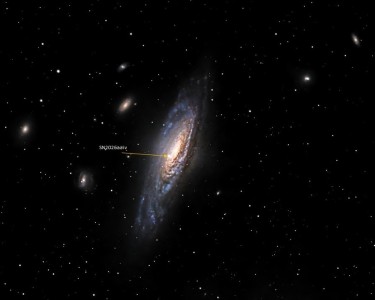
With an apparent magnitude of 8, M104 (the Sombrero Galaxy, NGC 4594) is beyond the limit of naked-eye visibility but can be spotted through small telescopes most easily during May. M104 is located 28 million light-years away in the constellation Virgo, and with a mass equal to 800 billion suns, it is one of the most massive objects in the Virgo galaxy cluster. M104 was discovered in 1781 by the French astronomer and comet hunter Pierre Méchain, one of Charles Messier’s colleagues. M104 is a brilliant, nearly edge-on galaxy with a bulbous core encircled by thick dust lanes cutting across the spiral structure of the galaxy. This dust lane is the site of star formation in the galaxy. The center of M104 is thought to be home to a massive black hole. Embedded in the bright core of M104 is a smaller disk (not visible in the image), which is tilted relative to the large disk. X-ray emission suggests that there is material falling into the compact core, where a one-billion-solar-mass black hole resides. [Video and Content Credits: NASA, the Office of Public Outreach – Space Telescope Science Institute (STScI) and JPL Caltech: Preston Dyches, Christopher Harris, and Lisa Poje, with subject matter guidance provided by JPL’s Bill Dunford and Lyle Tavernier, and the Night Sky Network’s Kat Troche] [Image Credit: Richard Murray - Astromart Gallery Contributor – Telescope: RCOS 10 - FL 1510mm @ F/6, Mount: Paramount ME, Camera: SBIG ST-8XME, https://www.astromart.com/gallery/photo/32634 ]
Excuse Me While I Kiss the Sky -- Month of May 2025
Welcome to the night sky report for May 2025 -- Your guide to the constellations, deep sky objects, planets, and celestial events that are observable during the month. The planets to look for in May are Mars and Jupiter. They're visible for a couple of hours after sunset in the western sky. Low in the eastern sky each morning you'll find bright Venus paired with much fainter Saturn. They start the month close together, but Saturn pulls away and rises higher over the course of the month. Also, the first week of May brings the annual Eta Aquarid meteors, peaking on May 6th. In May, we are looking away from the crowded, dusty plane of our own galaxy toward a region where the sky is brimming with distant galaxies. Locate Virgo to find a concentration of roughly 2000 galaxies and search for Coma Berenices to identify many more. Coma Berenices is a great target for binoculars. Look for galaxies like M104 (Sombrero Galaxy), M87 (Virgo A Galaxy), and M64 (Black Eye Galaxy). The night sky is truly a celestial showcase. Get outside and explore its wonders from your own backyard.
For planet watching this month, you'll find Mars and Jupiter in the west following sunset. Mars sticks around for several hours after it gets dark, but Jupiter is setting by 9:30 or 10 PM, and getting lower in the sky each day. The first quarter Moon appears right next to the Red Planet in early May. Find them in the west during the first half of the night.
In the morning sky, Venus and Saturn are the planets to look for in May. They begin the month appearing close together on the sky, and progressively pull farther apart as the month goes on. For several days in late May, early risers will enjoy a gathering of the Moon with Saturn and Venus in the eastern sky before dawn. Watch as the Moon passes the two planets while becoming an increasingly slimmer crescent. You'll find the Moon hanging between Venus and Saturn on May 23rd.
Early May brings the annual Eta Aquarid meteor shower. These are meteors that originate from Comet Halley. Earth passes through the comet’s dust stream each May, and again in October. Eta Aquarids are fast moving, and a lot of them produce persistent dust trains that linger for seconds after the meteor’s initial streak.
This is one of the best annual showers in the Southern Hemisphere, but tends to be more subdued North of the Equator, where we typically see 10-20 meteors per hour. On the peak night this year, the Moon sets by around 3 AM leaving dark skies until dawn for ideal viewing conditions. While the peak is early on the morning of May 6th, the two or three nights before that are also decent opportunities to spy a few shooting stars.
Waiting for a Nova
Astronomers have been waiting expectantly for light from a distant explosion to reach us here on Earth. An event called a nova is anticipated to occur sometime in the coming months. Some 3000 light years away is a binary star system called T Coronae Borealis, or “T CrB.” It consists of a red giant star with a smaller white dwarf star orbiting closely around it. The giant’s outer atmosphere is all puffed up, and the dwarf star is close enough that its gravity continually captures some of the giant’s hydrogen. About every 80 years, the white dwarf has accumulated so much of the other star’s hydrogen, that it ignites a thermonuclear explosion. And that’s the nova.
T Coronae Borealis is located in the constellation Corona Borealis, or the “Northern Crown,” and it’s normally far too faint to see with the unaided eye. But it's predicted the nova will be as bright as the constellation’s brightest star, which is about as bright as the North Star, Polaris. You’ll find Corona Borealis right in between the two bright stars Arcturus and Vega, and you can use the Big Dipper’s handle to point you to the right part of the sky. Try having a look for it on clear, dark nights before the nova, so you’ll have a comparison when a new star suddenly becomes visible there.
You may have heard about this months ago, as astronomers started keeping watch for the nova midway through 2024, but it hasn't happened yet. Predicting exactly when novas or any sort of stellar outburst will happen is tricky, but excitement began growing when astronomers observed the star to dim suddenly, much as it did right before its previous nova in 1946. When the nova finally does occur, it won't stay bright for long, likely flaring in peak brightness for only a few days. And since it's not predicted again for another 80 years, you might just want to join the watch for this super rare, naked eye stellar explosion in the sky.
Pleasant spring evenings are ideal for tracing the legendary patterns of the night sky. Find the pattern of the Big Dipper—part of Ursa Major, the Great Bear. Trace past the curve of the Big Dipper’s handle, down through the bright orange star Arcturus, and continue until you come to another bright star: Spica.
Spica is actually a pair of massive blue-white stars. Spica anchors the constellation Virgo, which dominates the southern sky in May. Facing Virgo, we are looking away from the crowded, dusty plane of our own galaxy. In this direction, we have a less obstructed view of the deeper Universe, which is brimming with other galaxies.
One of these is a lenticular, or lens-shaped, galaxy known as the Sombrero Galaxy. NASA’s Hubble Space Telescope provides a detailed view of the dark lanes of dust ringing the Sombrero Galaxy’s bright core.
Just above the Y-shape in Virgo is a concentration of roughly 2000 galaxies known as the Virgo Cluster. One of the largest of these is M87, a giant elliptical galaxy with trillions of stars and a supermassive black hole in its core.
The black hole is emitting a jet of material. An image from a ground-based radio observatory shows that the jet shines very brightly in radio light. The radio image also shows a turbulent cloud: evidence for a second jet, firing in the opposite direction.
Next to Virgo lies the constellation Coma Berenices—Bernice’s hair. Tangled in Bernice’s locks are many other distant galaxies—among them the spiral galaxy M64. M64 is also known as the Black Eye Galaxy for the dark area in its disk. Hubble shows that the dark region is a large band of dust spinning in the opposite direction of the inner regions, likely as a result of a collision in the galaxy’s past.
Back toward the handle of the Big Dipper sits the small pattern of Canes Venatici, the hunting dogs. Within the boundaries of this constellation, just below the end star of the Dipper’s handle, telescopes find another faint swirl of light: M51. Hubble shows M51 as a spectacular face-on spiral—the Whirlpool Galaxy—along with a companion galaxy. An X-ray image of the companion reveals shock waves caused by outbursts from a supermassive black hole.
There are some key differences between the night sky in the Southern Hemisphere, as compared to the North. To start with, there's no counterpart to the North Star for the Southern Hemisphere. The celestial poles shift over time, so eventually there will be a "South Star," but not at the moment.
Next, from Orion to the Teapot to the Gemini twins, the seasonal star patterns northern observers are most familiar with appear flipped upside down when viewed in southern skies. The Moon also appears the other way around, and its phases fill up from left to right, instead of right to left as they do in the north.
Stars near the north celestial pole, including Ursa Major and Cassiopeia are below the horizon for much of the Southern Hemisphere. But there are lots of dazzling constellations easily visible only from the Southern Hemisphere, like Crux, Carina, Tucana (the toucan) and Centaurus (the centaur)!
Next, while observers in both hemispheres are well-acquainted with the brightest star in the sky, Sirius, Southern Hemisphere skywatchers get to enjoy the second and third brightest stars, as well. The second-brightest star, Canopus, appears about half as bright as Sirius, but that's still quite bright. And the two stars are often seen together in southern skies. The third brightest star in in our skies is also the closest star system to our own – Alpha Centauri. It's too far south in the sky to be visible for most of the Northern Hemisphere. But it's quite well-known to skywatchers in the south.
Finally, there are two entire galaxies easily observed in the southern sky with the unaided eye. These are the Magellanic Clouds, which are dwarf galaxies that orbit our galaxy the Milky Way. They make for a stunning sight in night sky photos from Southern latitudes.
And that's a really short list of some of the ways the skies above the Southern Hemisphere are unique. Our view of the cosmos may be different from one part of the planet to the other, but the insights we gain from looking up and exploring are something we all can share.
The night sky is always a celestial showcase. Get outside and explore its wonders from your own backyard.
The following Deep Sky Objects (DSOs) are found in constellations that are observable during the month. Some of the objects listed here can be viewed with binoculars or a small telescope, but the majority will require a moderate to large aperture telescope (7 inches to 12 inches in diameter) with appropriate filters and a dark sky, especially for many of the nebulae. The following is adapted from my personal viewing list: "The Guy Pirro 888 Best and Brightest Deep Sky Objects in the Northern Skies" (See link below). All the objects in this list can be observed from the northern hemisphere up to around the mid-Northern Latitudes (Princeton, New Jersey -- 40 degrees N).
Constellation: Bootes (BOO)
NGC 5248 Galaxy C45, Herschel 400 H34-1
NGC 5466 Globular Cluster Herschel 400 H9-6
NGC 5557 Galaxy Herschel 400 H99-1
NGC 5676 Galaxy Herschel 400 H189-1
NGC 5689 Galaxy Herschel 400 H188-1
Constellation: Camelopardalis (CAM)
IC 342 Galaxy C5 Hidden Galaxy
IC 356 Galaxy P127
IC 361 Open Cluster P213
IC 3568 Planetary Nebula P128 Lemon Slice Nebula
NGC 1501 Planetary Nebula Herschel 400 H53-4 Camel’s Eye Nebula
NGC 1502 Open Cluster Herschel 400 H47-7, endpoint of Kemble’s Cascade
NGC 1569 Galaxy P136
NGC 1961 Galaxy Herschel 400 H747-3
NGC 2146 Galaxy P130 Dusty Hand Galaxy
NGC 2336 Galaxy P70
NGC 2403 Galaxy C7, Herschel 400 H44-5
NGC 2655 Galaxy Herschel 400 H288-1
NGC 2715 Galaxy P265
Constellation: Cancer (CNC)
NGC 2632 Open Cluster M44 Beehive Cluster, Praesepe
NGC 2682 Open Cluster M67 King Cobra Cluster
NGC 2775 Galaxy C48, Herschel 400 H2-1
Constellation: Canes Venatici (CVN)
NGC 4111 Galaxy Herschel 400 H195-1
NGC 4143 Galaxy Herschel 400 H54-4
NGC 4145 Galaxy P342
NGC 4151 Galaxy Herschel 400 H165-1
NGC 4214 Galaxy Herschel 400 H95-1
NGC 4217 Galaxy P83
NGC 4242 Galaxy P214
NGC 4244 Galaxy C26
NGC 4258 Galaxy M106, Herschel 400 H43-5
NGC 4346 Galaxy Herschel 400 H210-1
NGC 4395 Galaxy P71
NGC 4449 Galaxy C21, Herschel 400 H213-1
NGC 4485 Galaxy Herschel 400 H197-1, paired with NGC 4490
NGC 4490 Galaxy Herschel 400 H198-1 Cocoon Galaxy, w/NGC 4485
NGC 4618 Galaxy Herschel 400 H178-1
NGC 4631 Galaxy C32, Herschel 400 H42-4 Whale Galaxy
NGC 4656 Galaxy Herschel 400 H176-1 Hockey Stick Galaxy
NGC 4736 Galaxy M94 Cat’s Eye Galaxy
NGC 4800 Galaxy Herschel 400 H211-1
NGC 5005 Galaxy C29, Herschel 400 H96-1, paired with NGC 5033
NGC 5033 Galaxy Herschel 400 H97-1, paired with NGC 5005
NGC 5055 Galaxy M63 Sunflower Galaxy
NGC 5194 Galaxy M51 Whirlpool Galaxy, paired with NGC 5195
NGC 5195 Galaxy Herschel 400 H186-1, paired with M51 (NGC 5194)
NGC 5272 Globular Cluster M3
NGC 5273 Galaxy Herschel 400 H98-1
NGC 5353 Galaxy P215, paired with NGC 5354
NGC 5371 Galaxy P177
Constellation: Centaurus (CEN)
IC 4329 Galaxy P272
NGC 4936 Galaxy P285
Constellation: Coma Berenices (COM)
NGC 4147 Globular Cluster Herschel 400 H19-1
NGC 4150 Galaxy Herschel 400 H73-1
NGC 4192 Galaxy M98
NGC 4203 Galaxy Herschel 400 H175-1
NGC 4212 Galaxy P193
NGC 4245 Galaxy Herschel 400 H74-1
NGC 4251 Galaxy Herschel 400 H89-1
NGC 4254 Galaxy M99 Saint Catherine’s Wheel Galaxy
NGC 4274 Galaxy Herschel 400 H75-1
NGC 4278 Galaxy Herschel 400 H90-1
NGC 4293 Galaxy Herschel 400 H5-5
NGC 4314 Galaxy Herschel 400 H76-1
NGC 4321 Galaxy M100
NGC 4340 Galaxy P54, paired with NGC 4350
NGC 4350 Galaxy Herschel 400 H86-2, paired with NGC 4340
NGC 4382 Galaxy M85, paired with NGC 4394
NGC 4394 Galaxy Herschel 400 H55-2, paired with M85 (NGC 4382)
NGC 4414 Galaxy Herschel 400 H77-1 Dusty Spiral Galaxy
NGC 4419 Galaxy Herschel 400 H113-1
NGC 4448 Galaxy Herschel 400 H91-1
NGC 4450 Galaxy Herschel 400 H56-2
NGC 4459 Galaxy Herschel 400 H161-1
NGC 4473 Galaxy Herschel 400 H114-2
NGC 4477 Galaxy Herschel 400 H115-2
NGC 4494 Galaxy Herschel 400 H83-1
NGC 4501 Galaxy M88
NGC 4548 Galaxy M91, Herschel 400 H120-2
NGC 4559 Galaxy C36, Herschel 400 H92-1
NGC 4565 Galaxy C38, Herschel 400 H24-5 Needle Galaxy
NGC 4651 Galaxy P222
NGC 4689 Galaxy Herschel 400 H128-2
NGC 4710 Galaxy P175
NGC 4725 Galaxy Herschel 400 H84-1
NGC 4826 Galaxy M64 Black Eye Galaxy
NGC 4889 Galaxy C35
NGC 5024 Globular Cluster M53
NGC 5053 Globular Cluster P78
Constellation: Corvus (CRV)
NGC 4027 Galaxy Herschel 400 H296-2
NGC 4038 Galaxy C60, Herschel 400 H28.1-4 Antenna Galaxy (North)
NGC 4039 Galaxy C61, Herschel 400 H28.2-4 Antenna Galaxy (South)
NGC 4361 Planetary Nebula Herschel 400 H65-1 Garden Sprinkler Nebula
Constellation: Crater (CRT)
NGC 3511 Galaxy P181
NGC 3887 Galaxy P105
NGC 3892 Galaxy P53
NGC 3962 Galaxy Herschel 400 H67-1
NGC 3981 Galaxy P245
Constellation: Draco (DRA)
NGC 3147 Galaxy Herschel 400 H79-1
NGC 4125 Galaxy P26
NGC 4236 Galaxy C3
NGC 4589 Galaxy P279
NGC 4750 Galaxy P292
NGC 5866 Galaxy M102, Herschel 400 H215-1
NGC 5907 Galaxy Herschel 400 H759-2 Splinter Galaxy
NGC 5982 Galaxy Herschel 400 H764-2
NGC 6015 Galaxy P151
NGC 6340 Galaxy P142
NGC 6503 Galaxy P80 Shooting Star Galaxy
NGC 6543 Planetary Nebula C6, Herschel 400 H37-4 Cat’s Eye Nebula
NGC 6643 Galaxy P194
Constellation: Gemini (GEM)
IC 443 Supernova Remnant P249 Jellyfish Nebula
IC 444 Reflection Nebula P306
IC 2157 Open Cluster P156
NGC 2129 Open Cluster Herschel 400 H26-8
NGC 2158 Open Cluster Herschel 400 H17-6
NGC 2168 Open Cluster M35 Shoe Buckle Cluster
NGC 2266 Open Cluster Herschel 400 H21-6
NGC 2304 Open Cluster Herschel 400 H2-6
NGC 2331 Open Cluster P157
NGC 2355 Open Cluster Herschel 400 H6-6
NGC 2371 Planetary Nebula Herschel 400 H316-2 Double Bubble Nebula (South)
NGC 2372 Planetary Nebula Herschel 400 H317-2 Double Bubble Nebula (North)
NGC 2392 Planetary Nebula C39, Herschel 400 H45-4 Eskimo Nebula
NGC 2395 Open Cluster Herschel 400 H11-8
NGC 2420 Open Cluster Herschel 400 H1-6
Constellation: Hercules (HER)
IC 4593 Planetary Nebula P158 White Eyed Pea Nebula
NGC 6205 Globular Cluster M13 Great Hercules Globular Cluster
NGC 6207 Galaxy Herschel 400 H701-2
NGC 6210 Planetary Nebula P34 Turtle Nebula
NGC 6229 Globular Cluster Herschel 400 H50-4
NGC 6341 Globular Cluster M92
Constellation: Hydra (HYA)
NGC 2548 Open Cluster M48, Herschel 400 H22-6
NGC 2784 Galaxy P87
NGC 2811 Galaxy Herschel 400 H505-2
NGC 2835 Galaxy P291
NGC 2935 Galaxy P263
NGC 2986 Galaxy P297
NGC 3078 Galaxy P243
NGC 3091 Galaxy P317
NGC 3109 Galaxy P88
NGC 3242 Planetary Nebula C59, Herschel 400 H27-4 Ghost of Jupiter Nebula
NGC 3311 Galaxy P98
NGC 3585 Galaxy P35
NGC 3621 Galaxy Herschel 400 H241-1
NGC 3717 Galaxy P345
NGC 3904 Galaxy P310
NGC 3923 Galaxy P89
NGC 4105 Galaxy P284, paired with NGC 4106
NGC 4590 Globular Cluster M68
NGC 5061 Galaxy P264
NGC 5078 Galaxy P304
NGC 5101 Galaxy P271
NGC 5236 Galaxy M83 Southern Pinwheel Galaxy
NGC 5694 Globular Cluster C66, Herschel 400 H196-2
Constellation: Leo (LEO)
NGC 2903 Galaxy Herschel 400 H56-1
NGC 2964 Galaxy Herschel 400 H114-1
NGC 3190 Galaxy Herschel 400 H44-2
NGC 3193 Galaxy Herschel 400 H45-2
NGC 3226 Galaxy Herschel 400 H28-2, paired with NGC 3227
NGC 3227 Galaxy Herschel 400 H29-2, paired with NGC 3226
NGC 3351 Galaxy M95
NGC 3338 Galaxy P307
NGC 3368 Galaxy M96
NGC 3377 Galaxy Herschel 400 H99-2
NGC 3379 Galaxy M105, Herschel 400 H17-1
NGC 3384 Galaxy Herschel 400 H18-1
NGC 3412 Galaxy Herschel 400 H27-1
NGC 3489 Galaxy Herschel 400 H101-2
NGC 3521 Galaxy Herschel 400 H13-1
NGC 3593 Galaxy Herschel 400 H29-1
NGC 3607 Galaxy Herschel 400 H50-2, paired with NGC 3608
NGC 3608 Galaxy Herschel 400 H51-2, paired with NGC 3607
NGC 3623 Galaxy M65
NGC 3626 Galaxy C40, Herschel 400 H52-2
NGC 3627 Galaxy M66
NGC 3628 Galaxy Herschel 400 H8-5 Hamburger Galaxy
NGC 3640 Galaxy Herschel 400 H33-2
NGC 3646 Galaxy P180
NGC 3655 Galaxy Herschel 400 H5-1
NGC 3686 Galaxy Herschel 400 H160-2
NGC 3705 Galaxy P311
NGC 3810 Galaxy Herschel 400 H21-1
NGC 3900 Galaxy Herschel 400 H82-1
NGC 3912 Galaxy Herschel 400 H342-2
Constellation: Leo Minor (LMI)
NGC 2859 Galaxy Herschel 400 H137-1
NGC 3245 Galaxy Herschel 400 H86-1
NGC 3277 Galaxy Herschel 400 H359-2
NGC 3294 Galaxy Herschel 400 H164-1
NGC 3344 Galaxy Herschel 400 H81-1
NGC 3395 Galaxy Herschel 400 H116-1
NGC 3414 Galaxy Herschel 400 H362-2
NGC 3432 Galaxy Herschel 400 H172-1
NGC 3486 Galaxy Herschel 400 H87-1
NGC 3504 Galaxy Herschel 400 H88-1
Constellation: Libra (LIB)
NGC 5812 Galaxy P46
NGC 5897 Globular Cluster Herschel 400 H19-6
Constellation: Lynx (LYN)
NGC 2419 Globular Cluster C25, Herschel 400 H218-1 Intergalactic Wanderer
NGC 2549 Galaxy P252
NGC 2683 Galaxy Herschel 400 H200-1 UFO Galaxy
NGC 2782 Galaxy Herschel 400 H167-1
Constellation: Sagitta (SGE)
IC 4997 Planetary Nebula P246
NGC 6838 Globular Cluster M71 Angelfish Globular Cluster
NGC 6879 Planetary Nebula P355
NGC 6886 Planetary Nebula P247
Constellation: Serpens Caput (SER - Head)
NGC 5904 Globular Cluster M5 Rose Globular Cluster
NGC 5921 Galaxy P336
NGC 6118 Galaxy Herschel 400 H402-2
Constellation: Serpens Cauda (SER - Tail)
IC 1276 Globular Cluster P118, Palomar 7 Globular Cluster
IC 4703 HII Ionized Nebula P337, includes M16 (NGC 6611) Eagle Nebula
IC 4756 Open Cluster P62 Graff’s Cluster
NGC 6535 Globular Cluster P199
NGC 6539 Globular Cluster P119
NGC 6604 Open Cluster P63
NGC 6611 HII Ionized Nebula M16 Eagle Nebula and Cluster, included in IC 4703
Constellation: Sextans (SEX)
NGC 2974 Galaxy Herschel 400 H61-1
NGC 3115 Galaxy C53, Herschel 400 H163-1 Spindle Galaxy
NGC 3166 Galaxy Herschel 400 H3-1, paired with NGC 3169
NGC 3169 Galaxy Herschel 400 H4-1, paired with NGC 3166
NGC 3423 Galaxy P187
Constellation: Ursa Major (UMA)
Messier 40 Double Star M40, Winnecke 4 (not a binary pair)
IC 2574 Galaxy P121 Coddington’s Dwarf Galaxy
NGC 2681 Galaxy Herschel 400 H242-1
NGC 2685 Galaxy P57 Helix Galaxy
NGC 2742 Galaxy Herschel 400 H249-1
NGC 2768 Galaxy Herschel 400 H250-1
NGC 2787 Galaxy Herschel 400 H216-1
NGC 2805 Galaxy P338
NGC 2841 Galaxy Herschel 400 H205-1
NGC 2950 Galaxy Herschel 400 H68-4
NGC 2976 Galaxy Herschel 400 H285-1
NGC 2985 Galaxy Herschel 400 H78-1
NGC 3031 Galaxy M81 Bode’s Galaxy
NGC 3034 Galaxy M82, Herschel 400 H79-4 Cigar Galaxy
NGC 3077 Galaxy Herschel 400 H286-1
NGC 3079 Galaxy Herschel 400 H47-5
NGC 3184 Galaxy Herschel 400 H168-1 Little Pinwheel Galaxy
NGC 3198 Galaxy Herschel 400 H199-1
NGC 3310 Galaxy Herschel 400 H60-4
NGC 3319 Galaxy P244
NGC 3348 Galaxy P282
NGC 3359 Galaxy P202
NGC 3556 Galaxy M108, Herschel 400 H46-5 Surfboard Galaxy
NGC 3587 Planetary Nebula M97 Owl Nebula
NGC 3610 Galaxy Herschel 400 H270-1
NGC 3613 Galaxy Herschel 400 H271-1, paired with NGC 3619
NGC 3619 Galaxy Herschel 400 H244-1, paired with NGC 3613
NGC 3631 Galaxy Herschel 400 H226-1
NGC 3665 Galaxy Herschel 400 H219-1
NGC 3675 Galaxy Herschel 400 H194-1
NGC 3718 Galaxy P275, paired with NGC 3729
NGC 3726 Galaxy Herschel 400 H730-2
NGC 3729 Galaxy Herschel 400 H222-1, paired with NGC 3718
NGC 3813 Galaxy Herschel 400 H94-1
NGC 3877 Galaxy Herschel 400 H201-1
NGC 3893 Galaxy Herschel 400 H738-2
NGC 3898 Galaxy Herschel 400 H228-1
NGC 3938 Galaxy Herschel 400 H203-1
NGC 3941 Galaxy Herschel 400 H173-1
NGC 3945 Galaxy Herschel 400 H251-1
NGC 3949 Galaxy Herschel 400 H202-1
NGC 3953 Galaxy Herschel 400 H45-5
NGC 3982 Galaxy Herschel 400 H62-4
NGC 3992 Galaxy M109, Herschel 400 H61-4 Vacuum Cleaner Galaxy
NGC 3998 Galaxy Herschel 400 H229-1
NGC 4026 Galaxy Herschel 400 H223-1
NGC 4036 Galaxy Herschel 400 H253-1, paired with NGC 4041
NGC 4041 Galaxy Herschel 400 H252-1, paired with NGC 4036
NGC 4051 Galaxy Herschel 400 H56-4
NGC 4062 Galaxy P332
NGC 4085 Galaxy Herschel 400 H224-1, paired with NGC 4088
NGC 4088 Galaxy Herschel 400 H206-1, paired with NGC 4085
NGC 4096 Galaxy P268
NGC 4100 Galaxy P347
NGC 4102 Galaxy Herschel 400 H225-1
NGC 4605 Galaxy P111
NGC 5322 Galaxy Herschel 400 H256-1
NGC 5448 Galaxy P129
NGC 5457 Galaxy M101 Pinwheel Galaxy, paired with NGC 5474
NGC 5473 Galaxy Herschel 400 H231-1
NGC 5474 Galaxy Herschel 400 H214-1, paired with M101 (NGC 5457)
NGC 5585 Galaxy P289
NGC 5631 Galaxy Herschel 400 H236-1
Constellation: Ursa Minor (UMI)
NGC 6217 Galaxy Herschel 400 H280-1
Constellation: Virgo (VIR)
NGC 4030 Galaxy Herschel 400 H121-1
NGC 4179 Galaxy Herschel 400 H9-1
NGC 4216 Galaxy Herschel 400 H35-1
NGC 4261 Galaxy Herschel 400 H139-2
NGC 4267 Galaxy P280
NGC 4273 Galaxy Herschel 400 H569-2
NGC 4281 Galaxy Herschel 400 H573-2
NGC 4303 Galaxy M61, Herschel 400 H139-1 Swelling Spiral Galaxy
NGC 4365 Galaxy Herschel 400 H30-1
NGC 4371 Galaxy Herschel 400 H22-1
NGC 4374 Galaxy M84, part of Markarian’s Chain
NGC 4388 Galaxy P190
NGC 4406 Galaxy M86, part of Markarian’s Chain
NGC 4417 Galaxy P116
NGC 4429 Galaxy Herschel 400 H65-2
NGC 4435 Galaxy Herschel 400 H28.1-1 Markarian’s Eyes Galaxy (North)
NGC 4438 Galaxy Herschel 400 H28.2-1 Markarian’s Eyes Galaxy (South)
NGC 4442 Galaxy Herschel 400 H156-2
NGC 4457 Galaxy P343
NGC 4461 Galaxy P315, paired with NGC 4458, part of Markarian’s Chain
NGC 4469 Galaxy P322
NGC 4472 Galaxy M49
NGC 4478 Galaxy Herschel 400 H124-2
NGC 4486 Galaxy M87 Virgo A Galaxy
NGC 4503 Galaxy P287
NGC 4517 Galaxy P30
NGC 4526 Galaxy Herschel 400 H31-1
NGC 4527 Galaxy Herschel 400 H37-2
NGC 4535 Galaxy Herschel 400 H500-2 Lost Galaxy
NGC 4536 Galaxy Herschel 400 H2-5
NGC 4546 Galaxy Herschel 400 H160-1
NGC 4550 Galaxy Herschel 400 H36-1
NGC 4552 Galaxy M89
NGC 4567/NGC 4568 Galaxy P56 Siamese Twins Galaxies
NGC 4569 Galaxy M90
NGC 4570 Galaxy Herschel 400 H32-1
NGC 4579 Galaxy M58
NGC 4594 Galaxy M104, Herschel 400 H43-1 Sombrero Galaxy
NGC 4596 Galaxy Herschel 400 H24-1
NGC 4608 Galaxy P341
NGC 4621 Galaxy M59
NGC 4636 Galaxy Herschel 400 H38-2
NGC 4638 Galaxy P256
NGC 4643 Galaxy Herschel 400 H10-1
NGC 4649 Galaxy M60
NGC 4654 Galaxy Herschel 400 H126-2
NGC 4660 Galaxy Herschel 400 H71-2
NGC 4665 Galaxy Herschel 400 H142-1
NGC 4666 Galaxy Herschel 400 H15-1
NGC 4691 Galaxy P294
NGC 4697 Galaxy C52, Herschel 400 H39-1
NGC 4698 Galaxy Herschel 400 H8-1
NGC 4699 Galaxy Herschel 400 H129-1
NGC 4742 Galaxy P59
NGC 4753 Galaxy Herschel 400 H16-1
NGC 4754 Galaxy Herschel 400 H25-1, paired with NGC 4762
NGC 4762 Galaxy Herschel 400 H75-2, paired with NGC 4754
NGC 4781 Galaxy Herschel 400 H134-1
NGC 4845 Galaxy Herschel 400 H536-2
NGC 4856 Galaxy Herschel 400 H68-1
NGC 4866 Galaxy Herschel 400 H162-1
NGC 4900 Galaxy Herschel 400 H143-1
NGC 4958 Galaxy Herschel 400 H130-1
NGC 4984 Galaxy P308
NGC 4995 Galaxy Herschel 400 H42-1
NGC 5018 Galaxy P273
NGC 5044 Galaxy P259
NGC 5054 Galaxy Herschel 400 H513-2
NGC 5068 Galaxy P203
NGC 5084 Galaxy P329
NGC 5087 Galaxy P319
NGC 5170 Galaxy P61
NGC 5247 Galaxy P67
NGC 5363 Galaxy Herschel 400 H6-1, paired with NGC 5364
NGC 5364 Galaxy Herschel 400 H534-2, paired with NGC 5363
NGC 5566 Galaxy Herschel 400 H144-1
NGC 5576 Galaxy Herschel 400 H146-1
NGC 5634 Globular Cluster Herschel 400 H70-1
NGC 5638 Galaxy P115
NGC 5701 Galaxy P113
NGC 5746 Galaxy Herschel 400 H126-1
NGC 5813 Galaxy P270
NGC 5838 Galaxy P266
NGC 5846 Galaxy Herschel 400 H128-1
NGC 5850 Galaxy P301
Constellation: Vulpecula (VUL)
NGC 6802 Open Cluster Herschel 400 H14-6
NGC 6823 Open Cluster Herschel 400 H18-7
NGC 6830 Open Cluster Herschel 400 H9-7
NGC 6853 Planetary Nebula M27 Dumbell Nebula
NGC 6882 Open Cluster Herschel 400 H22-8
NGC 6885 Open Cluster C37, Herschel 400 H20-8
NGC 6940 Open Cluster Herschel 400 H8-7
For more information:
Northern Latitudes:
https://hubblesite.org/resource-gallery/tonights-sky
https://science.nasa.gov/skywatching/whats-up
https://nightsky.jpl.nasa.gov/planner.cfm
https://blogs.nasa.gov/Watch_the_Skies/
https://solarsystem.nasa.gov/skywatching/home/
https://science.nasa.gov/mission/hubble/science/explore-the-night-sky/hubble-messier-catalog/
https://www.cfa.harvard.edu/skyreport
http://outreach.as.utexas.edu/public/skywatch.html
https://griffithobservatory.org/explore/observing-the-sky/sky-report/
http://www.beckstromobservatory.com/whats-up-in-tonights-sky-2/
https://www.fairbanksmuseum.org/planetarium/eye-on-the-night-sky
http://dudleyobservatory.org/tonights-sky/
https://cse.umn.edu/mifa/starwatch
http://www.schoolsobservatory.org.uk/learn/astro/nightsky/maps
https://tonightssky.com/MainPage.php
https://earthsky.org/astronomy-essentials/visible-planets-tonight-mars-jupiter-venus-saturn-mercury
https://www.timeanddate.com/astronomy/night/
https://www.adventuresci.org/starcharts
https://www.astromart.com/news/search?category_id=3&q=kiss+the+sky&from=&to
Equatorial Latitudes:
https://heavens-above.com/SkyChart2.aspx
https://in-the-sky.org/data/constellations_map.php
https://ytliu0.github.io/starCharts/chartGCRS.html
Southern Latitudes:
https://www.scitech.org.au/explore/the-sky-tonight/
https://www.stardome.org.nz/star-charts--sky-spotter
This is my personal deep sky observing list. I use it to line up my DSO targets on any particular night:
Daily Moon Observing Guide:
https://moon.nasa.gov/moon-observation/daily-moon-guide/?intent=011
Find Astronomy Clubs, Events, and Star Parties in Your Area:
https://nightsky.jpl.nasa.gov/
Watch Satellites Pass Over Your Location:
https://james.darpinian.com/satellites/
Astromart News Archives:
https://www.astromart.com/news/search?category_id=3&q=.
Check out some of my favorite Words of Wisdom:
https://www.astromart.com/news/show/words-of-wisdom-some-are-deep-others-not-so-much
https://www.astromart.com/news/show/words-of-wisdom-my-favorite-proverbs-from-around-the-world
Do you enjoy reading these postings?
Then click here and buy the Astromart crew a cup of coffee (and maybe even some donuts):
https://www.astromart.com/support-options