Flirting With Disaster -- Two Stars in a Final Kiss
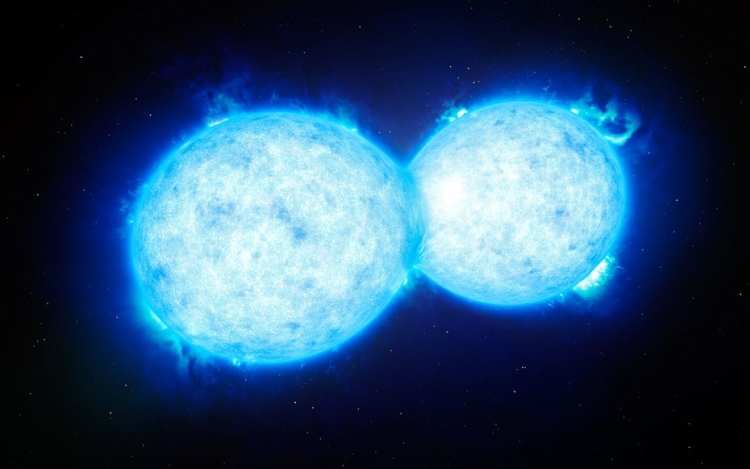
Using ESO's Very Large Telescope (VLT), an international team of astronomers have found the hottest and most massive double star with components so close that they touch each other. The two stars in the extreme system VFTS 352 could be heading for a dramatic end, during which the two stars either coalesce to create a single giant star, or form a binary black hole.
The double star system VFTS 352 is located about 160,000 light-years away in the Tarantula Nebula. This remarkable region is the most active nursery of new stars in the nearby Universe and new observations from ESO's VLT have revealed that this pair of young stars is among the most extreme and strangest yet found.
This star's name indicates that it was observed as part of the VLT FLAMES Tarantula Survey, which utilized the FLAMES and GIRAFFE instruments on ESOs Very Large Telescope to study over 900 stars in the 30 Doradus region of the Large Magellanic Cloud (LMC). The survey has already led to many exciting and important findings including the fastest rotating star (ESO 1147), and an extremely massive solitary runaway star (ESO 1117). It is helping to answer many fundamental questions concerning how massive stars are affected by rotation, binarity, and the dynamics in dense star clusters.
VFTS 352 is composed of two very hot, bright, and massive stars that orbit each other in little more than a day. The centers of the stars are separated by just 12 million kilometres. In fact, the stars are so close that their surfaces overlap and a bridge has formed between them. VFTS 352 is not only the most massive known in this tiny class of "Over-contact Binaries," but it also contains the hottest components, with surface temperatures above 40,000 degrees Celsius.
Both components are classed as O-Type stars. Such stars are typically between 15 and 80 times more massive than the Sun and can be up to a million times brighter. They are so hot that they shine with a brilliant blue-white light and have surface temperatures over 30,000 degrees Celsius.
Extreme stars like the two components of VFTS 352, play a key role in the evolution of galaxies and are thought to be the main producers of elements such as oxygen. Such double stars are also linked to exotic behavior such as that shown by "Vampire Stars," where a smaller companion star sucks matter from the surface of its larger neighbor (ESO 1230).
In the case of VFTS 352, however, both stars in the system are of almost identical size. Material is, therefore, not sucked from one to another, but instead may be shared. The component stars of VFTS 352 are estimated to be sharing about 30 per cent of their material.
Such a system is very rare because this phase in the life of the stars is short, making it difficult to catch them in the act. Because the stars are so close together, astronomers think that strong tidal forces lead to enhanced mixing of the material in the stellar interiors.
"VFTS 352 is the best case yet found for a hot and massive double star that may show this kind of internal mixing," explains Leonardo A. Almeida of the University of Sao Paulo in Brazil. "As such it's a fascinating and important discovery."
Astronomers predict that VFTS 352 will face a cataclysmic fate in one of two ways. The first potential outcome is the merging of the two stars, which would likely produce a rapidly rotating, and possibly magnetic, gigantic single star. "If it keeps spinning rapidly it might end its life in one of the most energetic explosions in the Universe, known as a long-duration Gamma Ray Burst, says Hugues Sana, of the University of Leuven in Belgium. Gamma Ray Bursts (GRBs) are bursts of highly energetic gamma rays that can be detected by orbiting satellites. They come in two types -- short duration (shorter than a few seconds) and long duration (longer than a few seconds). Long-duration GRBs are more common and are thought to mark the deaths of massive stars associated with a class of very energetic supernova explosions.
The second possibility is explained by theoretical astrophysicist Selma de Mink of University of Amsterdam. "If the stars are mixed well enough, they both remain compact and the VFTS 352 system may avoid merging. This would lead the objects down a new evolutionary path that is completely different from classic stellar evolution predictions. In the case of VFTS 352, the components would likely end their lives in supernova explosions, forming a close binary system of black holes. Such a remarkable object would be an intense source of gravitational waves."
This animated artist's impression shows VFTS 352 -- the hottest and most massive double star system to date where the two components are in contact and sharing material. The two stars in this extreme system lie about 160,000 light-years from Earth in the Large Magellanic Cloud. This intriguing pair could be heading for a dramatic end, either with the creation of a single monster star or the formation of a binary black hole. (Video Credit: ESO, L. Calcada)
Regardless of how VFTS 352 meets its demise, this system has already provided astronomers with valuable new insights into the poorly understood evolutionary processes of massive Over-contact Binary Star systems.
For more information:
http://www.eso.org/public/news/eso1540/
http://www.astromart.com/news/news.asp?news_id=1410
http://www.astromart.com/news/news.asp?news_id=1397
http://www.astromart.com/news/news.asp?news_id=1377
http://www.astromart.com/news/news.asp?news_id=1373
http://www.astromart.com/news/news.asp?news_id=1221
http://www.astromart.com/news/news.asp?news_id=1095
http://www.astromart.com/news/news.asp?news_id=1021
AstroMart News Archive:
http://www.astromart.com/news/search.asp?search=.+
Funding Member
