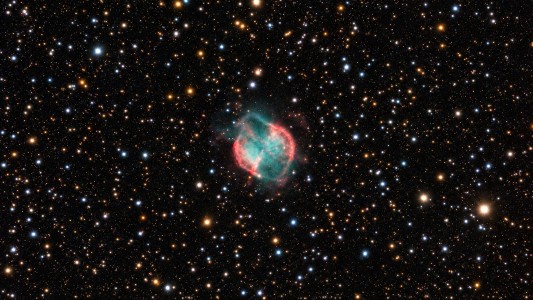
GAIA Space-Based Observatory to Record a Billion Stars
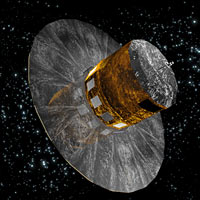
EADS Astrium has signed a contract with the European Space Agency (ESA) to develop and build the satellite for the Global Astrometric Interferometer for Astrophysics (GAIA) mission. GAIA will create an extraordinarily precise 3-D map of the Galaxy, mapping and recording more than one billion stars over a five year period. The satellite, worth $380 million, is due to be launched in 2011.
The GAIA mission will help us better understand the composition, formation and evolution of our Galaxy. GAIA will be placed in orbit at the point of Lagrange L2 – a point of stability 1.6 million kilometres from Earth in line with the Sun. This position in space offers a very stable thermal environment, very high observing efficiency (since the Sun, Earth and Moon are behind the instrument field of view), and a low radiation environment. GAIA’s measurement accuracy is so great that if it were on the Moon, it could measure the thumbnail of a person on Earth.
During its five year mission, GAIA will monitor each of its target stars about 80 times, precisely charting distances, movements and changes in brightness across several avelengths. It will provide important data on the presence of thousands of planets, and discover several tens of thousands of new bodies - comets and asteroids - in our own solar system.
The observatory will use the global astronomy concept successfully demonstrated by its predecessor HIPPARCOS, also built by EADS Astrium. HIPPARCOS successfully mapped 100,000 stars in 1989. GAIA will be equipped with a latest generation payload integrating the most sensitive telescope ever made. The telescope will have the largest focal plane ever constructed – with 106 Charged Coupled Devices (CCD) creating a one Gigapixel imager.
EADS Astrium is Europe’s leading satellite system specialist. EADS Astrium in France will be in charge of overall development of the satellite as well as the design, development, and integration of the payload and software design.
EADS Astrium in the UK will design and develop the electrical service module which includes the central data management system, and electrical power control and distribution system on the spacecraft.
EADS Astrium in Germany will be responsible for the mechanical, thermal and propulsions systems on the spacecraft.
GAIA will also be equipped with two key components. The first one is a deployable sun-shield, covering an area of one hundred square metres, to minimise the temperature fluctuations on the highly sensitive optics. The second is a new micro-propulsion system, to be used to smoothly control the spacecraft in order not to disturb the optics during the sky scanning.
The mission is particularly ambitious, both in terms of the number of stars to be mapped and the measurement precision required. Data supplied by GAIA will be analysed by a scientific team of leading European astrometry specialists and should lead to a huge leap forward in our understanding of the universe, and in our knowledge of the structure and evolution of our galaxy.
Additional scientific benefits include detection and characterisation of tens of thousands of extra-solar planetary systems, a comprehensive survey of objects ranging from huge numbers of minor bodies in our solar system, through galaxies in the nearby Universe, to about 10 million galaxies and 500,000 distant quasars. It will also provide stringent new tests of general relativity.
For more information:
http://www.esa.int/esaCP/SEM9OT8ATME_index_0.html
http://www.space.eads.net/press-center/press-releases/eads-astrium-awarded-euros-317-million-gaia-spacecraft-contract-by-esa
http://www.space.eads.net/families/exploring-the-universe/wider-universe/gaia-recording-over-a-billion-stars-for-an-extraordinary-3-d-map-of-the-galaxy
