Has the Hypothetical Axion Dark Matter Particle Been Found?
Space scientists at the University of Leicester in the UK have detected a curious signal in the X-ray sky -- one that provides a tantalizing insight into the nature of mysterious dark matter.
The Leicester team has found what appears to be a signature of the Axion, a predicted dark matter particle candidate that has been a puzzle to science for years.
In a study published in the journal "Monthly Notices of the Royal Astronomical Society," the University of Leicester scientists describe their finding of a signal that has no conventional explanation.
As Professor George Fraser, who sadly died in March of this year, wrote: "The direct detection of dark matter has preoccupied physics for over thirty years." Dark matter, a kind of invisible mass of unknown origin, cannot be seen directly with telescopes, but is instead inferred from its gravitational effects on ordinary matter and on light. Dark matter is believed to make up 85 percent of the matter of the Universe.
"The X-ray background - the sky, after the bright X-ray sources are removed - appears to be unchanged whenever you look at it," explained Dr Andy Read, also from the University of Leicester. "However, we have discovered a seasonal signal in this X-ray background, which has no conventional explanation, but is consistent with the discovery of Axions."
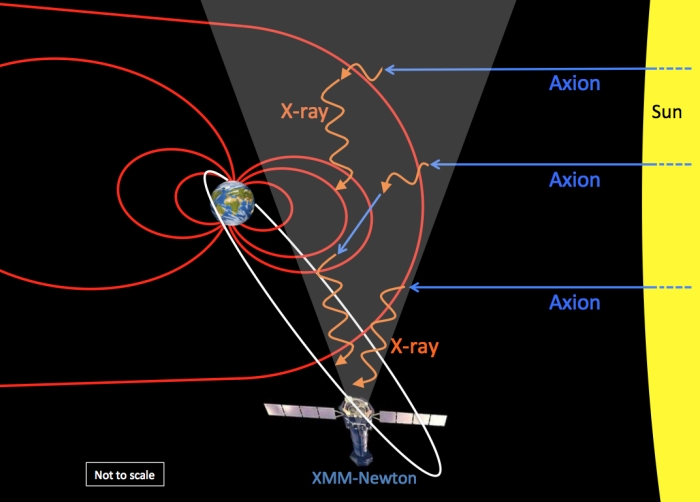
This result was found through an extensive study of almost the entire archive of data from the European Space Agency (ESA) X-ray observatory, XMM-Newton, which will celebrate its 15th year in orbit this December 2014. Previous searches for Axions, notably at CERN and with other spacecraft in Earth orbit, have so far proved unsuccessful.
As the principal author Professor Fraser explains in the paper: "It appears plausible that Axions - dark matter particle candidates - are indeed produced in the core of the Sun and do indeed convert to X-rays in the magnetic field of the Earth." It is predicted that the X-ray signal due to Axions will be greatest when looking through the sunward side of the magnetic field because this is where the field is strongest.
Dr Read concludes: "These exciting discoveries, in George's final paper, could be truly ground breaking, potentially opening a window to new physics, and could have huge implications, not only for our understanding of the true X-ray sky, but also for identifying the dark matter that dominates the mass content of the cosmos."
President of the Royal Astronomical Society Professor Martin Barstow, who is also Pro-Vice-Chancellor at the University of Leicester said: "This is an amazing result. If confirmed, it will be the first direct detection and identification of the elusive dark matter particles and will have a fundamental impact on our theories of the Universe."
For more information:
http://www.ras.org.uk/news-and-press/2524-curious-signal-hints-at-dark-matter
http://www.astromart.com/news/news.asp?news_id=1424
http://www.astromart.com/news/news.asp?news_id=1405
http://www.astromart.com/news/news.asp?news_id=1227
http://www.astromart.com/news/news.asp?news_id=1023
http://www.astromart.com/news/news.asp?news_id=1020
http://www.astromart.com/news/news.asp?news_id=831
http://www.astromart.com/news/news.asp?news_id=489
http://www.astromart.com/news/news.asp?news_id=392
AstroMart News Archive:
http://www.astromart.com/news/search.asp?search=.+
The Leicester team has found what appears to be a signature of the Axion, a predicted dark matter particle candidate that has been a puzzle to science for years.
In a study published in the journal "Monthly Notices of the Royal Astronomical Society," the University of Leicester scientists describe their finding of a signal that has no conventional explanation.
As Professor George Fraser, who sadly died in March of this year, wrote: "The direct detection of dark matter has preoccupied physics for over thirty years." Dark matter, a kind of invisible mass of unknown origin, cannot be seen directly with telescopes, but is instead inferred from its gravitational effects on ordinary matter and on light. Dark matter is believed to make up 85 percent of the matter of the Universe.
"The X-ray background - the sky, after the bright X-ray sources are removed - appears to be unchanged whenever you look at it," explained Dr Andy Read, also from the University of Leicester. "However, we have discovered a seasonal signal in this X-ray background, which has no conventional explanation, but is consistent with the discovery of Axions."
This result was found through an extensive study of almost the entire archive of data from the European Space Agency (ESA) X-ray observatory, XMM-Newton, which will celebrate its 15th year in orbit this December 2014. Previous searches for Axions, notably at CERN and with other spacecraft in Earth orbit, have so far proved unsuccessful.
As the principal author Professor Fraser explains in the paper: "It appears plausible that Axions - dark matter particle candidates - are indeed produced in the core of the Sun and do indeed convert to X-rays in the magnetic field of the Earth." It is predicted that the X-ray signal due to Axions will be greatest when looking through the sunward side of the magnetic field because this is where the field is strongest.
Dr Read concludes: "These exciting discoveries, in George's final paper, could be truly ground breaking, potentially opening a window to new physics, and could have huge implications, not only for our understanding of the true X-ray sky, but also for identifying the dark matter that dominates the mass content of the cosmos."
President of the Royal Astronomical Society Professor Martin Barstow, who is also Pro-Vice-Chancellor at the University of Leicester said: "This is an amazing result. If confirmed, it will be the first direct detection and identification of the elusive dark matter particles and will have a fundamental impact on our theories of the Universe."
For more information:
http://www.ras.org.uk/news-and-press/2524-curious-signal-hints-at-dark-matter
http://www.astromart.com/news/news.asp?news_id=1424
http://www.astromart.com/news/news.asp?news_id=1405
http://www.astromart.com/news/news.asp?news_id=1227
http://www.astromart.com/news/news.asp?news_id=1023
http://www.astromart.com/news/news.asp?news_id=1020
http://www.astromart.com/news/news.asp?news_id=831
http://www.astromart.com/news/news.asp?news_id=489
http://www.astromart.com/news/news.asp?news_id=392
AstroMart News Archive:
http://www.astromart.com/news/search.asp?search=.+
Funding Member