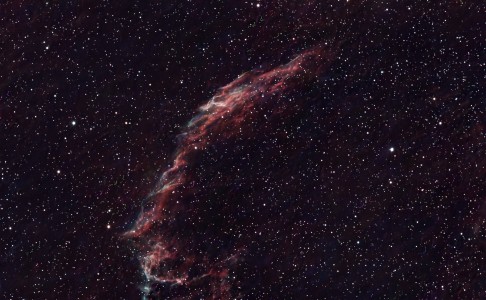
Hubble Reaches the Big Quarter Century Milestone
The Hubble Space Telescope celebrates its 25th year of service on April 24, 2015. During its 25 year long mission the NASA/ESA Hubble Space Telescope has changed our view of the Universe significantly. Some of the most ground breaking discoveries made in astronomy in the 20th century were made by Hubble.
There are a lot interesting facts that the average Hubble fan may not know about this famous telescope. For example, NASA named the world's first space-based optical telescope after American astronomer Edwin P. Hubble (1889—1953). Dr. Hubble confirmed an "expanding" universe, which provided the foundation for the Big Bang theory.
Some additional interesting Hubble statistics:
Launched: April 24, 1990 from Space Shuttle Discovery (STS-31)
Deployment: April 25, 1990
Original Mission Duration: Up to 20 years
Servicing Mission 1: December 1993
Servicing Mission 2: February 1997
Servicing Mission 3A: December 1999
Servicing Mission 3B: February 2002
Servicing Mission 4: May 2009
Size
Length: 43.5 feet (13.3 m) -- the length of a large school bus.
Weight
At Launch: approx. 24,000 lbs. (10,886 kg)
Post SM4: approx. 27,000 lbs. (~12,247 kg)
Maximum Diameter: 14 feet (4.2 meters)
Spaceflight Statistics
Orbit: Altitude of 340 miles (295 nautical miles, 547 km, inclined 28.5 degrees to the equator (Low-Earth Orbit)
Time to Complete One Orbit: approx. 95 minutes
Speed: approx. 17,000 mph (27,300 kph)
Optical Capabilities
Sensitivity to Light: Ultraviolet through infrared (115—2500 nanometers)
First Image on May 20, 1990: Star Cluster NGC 3532
Data Statistics
Hubble transmits about 140 gigabits of raw science data every week.
Power Needs
Energy Source: The sun
Mechanism: Two 25 foot solar panels
Power generation (in sunlight): approx. 5,500 watts
Power usage (average): approx. 2,100 watts
Pointing Accuracy
In order to take images of distant, faint objects, Hubble must be extremely steady and accurate. The telescope is able to lock onto a target without deviating more than 7/1000th of an arc second, or about the width of a human hair seen at a distance of 1 mile.
Hubble's Mirrors
Primary Mirror Diameter: 94.5 in (2.4 m)
Primary Mirror Weight: 1,825 lbs. (828 kg)
Secondary Mirror Diameter: 12 in (0.3 m)
Secondary Mirror Weight: 27.4 lbs. (12.3 kg)
Power Storage
Batteries: 6 nickel-hydrogen (NiH) batteries
Storage Capacity: equal to 20 car batteries
The Hubble has amazing capabilities that have helped it make many amazing discoveries. Here are some of them:
- Hubble has made more than 1.2 million observations since its mission began in 1990.
- Hubble has no thrusters. To change pointing angles, it uses Newton's third law by spinning its wheels in the opposite direction. It turns at about the speed of a minute hand on a clock, taking 15 minutes to turn 90 degrees.
- Hubble has the pointing accuracy of .007 arc seconds, which is like being able to shine a laser beam on a dime 200 miles away.
- Outside the haze of our atmosphere, Hubble can see astronomical objects with an angular size of 0.05 arc seconds, which is like seeing a pair of fireflies in Tokyo from your home in Maryland.
- Hubble has peered back into the very distant past, to locations more than 13.4 billion light years from Earth.
- The Hubble archive contains more than 100 Terabytes, and Hubble science data processing generates about 10 Terabytes of new archive data per year.
- Hubble weighed about 24,000 pounds at launch and currently weighs about 27,000 pounds following the final servicing mission in 2009.
- Astronomers using Hubble data have published more than 12,800 scientific papers, making it one of the most productive scientific instruments ever built.
- Hubble does not travel to stars, planets, or galaxies. It takes pictures of them as it whirls around Earth at about 17,000 mph.
- Hubble has traveled more than 3 billion miles along a circular Low Earth Orbit currently about 340 miles in altitude.
For more information:
http://hubble25th.org/
http://www.nasa.gov/content/goddard/nasa-refresher-on-hubble-facts-for-the-25th-anniversary
http://imgsrc.hubblesite.org/h25/uploads/uploaded_file/file_name/206/25_years_hubble_press_pack.pdf
http://www.astromart.com/news/news.asp?news_id=1179
http://www.astromart.com/news/news.asp?news_id=1059
http://www.astromart.com/news/news.asp?news_id=985
http://www.astromart.com/news/news.asp?news_id=939
http://www.astromart.com/news/news.asp?news_id=832
http://www.astromart.com/news/news.asp?news_id=501
AstroMart News Archive:
http://www.astromart.com/news/search.asp?search=.+
Funding Member
