Hubble Uncovers a Galaxy Where Star Formation Has Gone Wild
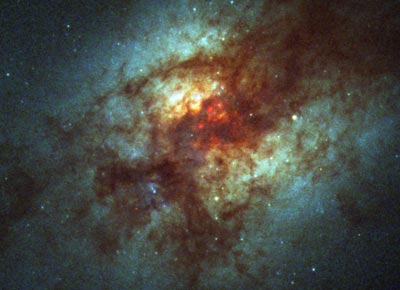
NASA's Hubble Space Telescope has uncovered a region of space where star formation has gone wild. The dusty core of two merging galaxies appear as a single, odd-looking galaxy called Arp 220. This latest view of Arp 220 is yielding new insights into the early universe, when galactic wrecks were more common.
Comments:
I can just see the late-night TV ads now on the cable channels, such as Spike TV:<br><br>Star Formation Gone Wild!<br><br>Feeling a little blue?- well they are too!<br>The youngest, hottest stars bare all for the cameras! Watch as their secrets are revealed! Merging galaxies show off their supermammoth star clusters- THEY won't be running out of gas anytime soon! Come join the starbirth frenzy!<br><br>Jess Tauber
The world according to Arp, eh?<br><br>Actually a long time ago (in a galaxy...) I had a knock down, drag out series of arguments with a hotshot astrophysics doctoral candidate (who strangely doesn't seem to exist on any web search now) at UCBerkeley, where I was studying linguistics.<br><br>One of my more annoying arguments was that redshift as such only showed time/distance dependent scaling of the universe, and as such was a RELATIVE, not absolute effect. Sure if atoms and subatomic particles are immutable spatially, then yes you get your universe expansion then extrapolable down to the big bang. BUT- if matter ISN'T so immutable, then it could be shrinking relative to the spacetime around us, and we (using matter right here as a yardstick) would never know the difference. But it could make a BIG difference theorywise. If matter is shrinking then NO BANG. In fact, we could be 'inside' a singularity.<br><br>And yes, I too was stopped from having anymore observing time on the largest telescopes (mostly by not having ever thought of seeking any...). 8)<br><br>Jess Tauber
I had the extreme good fortune to hear Dr. Halton Arp speak at the 2005 Texas Star Party. He changed my view of the universe forever. <br><br>I was very skeptical going into his lecture, and I came out with questions. In the time since, I've read his works and find them extremely compelling.<br><br>His data leaves little doubt that the "standard" views of quasar distances, galaxy formation, and the redshift-distance correlation have some problems. <br><br>I now read many of the "news" stories on Astromart and in Sky and Telescope Magazine and find myself laughing at the conclusions drawn. They are so often based on faulty assumptions long ago proven incorrect by Dr. Arp's observations.<br><br>Thank you, Dr. Arp, for making the universe safe again. <br><br>I can understand his view of cosmology. It makes sense. That's something I haven't been able to say about most of the cosmological models proposed in the last 20 years. I have fallen in love with astronomy again, thanks to the Arp galaxies!<br><br>Shannon Moore<br><br>
By the way, I emailed Dr. Arp regarding the Astromart news story of <b>Tuesday, May 30, 2006: Hubble Captures First-ever Five-Image Gravitationally Lensed Quasar</b><br><br>Since Dr. Arp has shown multiple cases of quasars (radio sources) surrounding galaxies, this seemed more likely to be another case of quasars with high intrinsic redshifts expelled from the central galaxy. Rather than a case of a distant radio source being lensed. Dr. Arp's reply email to me indicated he agreed it was not a case of lensing.<br><br>Shannon Moore <br> <br>
