Hypervelocity Planets Being Ejected from the Milky Way at Relativistic Speeds
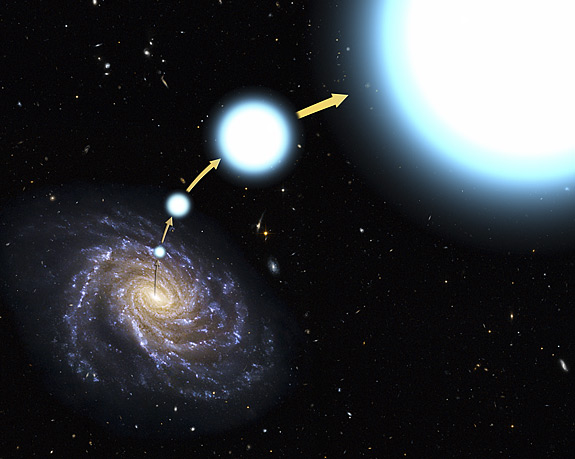
Seven years ago, astronomers found the first runaway star flying out of our Galaxy at a speed of 1.5 million miles per hour. The discovery intrigued theorists, who wondered: If a star can get tossed outward at such an extreme velocity, could the same thing happen to planets?
New research shows that the answer is yes. Not only do runaway planets exist, but some of them zoom through space at a few percent of the speed of light - up to 30 million miles per hour.
"These warp-speed planets would be some of the fastest objects in our Galaxy. If you lived on one of them, you'd be in for a wild ride from the center of the galaxy to the Universe at large," said astrophysicist Avi Loeb of the Harvard-Smithsonian Center for Astrophysics.
"Other than subatomic particles, I don't know of anything leaving our galaxy as fast as these runaway planets," added lead author Idan Ginsburg of Dartmouth College.
Such speedy worlds, called hypervelocity planets, are produced in the same way as hypervelocity stars. A double-star system wanders too close to the supermassive black hole at the galactic center. Strong gravitational forces rip the stars from each other, sending one away at high speed while the other is captured into orbit around the black hole.
For this study, the researchers simulated what would happen if each star had a planet or two orbiting nearby. They found that the star ejected outward could carry its planets along for the ride. The second star, as it's captured by the black hole, could have its planets torn away and flung into the icy blackness of interstellar space at tremendous speeds.
A typical hypervelocity planet would slingshot outward at 7 to 10 million miles per hour. However, a small fraction of them could gain much higher speeds under ideal conditions.
Current instruments can't detect a lone hypervelocity planet since they are dim, distant, and very rare. However, astronomers could spot a planet orbiting a hypervelocity star by watching for the star to dim slightly when the planet crosses its face in a transit.
For a hypervelocity star to carry a planet with it, that planet would have to be in a tight orbit. Therefore, the chances of seeing a transit would be relatively high, around 50 percent.
"With one-in-two odds of seeing a transit, if a hypervelocity star had a planet, it makes a lot of sense to watch for them," said Ginsburg.
Eventually, such worlds will escape the Milky Way and travel through the intergalactic void.
Headquartered in Cambridge, Mass., the Harvard-Smithsonian Center for Astrophysics (CfA) is a joint collaboration between the Smithsonian Astrophysical Observatory and the Harvard College Observatory. CfA scientists study the origin, evolution, and ultimate fate of the universe.
For more information:
http://www.cfa.harvard.edu/news/2012/pr201206.html
http://now.dartmouth.edu/2012/03/cosmic-loners-orphan-stars-and-planets-wander-the-galaxy-time/
http://www.time.com/time/health/article/0,8599,2109932,00.html
http://www.astromart.com/news/news.asp?news_id=1095
http://www.astromart.com/news/news.asp?news_id=378
http://michigantoday.umich.edu/story.php?id=7864
AstroMart News Archive:
http://www.astromart.com/news/search.asp?search=.+
Funding Member
