Is Earth in a Vortex of Space-Time? NASA's Gravity Probe B may soon provide the answer
Almost 90 years after Albert Einstein first postulated his general theory of relativity, Physisists will put his theory to an experimental test. For more than a year, NASA's Gravity Probe B satellite has been orbiting the Earth, using four ultra-precise gyroscopes to collect the data required. Now, scientists are beginning the year-long task of data analysis and validation.
The experiment will check, very precisely, tiny changes in the direction of spin of four gyroscopes contained in Gravity Probe B, which is orbiting at a 400-mile altitude directly over the poles. So free are the gyroscopes from disturbance that they will provide an almost perfect space-time reference system. They will measure how space and time are warped by the presence of the Earth and, more profoundly, how the Earth's rotation drags space-time around with it. These effects, if they indeed can be measured, have far-reaching implications for the nature of matter and the structure of the Universe.
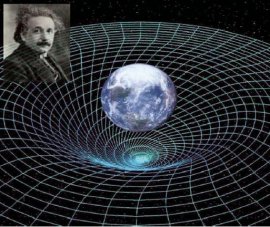
Time and space, according to Einstein's theory of relativity, are woven together, forming a four-dimensional fabric called "space-time." The tremendous mass of Earth causes a dimple in this fabric, much like a heavy person sitting in the middle of a trampoline. Gravity, says Einstein, is simply the motion of objects following the curvaceous lines of the dimple.
As Earth spins on its axis, it should twist the dimple slightly, pulling it around into a 4-dimensional swirl. This minimal twisting of space-time is what Gravity Probe B has been designed to measure.
The idea behind the experiment is simple: Put a spinning gyroscope into orbit around the Earth, with the spin axis pointed toward some distant star as a fixed reference point. Free from external forces, the gyroscope's axis should continue pointing at the star forever. But if space-time is twisted, the direction of the gyroscope's axis should drift over time. By noting this change in direction relative to the reference star, the twists of space-time could be measured.
In practice, the experiment is tremendously difficult. The four gyroscopes in Gravity Probe B are the most perfect spheres ever made by humans. These ping pong-sized balls of fused quartz and silicon are 1.5 inches across and never vary from a perfect sphere by more than 40 atomic layers. If the gyroscopes weren't so spherical, their spin axes would wobble even without the effects of relativity.
According to calculations, the twisted space-time around Earth should cause the axes of the gyros to drift merely 0.041 arcseconds over a year. (An arcsecond is 1/3600th of a degree). To measure this angle reasonably well, Gravity Probe B needed a fantastic precision of 0.0005 arcseconds. It's like measuring the thickness of a sheet of paper held edge-on 100 miles away.
"There were not any major surprises" in the experiment's performance, says physics professor Francis Everitt, the Principal Investigator for Gravity Probe B at Stanford University. Now that data collection is complete, he says the mood among the Gravity Probe B scientists is "a lot of enthusiasm, and a realization also that a lot of grinding hard work is ahead of us."
A careful, thorough analysis of the data is underway. The stakes are high. If the physisists detect the vortex, precisely as expected, it simply means that Einstein was right... again.
But what if they don't? We will know the results in about a year.
FOR MORE INFORMATION:
http://einstein.stanford.edu/
http://www.gravityprobeb.com/
Funding Member
